|
UGANDA LITTLE LEAGUE
BASEBALL HISTORY
The story of Uganda
Little League Baseball starts in August of 2002 and is a story of overcoming
obstacles and doing things that people said could not be done.
Beginning
Richard Stanley was a
volunteer sent to Uganda by ACDI/VOCA to assist the Uganda Vegetable Oil
Development Project in late July 2002. While there, Mr. Christopher
Gashirabake asked him if he would help start baseball in Uganda. He agreed
if the government would help in building fields and not hold up the delivery of
baseball equipment with taxes and duties. On his return to the U.S., he
found that Little League International was willing to donate a starter kit, as
was Major League Baseball, but he had to pay for the shipping from the U.S. to
Uganda. With the help of the Transform Foundation, this was arranged, with
the equipment leaving the U.S. in early January 2003.
Ms. Priscilla Sarah
Nakibuuka, had expressed an interest in baseball to Mr. Stanley in July 2002,
and now volunteered to assist in working to get Uganda Little League Baseball
started. Little League International appointed her as the Country Director
in the fall of 2002, and she then proceeded to convince 4 international schools
in Kampala and the Sir Apollo Kaggwa school to agree to become leagues and play
when the equipment arrived.
With the help of the
ACDI/VOCA office in Kampala, the container with the two kits arrived in Kampala
late in March 2003. The government valued the equipment at $40,000 and
wanted to collect $16,000 in taxes and duties. With the help of many
government officials, especially Mr. Francis Wafula at the Ugandan Mission to
the UN in New York and the people he introduced us to and who we met in Kampala,
Dr. Jotham Musinguzi, Mr. Moses Kaggwa, Peter Malenga, and many others, the
equipment was finally freed of customs in late June 2003 and distributed to the
schools. It was too late to start the schools playing for the tournaments
of 2003, but they promised to start play when the schools returned later in the
year.
Little League
International agreed to supply two more starter kits in the fall of 2003, and
Major league baseball agreed to match what they had given us in the prior year
after some discussion. This time, with the help of U.S. Ambassador James
Kolker and his assistant, Jack Lopinski, the container of equipment was shipped
to the U.S. Embassy and arrived without trouble. Future shipments of
donated baseball equipment from Little League International and Major League
Baseball also were shipped through the U.S. Embassy until Ambassador Kolker and
Mr. Lopinski were rotated out of Uganda in the late summer of 2005 to other
posts as their normal three year assignments were finished.
Tournaments
The schools began to
play baseball for children 12 and under in the latter part of 2003. At the
International School of Uganda, which has a full size, all grass soccer field,
Mr. Evan Bringham, the games master and an American, built the first backstop in
Uganda at one corner of the soccer field. The two people who are most
responsible for Little League Baseball succeeding in Uganda are Ms. Nakibuuka
and Mr. Bringham. Ms. Nakibuuka for convincing the International School of
Uganda to start baseball and Mr. Bringham for building the backstop and giving
the Uganda Little League a place to hold its National tournaments which for the
first time was held in June 2004.
Four leagues
participated in the semifinals held at 9:30AM on opposite corners of the soccer
field. The championship game followed, and the Heritage School defeated
the International School of Uganda for the title. The Kabila School
defeated the Sir Apollo Kaggwa School in the consolation game. The
Heritage School now had the right to play for the European/Middle East/Africa
Little League Regional title which is held in Kutno, Poland each July. The
problem was that they had to pay their way there and for $30,000 in travel cost,
that did not happen.
The success of the
Little League program in 2004, and the arrival of new equipment in 2004, allowed
the program to expand to 11 leagues for the 2005 tournament. More
equipment arriving in 2005, allowed us to expand to 15 leagues for the 2006
season, and for the first time, we held a tournament for 13-14 year olds, in
addition to the third 12 and under tournament. The lack of money to pay
for the travel to play in the European/Middle East/Africa tournaments continues
to keep the championship teams at home. The schedule for the 2007 season
has eight tournaments scheduled for June 2007. We will hold tournaments
for 12 and under, 13-14, 15-16 and 17-18 in baseball and also in softball.
The first half will be played at the International School of Uganda during June
16 and June 17. The latter four tournaments for the older children will be
played in Jinja during June 23 and 24th.
Elimination tournaments
will be played during the early weeks of June to get each tournament to the 4
semifinalists that will be playing on the above dates. Uganda Little
League Baseball has now expanded to 25 leagues covering baseball and softball
from ages 6 to 18. While our goal is to expand to 100 leagues over the
next several years, the major thing holding us back is the lack of equipment and
money to obtain it, ship it and to distribute it. While the equipment is
meant to start leagues, almost all of our leagues need funds to obtain new
equipment to maintain their programs. Baseball equipment is difficult to find
and very expensive to buy in Uganda.
Recent Developments
With the departure of
our helpful contacts in the U.S. Embassy, Uganda Little League Baseball has been
very fortunate to be getting great assistance from several people in the Ugandan
Ministry of Sports, the National Council of Sports, and other Ministries.
We first met Mr. Apitta Omara in 2005. Mr. Okello Oryem and Mr. Jasper
Aligawesa about the same time. It is a result of their efforts and
encouragement that we were able to receive the latest and largest shipment of
donated equipment to ever be shipped to Uganda Little League without
encountering problems with duties and taxes. They have also been most
helpful in allowing Little League Baseball to expand to large schools in Lira,
Luwero and Mbarara this past spring.
2006
- 2007
In August 2006, Major
League Baseball gave Uganda Little League Baseball $15,000 to help level fields
and install backstops. With that money, we have leveled five fields and
will be installing several backstops. We hope Major League Baseball will
grant additional funds to continue to make playing fields available.
In October 2006, due to
a generous donor, Uganda Little League Baseball purchased 40 acres of land near
Kampala to build a central complex of at least 6 fields to host National and
International Tournaments. We are now in the process of seeking additional
funding to actually build the fields, and then eventually dormitories to house
the visiting teams so that week long tournaments can be held with as many as 12
to 16 teams playing everyday. We expect to finish the fields by the end of
2007. The cost for building the fields is approximately $350,000.
The dormitories needed will cost an additional $300,000.
At the Little League
International Congress held in Houston, Texas in mid April 2007, Uganda Little
League Baseball, joining with South Africa, Ghana and Burkina Faso, formed a
committee to coordinate the development of Little League Baseball in Africa.
Some of the five year goals are to expand into 30 countries and to host All
African Tournaments at all age levels in baseball and softball with the winners
coming to the U.S. every August to play for the World Championships. We
will need large quantities of equipment, corporate sponsorships, many trained
coaches and umpires and many volunteers to make this happen. Uganda Little
League Baseball has over come many obstacles in its short 5 year history, this
is just a few more.
2008
For the first time in the more
than 75 year history of Little League Baseball, an African team will travel
to Europe to play in a Little League Regional
Tournament. The winners of these regional tournaments travel to the
U.S. to play for
the World Championships every August. That will be the dream of the 12
players, age 12 and under, and the 5 adults making up the traveling squad
that will step off the plane in
Warsaw,
Poland on July 21. They
will then travel by bus to the Europe/Middle East/Africa Regional
Headquarters in
Kutno,
Poland where the tournament
will be held.
For the
Uganda team,
there will be a lot of firsts. They are scheduled to land at
Brussels at 6 AM after their almost 9 hour overnight flight from
Entebbe
Airport. There they will step on
European soil for the first time prior to boarding their plane for
Warsaw a little after 9AM. For all
but the country director, this will conclude their first flights in a jet
plane. When they get to Kutno, they will see a real baseball field with
grass for the first time, and be able to practice on it before the actual
tournament games commence on July 24th.
Ms. Priscilla Sarah Nakibuuka,
the Uganda Country Director will be leading the adult contingent of
Washington Mugzrawa, the Head Master and President of the Reverend John
Foundation Primary School Little League, Owarra Deusdedit and George
Mukhobe, coaches of the team, and Paul Kataregga, Uganda Little League Vice
President. Aside from getting the players to Poland, they are also seeing
for the first time a real baseball field in person, and this is very
important for them as they are all involved with building a complex in
Uganda similar to the one in Kutno with the hope that Uganda will be able to
host this tournament next July.
Getting to
Poland for an
African team involves overcoming many obstacles. In
Uganda’s case, the airfare of
$25,000US, plus the need for a visa for each traveler of $100US which had to
be obtained in Kenya, since
Poland does not have an embassy in
Uganda, prevents all African Little
League programs from traveling to Europe. Little
League hosts regional tournaments for boys and girls from age 12 and under
thru age 18, or eight tournaments every July, with the winners going to the
U.S. The
U.S. trips are
paid for by Little League International, but the local leagues must pay
their way to the regional tournaments. If
Uganda would send eight teams to
Europe, the cost would be well over $200,000 per year
just in travel expenses. Where the average family monthly income for a
school teacher is less than $200 per month, it is obvious why no African
team has traveled to Europe
in past years.
It is the hope of Uganda Little
League Baseball to build its complex in time to host all the eight regional
tournaments starting in 2009 so that more African Countries can play in them
without having the expense of having to travel to
Europe. Kutno was built for a little less than $2
million and Uganda Little League Baseball is trying to raise that money now
so that many African teams of boys and girls, from all over the continent,
can have the chance to make their dream a reality of playing for the World
Championships in the U.S. every August.
March 2009
We have been notified by Little
League International that our proposal to host the Middle East/Africa Regional
Tournament was not successful. Our proposal can be viewed at
www.baseballforgood.org This year, as in last year, the Middle East/Africa
Regional Tournament will be held in Kutno, Poland, the last week in July. As
this is written, the tournament will have only the three Middle East teams it
had last year. Uganda will not go this year, and instead will put the $35,000
travel costs into building the dorms at the Uganda Little League Baseball
complex. At this moment, no African teams will be participating in Kutno
because of cost and visa problems, instead, Little League International has
suggested that Uganda host an All African Tournament. We have agreed to host it
the first week in August.
The only problem at this moment is that the winner of
the All African Tournament will have to return home, instead of going to
Williamsport for the Little League World Series. Without the World Series Trip
as the reward for winning, I am not sure how many, if any African teams will
participate in the All Africa Tournament. Little League International assures
us that they will send out the invitation, and hopefully, we do get
participation of African Countries. We will be able host up to 16 teams in our
newly built dorms. The Ugandan Government has indicated that they would make
this into a National Event if it is held the first week in August. What we
proposed in our bid to host the Middle East/Africa Tournament will be what we
will do in hosting the All Africa Tournament.
As a result of the annual meeting of
Uganda Little League Baseball that took place in January in Kampala, the
schedule for the National Tournaments in baseball and softball has been set.
Each tournament will take place at the new Little League Complex in Mipigi
District during the weeks indicated on the home page. The length of each
tournament will depend upon how many teams come to the complex. By early May,
two dormitories will be finished. Each dorm will have 8 team rooms for 14
participants and also adjoining rooms to house 3 coaches. Up to 14 players and
3 coaches for each team will be housed and fed during the tournaments. Bunk
beds with mattresses will be supplied. Each team member and coach will be
expected to bring their own sheets and pillow cases and blankets. The
tournaments length will depend upon how many teams will come for each
tournament. We expect that each team will play at least one game every day of
the tournament. The tournaments are expected to all end on the Sunday. Each
tournament will be at least 4 days long, or could run as long as 7 days. We
expect each league to let us know no later than April 15, 2009 of their
intention to come to the complex to participate. Each team will then be issued
a formal invitation to attend the tournaments they are qualified to attend and
the date each tournament will start. All the teams are expected to arrive
before 5PM on the day before their first scheduled game.
This year, for the first time, we are
asking that each league supply us with the names of all players playing baseball
or softball at each age. These rosters can always be added to as the year
progresses, but we want to make sure that every player who comes to the
tournament is on the league's roster of possible players and has played for that
league. Any player not on the roster submitted during the playing season by
April 30, will not be allowed to play in the tournaments. Remember, it is the
responsibility of each team that if they win and go on to Regional Tournament
play, each player of that team must have proof of their age before they will be
allowed to play in the Regional Tournament. For boys, it is the age they are
on April 30, 2009. For girls it is the age they are on December 31, 2008.
May 2009
This month marks several significant events. We will be hosting 8 tournaments
starting in May and ending mid June. For the very first time, we will have teams
of boys and girls in the 17-18 age group playing in tournaments, along with the
15-16s, the 13-14s and the 12 and under group. They will be playing on the
fields that we have been working on for the past several months. Field one and
two are the ones with grass. We brought over and planted Blue Grass seed on both
infields to see how it makes out in Uganda in January. The outfields of these
two fields have grass plugs planted, which is the normal way of planting grass
in Uganda. Both fields are for Little League 12 and under baseball and girls
softball. Both these fields are 250 feet down the lines, and currently, since we
have no fencing around them, about 330 feet to centerfield. We had applied for
money to fence our fields from the Baseball Tomorrow Fund, but were informed, as
of the first week in May, that we were not approved to receive a grant. For the
time being, we will play without fencing.
Fields 3, 4, and 5 will be used to host the older boys baseball tournaments.
Field 3 and 4 have dimensions of 330 feet down the lines and 400 feet to
centerfield, but with no grass and no fences. Any ball that rolls past the
outfielders will drop off the playing surface and be declared a ground rule
double, until we can get fences up. If the umpires see the ball disappear
without a bounce, it will be a home run. We will have some fun. Field five, has
foul lines of 300 feet and centerfield about 400 feet, but also has no fences at
the moment, or grass. We still have lots of work to do.
At this time, we expect 5 teams of boys and 4 teams of girls playing in the
17-18 tournaments. We expect 8 boys and 4 girl teams playing in the 15-16 age
group, but 6 boys and only 2 girl teams in the 13-14 age group. We expect 8 boys
and 5 girl teams playing in the 12 and under tournaments.
It appears we will be hosting an All African Tournament for boys 12 and under
during the first week in August. We have been told that teams will be coming to
Uganda from Ghana, Sudan, Tanzania, and Kenya, and possibly from Cameroon.
Others may also come.
Arriving in Uganda on May 26 and staying for 4 weeks will be two gentlemen who
will be doing some filming to be used in making a 5 or 10 minute short that
might be used to get funding for a full length documentary film that will cover
what we are doing in Uganda regarding baseball. If they get the funding, they
will cover our January clinic with the MLB Envoy program. the every three year
International Little League world meeting in Lexington, Ky. next March, our
National Tournaments next May and June, hopefully the Middle East/Africa
Tournament, if it is played in Uganda next year, and the Little League World
Series that we hope a Uganda team might be able to play in.
July 2009
Uganda Little League held the annual
National Little League Championship Tournaments from May 28 thru June 14, 2009.
We started with the 13-14 year olds, went to the 17-18 year olds, then the 15-16
year olds and finally the 11-12 year olds. Each tournament was four days of
playing games, and required the teams to play 4 games in the first three days
and then the consolation games and championship games were played on the fourth
day. We had teams come from the west, Mbarara, the north, Lira and Luwero, and
the east, Jinja, besides Kampala. The games were being filmed by a team from
New York looking to produce a 5 or 10 minute video that will be used to raise
money for a full length documentary film which will be shot over the next 14
months. The expectation is that they will follow a player through the coaches
training program that Major League Baseball will conduct at the complex in
January 2010, the National Tournament to be held next June, the Middle
East/Africa Little League Regional Tournament next July, and hopefully on to the
Little League World Series next August. We will let you know when it is done
and when it might be appearing in a theater near you.
For the first time, we held a
tournament for 17 and 18 year olds this year. Our biggest disappointment during
our tournaments was the lack of girl softball teams that came. While a team of
17-18 year olds wanted to come, we could not get a team for them to play
against. Therefore, we asked them not to come this year. The same thing was
true for the 11-12 year olds and the 13-14 year old girls. The only girl
tournament held this year was for the 15-16 year olds. The girl tournaments
were to be held at the same time as the boys tournaments of the same age group.
We will now work on getting more girl teams playing in time for next year and
the future.
During the first week of August, we
will be hosting an All Africa Tournament for 11 and 12 year old boys. We will
be hosting teams from Tanzania, South Sudan, and Kenya. Teams from Cameroon and
Ghana have indicated their desire to participate, but were uncertain about their
funding. Hopefully they will come. The championship game for this tournament
will be held on August 8, 2010.
Now that the complex has several
fields to play on, local children have come to the fields and have asked if they
could learn to play. We are now working with the local population to form the
Mpigi Little League, which will be open to girls and boys of all ages. We will
keep you informed about our progress with this league.
August 2009
During the first week of August,
Uganda hosted the first All Africa Little League Tournament for boys ages
11-12. South Sudan, Kenya and Tanzania sent teams. All three of the
visiting squads were fairly new to Little League Baseball, but all came to
play and learn. They arrived at the complex during the morning of August 1,
2009. After a coaches meeting on the afternoon of the first day, the
coaches all agreed that the first games would be played on Sunday August 2,
and everyone would play each other twice during the week. Games were thus
scheduled for everyday at 10AM and 2PM. At 4PM on Friday, the best team
would play a team composed of the best three players from each of the other
three teams. The Championship game would be played on Saturday at 10AM,
August 8th.
After suitable opening
ceremonies, the games began. After the 2PM game on Friday, Uganda was 6 and
0, South Sudan was 4 and 2, Kenya was 2 and 4 and Tanzania was 0 and 6.
Uganda then went on to defeat the All Stars on Friday afternoon and also
defeated South Sudan in Saturdays Championship game. Uganda winds up
"Undefeated, Untied and Uninvited", just like a famous football team of 70
some years ago.
Tanzania came with 6 adults
besides its coaches. Every day, except Friday, at 4PM, a softball game
broke out including the coaches, umpires and other adults, including several
women, and some of the players. Sides varied from 10 to 15 players and the
games went on until 6PM. Everyone had a grand time and the coaches of the
visiting countries found out about how softball is played, so that they
could go home to teach softball to the girls of their respective countries.
We expect that next year, Rwanda
will be join us in this tournament along with Burundi, as they have both
contacted Uganda to help them get started with baseball and softball.
Uganda's goal is to make this tournament into the Regional Little League
Middle East/Africa tournament with the winner going to the Little League
World Series at the end of August.
November 2009
South Africa has informed us that
they intend to come to Uganda to play in the Middle East/Africa Regional
Little League Tournament for boys ages 11 and 12 during late July or early
August 2010 if it is played in Uganda instead of Europe. They will join
Cameroon, Kenya, South Sudan and Tanzania who have also indicated that they
will send teams only if it is played in Uganda. This is great news for what
we are doing in Uganda. We also know that Saudi Arabia, Kuwait and Dubai
will attend if it is played in Uganda or Europe. Rwanda and Burundi have
also indicated that they would like to field a team, and we also expect
several other African countries to join us if it is played in Uganda. This
puts a lot of pressure on Little League International to award the
tournament to Uganda, but it also puts pressure upon Uganda to make sure the
facility if built and operational to current western standards. We need to
not only finish the second dorm and make sure the guest house operates as a
luxury hotel, but we also have to make sure we can feed and maintain up to
250 players and 50 coaches for about 8 days of the tournament. We will be
needing money and people to do the many jobs, including transport to the
complex and maintenance of the facility.
As we already mentioned, Uganda
will be hosting two training sessions in January. Each one will be lasting
8 days and the second session will be a repeat of the first one. The
purpose of the sessions is to train coaches on how to coach baseball and
softball. We expect to host around 50 people from Eastern Africa during
each session. There is no charge for the sessions or room and board, all
they have to do is show up on time. The first session starts on January
15th and the second on January 24th. The training will be done by two
envoys sent and paid for by Major League Baseball. All the trainees are
expect to arrive the afternoon before each session begins. Little League
International will be using these two trainers from MLB to evaluate our
facility to determine if it is suitable to host the Middle East/Africa
Regional Tournament scheduled for late July or early August in 2010. That
means we will know if Uganda will host the tournament sometime around the
early part of February 2010.
In March, we expect to be
attending the Little League World Congress that is held every three years.
This one will be in Lexington, Ky during the middle of March. We expect the
Little League Africa Committee will be meeting face to face during the
congress for the first time since it was formed 3 years ago at the last
congress in Houston, Texas. At the meeting we will be working on getting
several of the Little League European/Middle East/Africa tournaments for the
older players, 17-18 year olds and 15-16 year olds in baseball and girls
softball to be played in Uganda in 2010 or future years. We are working
very hard on breaking Africa away from Europe and we can do it. The biggest
problem facing us is once again money. Little League International pays for
the regional winners to come to the World Championships every year, and in
our estimate, it would cost them to send the eight teams from Africa to the
U.S. every year about $1 million. Little League International needs money
to do this, as does the African Little League programs for equipment and
travel to the regional tournaments. If anyone knows how we can get this
assistance, kindly let Little League International, the African Committee of
Little League, or this web site how they can help.
December 2009
During December, the U.S.
Coordinator traveled to Dubai for meetings with Dubai Little League, and
then to Indianapolis, Indiana for the Annual Winter Baseball meetings. In
Dubai, it was suggested that if Uganda hosts the Middle East/Regional
Tournament, moving it to mid June would attract several other countries,
namely Egypt, Pakistan and others. Mr. Anthony Collins of Dubai will be
following up with these countries and keep us informed about the
possibilities. We had a very nice reception in Dubai. Meanwhile, we
continue to make great progress with Major League Baseball. At the Winter
Meetings, Mr. Dave Dombrowski, President and General Manager of the Detroit
Tigers, Mr. Roland Hemond, Special Assistant to the President of the Arizona
Diamond Backs and Mr. Joseph Reaves, Director, International Operations for
the Los Angeles Dodgers are now joining with Uganda Little League Baseball
to get on going support for the project from Major League owners,
Administrators and even players. They are telling our story and encouraging
support from the people they deal with on a regular basis. They will assist
us in funding, equipment support and in training players and coaches. The
January program that is discussed below, is just the beginning.
February 2010
The first month of the new year
has seen some very significant progress made in Uganda baseball. Starting
on Saturday, January 16, 33 want to be coaches of baseball and softball
arrived at the complex. Pat Doyle and Tom Gillespie, the two Major League
Baseball instructors had already arrived late on Friday night. After
everyone settled down in the dorms, with Pat and Tom at the guest house, the
classes began promptly at 8:30 every morning for the next 7 days. Lunch was
from 12:30 to 2PM, and diner from 6 to 7:30. Each day ended with a short
session from 7:30PM to about 8:15, followed by a hollywood comedy. By the
end of the program, would be coaches had been shown all aspects of fielding,
throwing, hitting, running and playing the game in a classroom setting,
watching the game played on the field and actually playing a softball game
every afternoon from 4:30 to 6PM. They had a wild celebration on the Friday
night when certificates were handed out and went home Saturday afternoon
knowing all aspects of the game.
On Saturday, January 23, the
second group of 30 arrived. The same procedures were followed for them as
the first group. The only difference was that from Sunday, January 17 thru
Monday, January 25, a game was played every day by players age 16-19, while
from Thursday, January 21 thru Saturday, January 30, a game was also played
by children age 10 thru 12. Anytime a future coach wanted to see baseball
being played by someone, all they had to do was look out the window and go
to the field. The one sad event happened just after Pat and Tom had
instructed the players on calling each other off on fly balls to the short
outfield. The game that followed had a terrible collision between the
center fielder and the shortstop, both going after the same short fly ball.
The shortstop was back playing the next day, despite the concussion and
stitches in his lip from where his teeth broke thru the skin. At the time
it was ugly, but everything worked out fine. The clinics had men and
women representatives from Kenya, Tanzania, Rwanda, Congo, South Sudan and
representatives from all over Uganda. With the players and coaches, we were
housing and feeding at one time about 100 people for a period of 5 days.
Everyone had a wonderful time.
On Monday, January 25, contracts
were signed by Clive Russell of the MLB London office and NTV to broadcast
Major League Baseball games on a delayed basis starting on Saturday morning,
Feb. 6. Major League Baseball will now be seen throughout Uganda on NTV
every Saturday morning from 9-11AM and every Sunday from 11-noon. The best
game of the prior week will be shown every Saturday once the regular season
begins in April, in the meantime, we will be showing the playoff games and
World Series games of 2009. Boys and girls, men and women will now be able
to see and learn about the game of baseball on free television wherever
electricity is available. In addition, the nightly sports news will begin
to cover Major League Baseball and Ugandan baseball and softball as part of
their routine news coverage.
In late 2009, three Ugandan
baseball clubs started to play every weekend. It is expected that this will
expand to 4, and eventually 6 and then 8 clubs in the near future. It is
from this program that an eventual National Team will be selected to
represent Uganda in International competition. Uganda Little League wishes
to see this program continue to develop and will certainly supply a home for
the entire program if they desire. The Kenyan representative at our coaches
clinic wants to start competition in several month at the complex. We may
wind up hosting best of 7 International Tournaments between Uganda, Kenya,
South Africa and other African nations as early as later this year.
The next big question is what
happens to the Middle East/Africa Little League Regional Tournament for boys
age 11-12? We expect to hear about this in the near future. We look
forward to hosting the tournament this year, but that is not yet certain.
We should know in a couple of weeks. We spent time with people from the
American Embassy who came out to visit us in January. They were very
impressed by our complex and expressed a desire to bring embassy people to
come to the complex for a picnic and a day of softball. We are also working
with them to make sure the team that wins the hoped for tournament in July
has no problem getting visas for the travel to the Little League World
Series within a day of their victory.
March 2010
Uganda needs $35,000 US to play
in the Middle East/Africa tournament this July. ARAMCO oil, alias
Saudi Arabia Little League has Little League International tell African
teams that if you want to play in the Middle East/Africa Regional tournament
for boys age 11-12, they will have to come up with about $35,000US.
The every three year Little
League Congress has just concluded in Lexington, Kentucky. Uganda,
representing the wishes of Kenya, Tanzania and South Sudan who all had the
hope of playing in the Middle East/Africa Regional Tournament with the
winner going to the World Series this August have had their dreams
shattered. For three years, Uganda has been fighting to have this
tournament played in Uganda. In 2007, we were told the tournament had
to be played in Poland because there was no place that could house it in
Africa. In early 2009, we were told that the tournament would still be
played in Poland because in Little League's opinion, our facility would not
be ready, instead you could host an All Africa Tournament expecting that it
would never happen. Much to Little League's surprise, Uganda did host
the tournament for a full week and Tanzania, Kenya and South Sudan came and
played. Knowing the the Uganda facility was going to be totally finished
early in 2010, Kenya, Tanzania, and South Sudan chartered with Little League
with the dream of playing in the Middle East/Africa tournament, expecting it
to be held at the brand new complex in Uganda. Now, in order to live that
dream, Little League International has once again told African teams it will
cost you $35,000 to partake in the tournament because it will once again be
held in Poland. That is the cost to bring 14 players and 3 coaches to
Poland, pay for the visas that the EU will do its best not give, and for
food and other items. Basically, an entry fee.
Why is this tournament still in
Poland? No delegate at the recently concluded Little League Congress can
figure out how Little League can put a Middle East/Africa tournament in
Europe when Europe has nothing to do with the tournament. It is the
equivalent of having the Canadian Regional Championship played in the
Caribbean Region. What did come out at the Congress was the fact that
ARAMCO Little League, alias Saudi Arabia refuses to play in Africa because
they claim it is too dangerous. When a Little League Official at the
meeting that Uganda thought would determine where the tournament would be
held was asked, "If the 9 chartered African countries voted to play in
Uganda and the three Middle East chartered countries voted not to, where
would the tournament be held?" The answer was quick. "In Poland." While
the African countries still thought the decision regarding location had not
been made, it comes out that it was decided back in December and this entire
show was a charade.
At the meeting, the Kuwait
representative expressed a desire to visit Uganda. He believes that he will
also come with the Dubai representative, who did not attend the congress but
in earlier conversations had indicated his desire to also come and play in
Uganda. Since it is so hot in the Middle East in July, they are thinking of
bringing their tournament teams to Uganda to play and practice in a better
environment. We have agreed to work this out, probably the second week in
July. Uganda will once again, on its own, host our All Africa Tournament
and now Kuwait and Dubai might join that tournament early in July.
Ms. Nakibuuka, our country
director was very disturbed when she heard the Regional tournament would
once again be back in Poland. She firmly believes that we are forced to go
in order to demonstrate that we will advance the baseball program in Uganda
beyond the national tournaments and into the International Lime Light. It
will help with the government and the media. Therefore, we now must find
the $35,000US to get the team to Poland and once again fight the battle with
the Polish embassy in Kenya over giving our children the visas they need to
get there. The problem now is where do we get the $35,000. That amount of
money could buy more than 16,000 baseballs or over 1,000 gloves, which is
more gloves than currently exist in Uganda. We could greatly expand the
number of children playing baseball in East Africa. Where does this leave
Kenya, Tanzania and South Sudan. The real question is how does ARAMCO exert
such power over Little League International, that no matter what they want
or do, is perfectly fine with Little League International, even though it
will hinder children of East Africa from getting the chance to play the game
due to lack of equipment. Every reason that the delegates at the conference
could come up with to explain this decision, all had a strange odor about
them. It would be unfortunate if any of them were true. I just hope it is
because they are afraid that a Ugandan team will beat them if they played.
That is another reason we must go to Poland. We will prove that no matter
what kind of entry fee you put before us, you cannot run away and hide. We
will come and get you. We could use everyone's help in funding this trip.
Donations should be made to 303 Development Corp., which is a 501 c 3 not
for profit in the U.S. where every cent goes to assist the Uganda Little
League Baseball program.
May 2010
Uganda is preparing to send its
11-12 year old country champion to the" Middle East/Africa" Regional Little
League Tournament in Kutno, Poland starting July 21. We have to be in Kutno
by the morning of July 20. Due to capacity restrictions and cost factors,
the Ugandan team will be leaving from Entebbe Airport late on July 16 with
the expectation of arriving in Warsaw, Poland early in the afternoon of
July17. We will then have to make our way the 50 miles or so west to Kutno,
where the tournament will be held. This will be an interesting adventure.
At the time this is written, we are being told that Kutno will only house
the players from July 18 on. If that is true, we will have to now find a
hotel in Warsaw to stay the night of July 17. More cost. It is now
estimated that the total cost for this trip will be about $40,000 which
includes travel, visa fees, meals, insurance etc. We have to tell the other
seven Ugandan Championship teams of boys and girls ages 11-12, 13-14, 15-16
and 17-18 that they cannot participate in their regional tournaments because
to do so would cost an additional $280,000. All this is because Saudi
Arabia (almost all Americans) refuse to play baseball or softball anywhere
in Africa and Little League International sacrifices Africa to benefit
them. Little League has made the $40,000 the cost to enter the
European/Middle East/African regional tournaments for each African Little
League team, and then wonders why no African teams come to play.
It is everyone's goal at Ugandan
Little League to win this tournament and represent Uganda and the rest of
Africa at the Little League World Series. We are not sure if that will
happen, but we will do our best. The boys and girls age 11-12 tournaments
are scheduled to run from June 10 thru 13. They will be the last of the 8
National Championship tournaments this year. Once they have concluded, we
will immediately begin the visa process. The EU visas will have to be
obtained from the Polish Embassy in Kenya. We have been told that it will
more difficult to obtain these visas than in 2008 when it took us 3 weeks
and many road blocks to finally get the visas at the very last minute.
Should we be delayed in getting these visas, we will lose the $30,000 in
plane fare we have already paid on non refundable tickets and not get to
Poland.
The
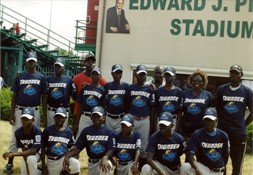
Trenton Thunder, as they have done since 2004 have once again supplied us
with uniform shirts and hats for the championship team. The shirts are
better than the ones that the team wore for the first African team to play
in a European Regional tournament in 2008. This time they all are
numbered. In 2008, they would not let us play unless all the players were
numbered. We accomplished that by using tape to make numbers that only had
straight lines by using the numerals 1,2,4,and 7 and various combinations of
them. In addition to the numbers, every shirt has "Uganda" printed on the
sleeve. Everyone in attendance will know where this team comes from. In
addition, there is a special shirt made up for the country director, Ms
Priscilla Sarah Nakabuuka so everyone will know who is in charge of this
operation.
 $35,000
Needed to send Ugandan team to Poland this July $35,000
Needed to send Ugandan team to Poland this July
$35,000 is needed so that the Uganda boys age 11-12 can go to Poland to play in
the Middle East/Africa Regional Tournament. Donations can be sent to 303
Development Corp at 366 Ardsley Street, Staten Island, N.Y. 10306. All funds
raised will go to support the travel costs of the Uganda Little League team.
They will leave Uganda on or about July 18 and return from Poland about July 27,
2010.
Please note this ad is
placed here for it's historical value, we did raise the $35,000.00 and we did go
to Poland in July of 2010.
July 2010
Starting in late May
and continuing thru June 13, 2010, Uganda hosted its eight Little League
National Championship Tournaments at the complex. Each tournament took
place over a four day period. Every team played at least 4 games during
their stay. Teams came from as far west as Bushenyi and as far east as
Torero. Lira could not send a team to compete in any of our tournaments
because of travel costs. This continues to be a problem in getting more
teams to play in the National Tournaments. We will be working on
getting sponsorships to pay for travel costs of some teams in the
future.
Every National
Champion has the opportunity to play in the Little League Regional
Tournaments, but unfortunately, all those tournaments continue to be
held in Europe, which means each team we send would have to come up with
the $40,000 entry fee, (travel costs) that Little League continues to
impose upon African teams by refusing to allow any of these tournaments
to be held in Africa. At this moment, Uganda has built the facility at
our Little League complex to host these tournaments, but as of yet, none
of them will be played in Uganda this year.
Starting on July 4,
2010 Uganda will host an African tournament for boys 11-12. We know
teams from Tanzania, Kenya and South Sudan will once again travel to the
complex to play a full 7 days of baseball, just as they did last
August. These three teams thought they might be playing in the Middle
East/Africa tournament this July, but unfortunately, they will not be
able to travel to Poland because they do not have the $40,000 entry fee
Little League International is charging them and no matter who wins this
tournament, only Uganda will be traveling to Poland.
On the evening of
July 16, the Uganda 11-12 boys team will board a SN Brussels Air Plane
to begin their trip to Kutno, Poland. They will fly to Brussels and
land there about 6AM on July 17. They will then fly to Warsaw and
arrive there at 3:10PM on July 17 and board a bus for the two hour ride
to Kutno. SN Brussels Airline has been most helpful in working
with us on getting us the best fare and allowing us to wait until our
tournament was over before submitting the names of the passengers for
the tickets. Not every airline would do this.
The tournament will
begin play on July 20. We believe at this time that South Africa,
Kuwait, Dubai and Saudi Arabia will join Uganda in this tournament. The
winner will be going to play in the Little League World Series in mid
August. In order to prepare for the possible trip to the U.S., the
traveling party had to apply for their U.S. visas in mid June, even
though we may never need them. Should we win in Poland, Mr. John Hoover
at the U.S. Embassy, who has been a big help to us, has arranged for the
entire traveling party to go to the Embassy for the visa interview as a
group shortly after they return to Uganda on July 27.
As you may be aware
of, Opposite Field Productions has been filming in Uganda the Little
League program since last June. They will be following the team to
Poland and have informed us that they expect to film each game Uganda
plays in with three cameras. They have also attempted to work out an
arrangement where they will edit the game film of each day and try and
send it back to NTV and UBS, two television stations in Uganda, in time
so that they can show the film on their evening news programs. Both
stations have covered our tournament play and featured the results on
the evening broadcast, including the news programs that they also
broadcast in the native language.
NTV has been broadcasting a Major
League Baseball game every Sunday from 8AM to 11AM. During the two
Sundays that our tournaments were being played on, we had as many as 50
players watching the game on the television set in the Guest House. NTV
is very happy with the ratings, which have gone up since the baseball
programming started back in February with games from last fall. MLB's
London office selects a game played during the week, puts it on a disc
and sends it to Uganda to be shown on the Sunday. People are learning
about baseball as a result. They know it is an American game, but it
has never received any coverage in any media until now, other than cable
television, which is expensive in Uganda and only shows the live ESPN
games that start at 3AM in the morning Uganda time.
During the
tournaments, we once again ran the Pitch, Hit and Run program sponsored
by Major League Baseball and Aquafina. We had winners in the 13-14 and
11-12 age group. Unfortunately, our winners only get the ribbons and do
not get a chance to compete at their local Major League Ball Park, nor
the Major League All Star Game. But they do have a good time cheering
for their teammates, as each team at each tournament selects three
players in each event to represent their team. The winners pictures
will be posted on the web site shortly.
Middle East/Africa Regional Tournament, July 2010
Failure of Little League Officials in Poland and Williamsport to understand
And Communicate Tie Breaker Rule costs Uganda trip to Little League
World Series
All the people involved
in baseball in Kutno Poland recognized that Uganda was the best baseball
team they had seen in years and had the best chance of competing, and
possibly winning the Little League World Series this August. Unfortunately,
they will be home instead of being in Williamsport. The story of how this
happens is as follows.
The Uganda Little
League Team left Entebbe Airport on the evening of Friday, July 16, 2010. It
arrived in Warsaw at 3:30PM on July 17 and proceeded to Kutno, arriving at
about 6:30PM. The team practices on Sunday and Monday and submits the
passports and birth certificates to the Kutno Administration upon its
arrival. On Monday morning, it is discovered that two of the 12 players are
considered 10 year olds and will not be allowed to play. This is an error on
Uganda's part as based upon our 2008 experience when 6 of the 12 players
that came to Poland that year were considered 10 year olds. At that time,
Uganda thought players had to be 12 or under. They were allowed to play in
2008, but not in this year. Unfortunately, when the passports for the
players were obtained in late June, the players were 11 years old, but on
April 30, they were 10. Uganda's mistake. Since they were already in Kutno,
Uganda was told that they could not play. Uganda was down to 10 players and
all the teams in Kutno knew what happened. To keep the players with the
team, the two 10 year olds were used as third base coaches during the games.
This will come into play shortly.
The tournament
begins with a coaches, umpires and league administrators meeting on Tuesday
evening. Schedule, times, rules and administration procedures are discussed
in some detail. Uganda asks that the tie breaker rule be reviewed. The Chief
Umpire and Regional Administrator say it is clearly covered in the rule book
on page T28. This will also come into play shortly.
Uganda plays its first game against South Africa on Wednesday. They give up
a bottom of the first inning home run to fall behind 1-0 and then win the
game 12-4, hitting 5 home runs from 5 different players. Everyone is
surprised at the fielding and throwing ability of the team as all teams are
scouting everyone else. The second game is against Dubai and Uganda wins by
a score of 13-3 on Wednesday morning. That evening, they play the second
game of the day at 6:30PM.
This is necessary
as the schedule calls for everyone to play 4 games in 3 days. This game is
against Saudi Arabia, a team that is arrogant and nasty to everyone and a
team that hasn't lost in Poland in over 25 years. Uganda wins by a score of
9-3 and ends the game with a pitcher to home to first to third triple play,
after they had walked the bases loaded and forced in a run. This shocks
everyone in the skill in which it was done. Everyone is cheering the
victory. People drive out from town upon hearing the results. Hotel people
are happy, and everyone is congratulating the Uganda kids. The nasty part of
this game is that the Saudi Team, in the 6th inning, protests the game
because we had a 10 year old coaching third base. In their opinion, he had
so much skill he influenced the outcome of the came. Because it is Saudi
Arabia, Little League entertains the protest even though its own rules on
page T11, say that the protest must be made to the umpire in chief at once.
Saudi Arabia knew, as did everyone playing in the games, that the 10 year
olds had been coaching 3rd base from our first game on. Therefore, the
protest should have been made as soon as the 10 year old showed up in the
coaching box, at the start of the bottom of the first inning. The result is
the 10 year olds are not allowed anywhere on the field or in the dugout, and
one of our two coaches is suspended for our next and final game, and cannot
even watch the game from the stands.
On Friday, Uganda
plays the very last game of pool play against our last opponent, Kuwait, who
had lost to Saudi Arabia on Thursday morning after holding the lead
throughout the game until very poor play handed the game to Saudi Arabia.
They have saved their best player and pitcher, a young lady, to pitch
against us. She is very good. The 3PM game starts in very cool, about 57
degrees, damp and windy conditions. Our team does not play well and we are
using our number 9 pitcher as most of our normal pitchers are not able to
pitch this game due to the strict pitching rules of Little League. A pitcher
can only pitch in one game per day, and if they throw from 21 to 35 pitches,
they cannot pitch the next day, 36-50, they cannot pitch for 2 days, 51-65
they cannot pitch for 3 days, and no pitcher can pitch more than 85 pitches
on any day. Uganda has used several pitches for 21-35 pitches because they
do not want any pitcher to pitch every day, and thus, have no pitcher
available for this game other than our 9th pitcher.
Uganda is the home
team and falls behind in the 3rd inning by 8-0 due to a grand slam home run
after an error and 3 walks. Lightening halts the game for 30 minutes. The
team is very flat, swinging at bad pitches and letting good pitches go for
called 3rd strikes. We have struck out more times in three innings than in
the prior three games. In the middle of the 4th inning, the game is held up
for another 35 minutes due to a thunder storm. We are now losing 9-0. In the
5th inning, we hit a home run and shortly thereafter, Kuwait's pitcher
reaches the 85 pitch maximum and needs to be replaced.
Several people ask
the head umpire and Administrator about the tie breaker rule. They are told
it is total runs allowed divided by innings played. The two lowest numbers
will go to the championship game. When the game started, Uganda had allowed
10 runs, Kuwait 14 runs, and Saudi Arabia 17 runs in 4 games. As the 6th
inning is being played, Uganda has now given up 9 more runs, or is up to 19
in 4 games, higher than Kuwait and Saudi Arabia. If it wants to make it to
the championship game, it needs to score at least 4 more runs because Kuwait
will have only played 22 innings and Uganda will have played 23 innings due
to having been involved in mercy rule games. With 2 out in the bottom of the
6th inning, Uganda scores 5 runs. Loses the game by 9-6, but is told they
will be playing in the championship game on Saturday. Kuwait is unhappy, but
still congratulates Uganda because Uganda has an excellent chance of winning
as they are the best team and Kuwait has no one to pitch in the championship
game on Saturday.
A barbeque and
singing and dancing contests are held after the game and everyone comes and
has a good time except Saudi Arabia, as they consider this party as beneath
them. Everyone else is anticipating the championship game to be played
between Uganda and Saudi Arabia on Saturday and are wishing Uganda their
best, including the umpires and regional administrators.
At about 9 PM, as
the party is winding down, Uganda is told they have to come to a special
meeting. The Regional Administrator and the Head Umpire notify Uganda and
Kuwait that Williamsport has corrected a mistake that Poland has made.
Poland sends Williamsport the results of every game and also notified them
about Uganda playing Saudi Arabia for the championship on Saturday.
Williamsport says that the tie breaker was misunderstood in Poland and that
because Uganda scored 2 or more runs with two out in the last inning, they
eliminated themselves from the championship game. They say the runs per
inning played number only applies to the first team into the championship
game. The second team will be determined by head to head play. As a result
of the Uganda Kuwait game, Saudi Arabia has the lowest run per inning ratio
and Kuwait beat Uganda. If Uganda had scored no runs in the last inning,
they would be playing Kuwait for the championship, but by scoring two or
more runs, Kuwait will play Saudi Arabia for the championship, and the team
that everyone thought was the best team, will be going home.
In summary, in
doing what they were told to do to get into the championship game (score
runs) by the Kutno Little League Officials, Uganda eliminated themselves
from the championship, and a team that never should have been in the
championship game will represent the Middle East/Africa region in
Williamsport. You cannot make this stuff up.
October 2010 -
Modern Breast Cancer Imaging Clinic to be built at Baseball complex.
  Uganda
Little League has formally partnered with the Uganda Cancer Research
Foundation and the Technicsan Medical group to build the most modern
western breast imaging clinic in the world. This clinic will set the
standard for detecting the early onset of breast cancer world wide. It
will also be part of the future research on combating the development of
breast cancer. The anticipated start up is scheduled for late June 2011
depending upon the availability of the scanning instruments from
Techniscan. Uganda
Little League has formally partnered with the Uganda Cancer Research
Foundation and the Technicsan Medical group to build the most modern
western breast imaging clinic in the world. This clinic will set the
standard for detecting the early onset of breast cancer world wide. It
will also be part of the future research on combating the development of
breast cancer. The anticipated start up is scheduled for late June 2011
depending upon the availability of the scanning instruments from
Techniscan.
The formal proposal
states that UCRF(USA), UCRF(Uganda), Techniscan Medical, and Uganda
Little League Baseball join together to plan, build and operate a
Medical Clinic for the main purpose of Breast cancer screening and
diagnosis. The Clinic will guarantee the best treatment for women
diagnosed with breast cancer by leading breast cancer surgeons and
medical oncologist in Uganda at a leading hospital. The guarantee will
be established through a memorandum of understanding with the clinicians
and the hospital. The Clinic will be built on Uganda Little League land
about 20 kilometers west of Kampala.
Uganda Little League
has some land that it will not be using. The medical clinic will also
have a first aid function for the local village and for participants in
Little League baseball and softball tournaments. A doctor and nurse
will always be available right on the baseball complex property during
every event that is held at the complex and the eventual school, when
the school is built.
UCRF obtains the
most modern means of detecting early stage breast cancer and will be
participants in finding the cure and prevention of breast cancer based
upon the new technology that Techniscan Medical brings to the complex.
Uganda doctors will be trained upon reading images that will show cancer
developments much sooner than any other method available to most women
in the world in a continent where it has been determined that breast
cancer tends to develop about 10 years before it does in the rest of the
world. By using the Techniscan instruments, doctors will be able to
follow the effects different treatments have on these growths in the
breast. By using modern computer networks, doctors anywhere in the
world could have access to these studies and scans that will be done at
the clinic. Uganda Little League is proud to be a part of this project
that will do so much for combating and possibly eliminating death and
disfigurement by cancer to women in Uganda.
January 2011:
 In January, Uganda
Little League will once again be working with Major League Baseball in
running a two week program starting the middle of January 2011 at the
baseball complex. In January, Uganda
Little League will once again be working with Major League Baseball in
running a two week program starting the middle of January 2011 at the
baseball complex.
This will be a unique program. We expect to invite
about 60 of the best baseball playing boys ages 14-15, with some of the
best 13 year olds and also some 16 year olds to the complex starting
about January 14.
We will also invite baseball coaches who currently
are coaching programs in East Africa to also attend since this program
is for their benefit also.
During the first 6
days, the players will be broken up into 4 teams each day and they will
play a game each afternoon. During the morning, they will be going
through different drills. On the evening of the 6th day, a draft will
be held to formally divide the players into 4 teams that will
participate in a tournament during the second week. The people doing
the draft will be the people from Major League Baseball. After the
draft is over, explanations will be held on the reasons why certain
players were taken first, second etc. What talents were they looking
for that they deemed most important and which were deemed less
important.
During the second
week, the teams will practice under the direction of the MLB managers
who will also bring some of the East Africa Coaches into their program.
Here the coaches will learn what kind of drills are to be preformed to
develop the talent. A game will be played each day and here the coaches
will learn how to set a lineup, handle a pitching staff and manage a
game with the idea of winning a tournament title. At the end of the
week, semifinal games and a championship game will be held. We hope
this will be a great learning experience on managing a baseball team to
win in a tournament setting and also give the players a chance to
demonstrate their talent so that word can spread to the baseball world
that there is great baseball talent coming up in Uganda. We would hope
to continue doing this kind of a program every January.
February 2011:
January saw many
things happening in Uganda. During the first half, construction on
fields 3,4 and 5 was taking place. A front end loader, bull dozer and
three trucks were being used to cut deeper into our hillside to expand
the size of fields 3 and 4 to bring them up to 330 feet down each line
and 400 feet to center field. We managed to complete the work in time
for the two week clinic that the MLB Envoys would help us run from
January 14 thru January 28. While fields 3 & 4 were expanded and were
playable for the clinic, field 5 still needs more work done to get it
playable. That will be done in the near future. Field 3 & 4, while
expanded, also had new mounds put in place and, and while relatively
level and playable, they still need top soil placed down and grass
planted, which will happen over the next two months or so. Construction
was also started in late December on a kitchen, storeroom and eating
area to feed and house over 150 diners at a time protected from the sun
and weather. While it was used to cook and feed over 110 people for 15
straight days, it still needs a tile floor installed for easy cleaning
and the storeroom needs shelves and a locked door installed over the
next couple of weeks. While incomplete at the moment, it was a huge
upgrade over prior events at the complex and was well liked by everyone
in attendance.
The clinic was a
very interesting event. It featured over 70 players aged 13 thru 16,
and over 50 other coaches and officials from Uganda, Kenya, Tanzania and
the U.S. The guest house was home for 5 American visitors and two high
level Kenya government officials. The food they ate was different from
what was being served in the eating area that was feeding over 110
clinic participants. The guest house hostess added some western flavor
to a variety of Uganda items, and some wine and beer was available at
each diner. In addition to the two MLB Envoys who arrived the evening
of January 13, Paul Post, who had written several articles for national
and local newspapers, came with an assistant to see first hand what was
happening in Uganda. They arrived on January 15 and returned to the
U.S. on January 22. The guest house never housed as many foreign
visitors as it did this January.
The players arrived
on January 14 and play began the next day. Our goal was to have the
best 14-15 year olds present, with a few of the best 13 year olds and to
eventually break them up into 4 teams and have them play an 8 day
tournament over the last week of the clinic. The coaches would learn
how to handle a tournament team with the idea of winning and how to
handle a pitching staff where a game had to be played every day, and you
needed to win as many games possible without overworking the pitchers.
While 45 players participated in this tournament on field 3 and 4, the
other 25 or so less advanced, went through their own drills and played
their own games on field one and two under the supervision of one of the
Envoys.
Every day started
with the players, on their own, out at dawn at 6:30AM, running on their
own. Breakfast was at 7:30. A meeting was held at 9AM to discuss the
plans and to view videos on the training topic of the day. By 10AM,
everyone was on the field going thru practice of playing actual games
with no inning starting after 12:15, because lunch was served at 12:30.
Play and drills resumed by 2PM until about 5PM. At 5PM, a spirited
softball game was played by the coaches on field one until 6PM. The
first two games for the coaches, which featured 13 to 14 fielders at
times and a few more batters, were "T" ball games. The subsequent games
were slow pitch games with two swings the limit. We went from 6 inning
games in the hour to 12 to 14 inning games by the second week. A great
way for the coaches to learn first hand how to play the game. We had 6
women coaches who played every game, as they will be coaching girls
softball in Uganda, Kenya and Tanzania. Everyone had a wonderful time
and the players, not being used to playing every day, much less for 8
hours every day, were getting worn down by the end of the second week.
Non the less, that did not stop them from coming to the guest house at
8PM to watch more DVD's on baseball followed by movies.
Based upon our
conversations with the two Envoys, we will be working on installing two
batting tunnels in the courtyard of dorm 2 over the next few months. We
also intend to extend the reach of our coaching abilities into the
north, and the east of Uganda to concentrate on under 12 and the 13-14
year old group. We expect to have at least 6 strong leagues covering
this area where we will have 60 or more excellently coached boys in each
age group playing a game every week of the year. Each league will bring
their best 14 players in May and August, when school is not in session,
to play against the other leagues at the complex in a 2 week tournament,
with a game every day. In addition, the Uganda Commissioner of Sports
is in the process of starting sports schools where a secondary school
will concentrate on one sport. He has asked each federation to supply
coaching to teach the teachers in the school how to coach the sport that
the school will specialize in. The government will supply the teachers
to be trained and will build the sport infrastructure. They are asking
the federations, and baseball and softball, to supply the coaching and
training for teaching the game and maintaining the facility. We have
volunteered to train all the schools. They want to start with 20 and go
to 150 in about 3 or 4 years. How many will be baseball oriented, we
have yet to hear. If this happens and we are given several of these
schools, our pool of players will expand exponentially, which is what we
need to happen to find the truly talented players in the country.
U.S. Embassy and
Peace Corps joins Uganda Commissioner of Sports in Expanding Baseball
and Softball
April 2011
During March, several significant developments took place that may prove
to be major advances in giving thousands of Ugandan children the
opportunity to play baseball and softball. Back in January, Uganda
Little League was asked to attend the roll out of the new schools sports
program of the Commissioner of Sports. The main purpose was to get the
teachers to learn how to be excellent coaches for a specific sport so
that they could teach the children the proper way to play that
particular sport in their school. In his plan, a secondary school in
each of the over 130 districts would be set up to concentrate on a
particular sport. The government would provide the funding for the
facilities needed and also designate the teachers to be trained to coach
that sport. Annual tournaments of the schools designated for a
particular sport would be held to determine National Champions. This
program would start with 20 secondary schools and when proven
successful, would be expanded to each district. The January meeting was
aimed to get the support of the various federations to do the training
of the teachers to become coaches for their sports. Baseball and
softball volunteered to train the teachers in every school that the
Commissioner would assign to us for baseball and softball. Of the 20
federations at the meeting, only two other federations offered to assist
without asking for government money. If the Commissioner gives us 10%
of the schools, baseball would expand by 25,000 players or more.
We would be able to
train the teachers by using our existing coaches in conjunction with the
MLB Envoy program we run every January. On March 22, we met with the
Peace Corps Associate Director - Education and the Programming and
Training Officer. We explained to them about the Sports Commissioner's
ideas. We also suggested that Peace Corp volunteers would be perfect
trainers of these teachers in the various sports the Commissioner would
like the teachers trained in. We found out, that one of the missions of
the Peace Corps in Uganda is to develop sports programs in the schools.
They admitted that they have not had too much success in this mission
over the last two years in motivating the schools to do this. But now
comes the Sports Commissioner's program that address the very problem
the Peace Corps was having a hard time solving. We have now put them
together and we have also offered to assist in the training via our own
programs.
Enter the Embassy.
During the middle of March, a softball tournament was held amongst
several teams, of which one was from the U.S. Embassy. The Deputy Chief
of Mission threw out the first pitch. I had an opportunity, as did
several other people, to talk to her about baseball in Uganda. A
subsequent newspaper article with her picture on it indicated that she
was very happy to see baseball and softball expanding in Uganda. The
Peace Corps supposedly meets with the embassy every week. The Peace
Corps people were going to bring up the topic of them possibly joining
with the Commissioner of Sports to expand sports into the areas of
Uganda where the Peace Corps operates. We would also hope that the
Embassy might aid the Peace Corps in this program by possibly supplying
baseball equipment where needed. If all goes well, Uganda Little
League has the facilities to house and host National tournaments of all
ages in baseball and softball. We can have hundreds of truly trained
coaches supported by the government, the Peace Corps, Major League
Baseball and possibly the U.S. Embassy coaching many thousands of
children in how to play and getting them the chance to play this great
game of baseball and softball on a National Level. If all goes as
planned, the Dominican Republic may no longer be the prime supplier of
baseball talent to the Major Leagues in about 5 to 10 years. The big
advantage Uganda has is all the players speak English.
July 29, 2011 - No Little League World Series for
Ugandan Team - NY Times
Published: July 29,
2011
By LYNN ZINSER
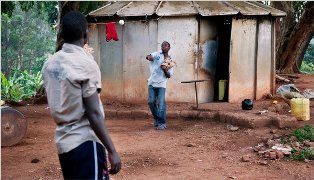 For
nearly two weeks, the players of the Rev. John Foundation Little League
team from Kampala, Uganda, believed they were headed to Williamsport,
Pa., for the Little League World Series. The team of 11 to 13 year olds,
which plays with donated equipment, was the first African team to
advance that far. But their fairy tale story ran smack into United
States immigration red tape. The players and their coaches learned this
week that at least some of the team’s visa applications were denied by
the State Department. The Little League World Series, which begins Aug.
19, will proceed without them. “It is unfortunate, as we were very much
looking forward to welcoming the first African team to the Little League
Baseball World Series,” Stephen Keener, president of Little League
Baseball and Softball, said in a statement. For
nearly two weeks, the players of the Rev. John Foundation Little League
team from Kampala, Uganda, believed they were headed to Williamsport,
Pa., for the Little League World Series. The team of 11 to 13 year olds,
which plays with donated equipment, was the first African team to
advance that far. But their fairy tale story ran smack into United
States immigration red tape. The players and their coaches learned this
week that at least some of the team’s visa applications were denied by
the State Department. The Little League World Series, which begins Aug.
19, will proceed without them. “It is unfortunate, as we were very much
looking forward to welcoming the first African team to the Little League
Baseball World Series,” Stephen Keener, president of Little League
Baseball and Softball, said in a statement.
The Ugandans were tripped up by their country’s inconsistent
infrastructure and the United States’ strict requirements for travel
visas. The State Department did not give specific reasons for the
denial, but it told Little League officials that there were
discrepancies in the players’ documentation. In Uganda, birth
certificates are far from the norm, and establishing someone’s age and
identity is complicated because parents and guardians are often
illiterate. “It is a difficult situation, I won’t deny that,” the State
Department spokesman Mark C. Toner said Friday at a news briefing. “But
you know, these cases are adjudicated by consular officials who look
very closely at all the appropriate data, and they make their decisions
based on that.”
The Ugandan children
play baseball because an American — Richard Stanley, a part owner of the
Trenton Thunder, the Yankees’ Class AA affiliate — introduced the sport
to the country eight years ago. “This would have been huge for kids all
over Africa,” Stanley said Friday. “This is a great opportunity to
expand the sport. All these kids want is an opportunity to go out and
play. They have the talent. They don’t have the facilities.”
Jay Shapiro, who has been following the team for two and a half years
while filming a documentary, “Opposite Field,” said in a telephone
interview from Kampala that the players were crushed when they heard the
news and that the embassy employee who told them on Wednesday was so
upset “she had tears in her eyes.” The team had come agonizingly close
to qualifying a year ago, beating Saudi Arabia in a qualifying
tournament in Kutno, Poland, but Shapiro said they lost the next day to
Kuwait because of a tiebreaker rule. This year, it beat Saudi Arabia on
July 16 and returned to Kampala full of hope about a trip to the United
States.
Shapiro said the State Department was right to question the players’
documentation, which he called incomplete. Documenting birth is not a
simple process in Uganda, Shapiro said. Birth certificates are scarce,
especially in the countryside. Many children are not born in hospitals.
Some of their parents are illiterate, and in many cases the people
raising the children are not their birth parents. A year ago, Little
League officials asked Shapiro to gather the necessary documentation and
oversee the process when the team qualified for the tournament in
Poland. This summer, Shapiro was not in Uganda. He had wrapped up the
film after last season, but he and his crew flew back to Kampala after
the team qualified for the World Series to add to the film. He said
after the visas were denied, he looked at the players’ documentation and
found it incomplete. “Last year’s team, I’m 100 percent convinced of
the legitimacy of that team,” Shapiro said. “This one, I couldn’t say I
was 100 percent convinced. The paperwork was sloppy. In reality, they
shouldn’t have even been allowed to go to Poland in the first place.
This should have been caught earlier.”
Before granting a visa to travel to the United States, the American
Embassy requires interviews with each child and his parents. If any of
their answers differ from what is on the paperwork, it is considered a
discrepancy. “I don’t think any of them were deliberately trying to
give false information,” Shapiro said. “They were just mistakes. But the
result is the same. And I don’t disagree with their decision.” Toner,
the State Department spokesman, said he did not know how many of the
players were denied visas. “It’s unclear to me whether it was a
preponderance of the kids, so that the team was no longer viable, if you
will, or whether every individual on the team was denied,” he said.
Stanley said he hoped Little League officials would appeal to the State
Department, but Pat Wilson, the vice president for operations for the
Little League, said that would not happen. “We are going to respect
their decision,” he said. “We don’t think it would be appropriate for us
to call into question their determination.” Wilson said there was no
precedent for a team’s qualifying for the Little League World Series but
failing to gain entry into the United States. He said a few teams
have had last-minute hitches in the process, but all were worked out.
Stanley said he
considered it a major setback to his efforts in Uganda. He became
involved eight years ago after visiting the country for a United Nations
economic development program and said he had spent more than $1.5
million building facilities and setting up a program. He said he paid
for the team to travel to Poland for the qualifying tournament in 2008,
in 2010 and again this year. He said each trip cost about $35,000. He
said his goal was to build sports schools that emphasize academics and
athletics. “When I talked to the minister of sports, he asked me, ‘Can
we win at this sport?’ ” Stanley said. “That’s what they care about,
because they can’t win at anything. They have great talent there, but I
told them: ‘You have to teach the kids. And those kids will play all day
long if you give them the opportunity.’ ”
Shapiro said Little
League should require teams attempting to qualify for the World Series
to go through a preliminary visa approval process so that there are no
last-minute disappointments.
“It’s a shame,” Shapiro said. “Their country isn’t ready for this. The
schools aren’t ready. The parents aren’t ready. The only thing that’s
ready are the kids and their talent. They will make it one day, and if
there is anything positive out of this, it’s for people to realize what
wonderful things are happening with these kids. They’ve got their own
little world growing here.”
July 7,
2011 Uganda team gets Polish visas
On July 1, we were told by Little League International that visas might be
obtained from the Polish Embassy in Nairobi if only the coaches who were to
travel to Poland would show up at the Polish Embassy at 9AM on Tuesday July
5 with the money, the proof of medical insurance, the notarized parents
consent forms, the photos, the letter from the baseball federation, the
letter from the Sports Commissioner, proof that the airline tickets were
already paid for, and the visa applications for the team and coaches. This
was done, and with the help of the U.S. State Department people, what
normally takes 15 days to process was done in two. As of Thursday morning,
July 7, the coaches were handed the visas that now allows the team to fly to
Poland, leaving Uganda at 2AM on July 10.
The two coaches will now make the 12 to 16 hour bus trip back to the
baseball complex after spending Monday thru Thursday in Kenya. They should
arrive on Friday morning and have about 36 hours to gather the team
together, collect their equipment for the trip to Poland and get to the
airport late Saturday night.

Help send
Uganda baseball teams to Poland
Let them show
how good they are
 Uganda
will have two excellent baseball teams ready to play in the
Europe/Middle East/Africa Little League Regional Tournaments in
July. The 11-12 year old team is supposed to be even better
than the team the went to Poland last year, and this time should
become the first African team to make it to the Little League
World Series. The 13-14 year old team should have many of the
players that were the best 11-12 team that played in Poland last
July. Uganda
will have two excellent baseball teams ready to play in the
Europe/Middle East/Africa Little League Regional Tournaments in
July. The 11-12 year old team is supposed to be even better
than the team the went to Poland last year, and this time should
become the first African team to make it to the Little League
World Series. The 13-14 year old team should have many of the
players that were the best 11-12 team that played in Poland last
July.
The major
problem will once again be money. To send each team to Poland
requires about $35,000. $25,000 is in airfare and the rest is
in visas, transport from Warsaw to Kutno and meals and other
expenses for the 15 travelers. By keeping these tournaments in
Europe, Little League makes it almost impossible for African
teams to participate due to these very high travel costs.
Please help Uganda to show that their children can produce
superior players and coaches to anything Europe and the Middle
East can. They just need a fair chance to get to the Little
League World Series.
UGANDA'S STRUGGLE TO OVERCOME THE
OBSTACLES TO PLAY IN THE MIDDLE EAST/AFRICA REGIONAL TOURNAMENT
** Why African Countries
don't participate in Little League Tournaments **
June 2011
Little League Middle
East/Africa Regional Tournament for boys ages 11-12 will once again be
held in Kutno, Poland from July 13-17, 2011. Why Africa is even
mentioned in the title escapes most people, since it will never be held
in Africa and virtually no African teams participate because of the
obstacles Uganda will attempt to overcome for the third time.
Does Little League
officialdom hinder African participation? You be the judge as Uganda
faces obstacle after obstacle.
The primary problem
for African teams is cost to get to the tournament in Poland. Uganda's
cost is estimated at $35,000US. No other participant in any Little
League Tournament in the world faces such a high entry cost.
The problem that
will stop Uganda's participation is getting the visa that would allow
them to travel to Poland. Since the tournament is held in Poland, that
will require Uganda to apply for the visas at the Polish Embassy. Since
Uganda has no Polish Embassy, it requires travel to Kenya, the nearest
Polish Embassy. This same problem will face most African countries
since most countries in Africa do not have a Polish Embassy. We are
told the normal visa procedure takes two weeks time. That means at
least two trips to Kenya or you stay two weeks in Kenya.
Paper work required
by the embassy: First of all you need to provide proof that you have
paid for the airline ticket as the visa will only be good for the date
you leave until the day you return and this information can only be
provided by the airline that will not give it to you until you have paid
for the tickets in full. If you do not get the visas, most airlines
will return most of the money you paid for the tickets over a period of
time. All the airlines have this policy knowing how hard it is for
Africans to get visas to the EU or to the U.S. A letter of Invitation
from Little League in Poland is required. The Polish embassy now
requires a letter from the Uganda Baseball and Softball Federation
allowing the Little League Team to travel. They also require a similar
letter from the Ugandan Commissioner of Sports. Then we must get
letters from the parents of each player allowing him or her to travel.
This letter has to be notarized, which in Uganda can only be done by a
lawyer at a cost of about $50US per player.
In order to get a
visa, each traveler needs a passport. To get the passports for each
child requires the payment of about $150US per player and to get it
rapidly, 3-5 days, we were told we needed a letter of invitation from
Poland inviting the team. Little League in Poland says they will not
send this letter until we give the names of all the players and their
passport numbers. We can't get passport numbers rapidly without the
letter. Thus we lose two weeks of time waiting for the passports in
order to get the letter of invitation.
Now comes the
question of birth certificates. This is going to always be a problem
since most births have not been registered in Uganda, as in most African
countries. This problem has been brought to Little League Baseball's
attention since at least 2004 and little has been done to address the
problem. We have suggested going to the school where the player first
registered for Primary one, or first grade and use that date for the
date of birth. This year Little League asked for us to go back to the
school the child attends to get the school, with official stamp on
school letter head to state the child's birth. This is all verbal, but
nothing on paper. We have done this.
As we write this, we
have been informed by the Polish Embassy in Kenya that in order to get a
visa, a new requirement is that each child and coach seeking a visa must
apply in person and wait the two weeks to get the visa. This will
require each child to travel to Kenya at a cost of $150US each, stay at
a hotel for two weeks, miss school which is in session from late May
until early August, to get a visa to play in the Little League Regional
Tournament. As it stands now, Uganda will not be going to Poland to
play because they are being denied the visa that would allow them to get
on the plane leaving July 10. We have already spent many thousands of
dollars which have all gone to waste.
Holding this and
other tournaments in Africa eliminates all the visa problems. In
Uganda, the visitor obtains his visa when he arrives at the airport.
All that needs to be done is to pay the $50 as you go through
immigration control upon arrival. Will Little League International ever
hold the tournament in Africa? The answer we keep getting is "No!"
Thus Uganda will forever be prohibited from participating in the Middle
East/Africa Tournament for 11&12 year olds and 13-14 year olds since
they will always be held in Poland.
Can Uganda Little
League get VISAs to play in the Little League Word Series?
October 2011
In early
September, a meeting was held at the U.S. Embassy with Uganda Little League
and the U.S. Ambassador, his first assistant, the head of the visa section
and the Embassy PR man. We informed the ambassador that we do not intend to
stop the program to develop baseball in Uganda. He was very happy to hear
that. Thus the purpose of the meeting was to see how we can bring next
year's World Series Eligible teams to play in the Little League World
Series. We have assured him that Uganda will continue to produce superior
teams that should each year be playing in the Regional Championship games in
our region every year and at every level that we can afford to send them to
play.
The result of the
meeting was that the problem was not age, contrary what an ill informed
State Department Spokesperson in Washington said at a Friday press briefing
in early August. There were two problems. One that can be easily fixed,
and one that may create problems for certain children if we try and fix it
easily.
Problem one was
how authentic were the birth certificates. One has to remember that birth
certificates are not routinely given out in Uganda and most people know what
month and year they were born, but many do not know the day they were born.
In order to play in the Little League Regional Tournaments, the players need
a birth certificate and a passport to get them to another country. To get a
visa to Poland takes about 15 business days. To get a passport takes about
two weeks under normal conditions. In order to save time, I supplied the
money and the coaches got the birth certificates and the passports. That
was mistake number one. There is only one office in Uganda that according
to the U.S. embassy can issue official birth certificates, and since the
parents are asked the date of birth on the birth certificates when they
visit the embassy, and then who got the birth certificates, the coaches
could be in danger of "Child Trafficking", a major crime. To fix this in
the future, the parents of the guardians of each player will now have to
have their parents obtain the birth certificate at the proper ministry.
Easy to fix, but takes time and money, which means now the team has to be
selected in early May in order to get their birth certificates, passports,
visas and tickets to the Regional Tournaments.
Now the problem
that can be fixed easily which will exclude many players, or may not be
fixable under current State Department Rules. According to the embassy,
when the U.S. visa is applied for, the parents named on the birth
certificate need to be present at the embassy to prove they are the parents
or guardians and that they can grant permission for the child to travel.
This does not apply if the person is age 18 or above, only if the person is
a minor, and that is all the embassy is concerned with, not the actual age.
If the two people named on the birth certificate do not come to the embassy,
then the person who does come needs to have a "Court Order" that states they
are the person responsible for the welfare of the child. If a parent is
dead, they must present a "Death Certificate" which almost no one in Uganda
obtains. Many of the children that play baseball in Uganda are taken care
of by one parent, an aunt, grandmother, sister of a relative or other
person. None have "Court Orders". Should the Uganda team apply for visas
to come to the U.S. next July, we have only about 2 weeks to apply for and
get the visas at a cost of $140.00 each. Who is going to get a lawyer and
apply for, pay for, and obtain a Court Order in those two weeks. We could
restrict our players to only those that have both parents on the birth
certificate alive. If that is the case, we will be telling most of the
children in Uganda that you are not allowed to play for the dream of making
it to the Little League World Series, but we will have no problem getting
the visas. I would rather abandon Little League if we had to do that.
We hope that
Little League and the U.S. State Department might take into account the type
of program the Little League World Series has been and will continue to be.
If this cannot be worked out, I am sad to say that Little League Baseball
and Softball in Africa will only be for the wealthy.
Special Christmas
for Uganda Little League
 Santa
Claus came in many forms to visit Uganda Little League this December.
Major League
Baseball
came for the ninth consecutive year bearing gloves and baseballs. This
time, something very special was added. The DVD package of discs of the
2011 World Series was added. This valuable present will enable us to
really show the coaches at the January clinic how to really play the
game of baseball. There were so many things that took place in this
World Series that anyone paying the slightest attention can learn so
much in coaching the game. We will be able to use this year after year
as the Ugandan players and coaches become more skilled in playing the
game and thus more competitive in International Competition. Santa
Claus came in many forms to visit Uganda Little League this December.
Major League
Baseball
came for the ninth consecutive year bearing gloves and baseballs. This
time, something very special was added. The DVD package of discs of the
2011 World Series was added. This valuable present will enable us to
really show the coaches at the January clinic how to really play the
game of baseball. There were so many things that took place in this
World Series that anyone paying the slightest attention can learn so
much in coaching the game. We will be able to use this year after year
as the Ugandan players and coaches become more skilled in playing the
game and thus more competitive in International Competition.
A second Santa Claus
was Ms. Susan Birnbaum of the New York City Police Foundation. Her
daughter at her high school in Westchester County started a drive to
collect slightly used baseball and softball equipment. On December 17,
they became the first individual donors to collect and deliver baseball
equipment to Pitch In For Baseball for the children of Uganda. We have
offers from several other people who wish to do this, but they were the
first. We hope several others will join them in the near future.
Santa Claus number
three has to be Wilson Sporting Goods. At the December Winter Meetings,
we managed to speak to the leadership of Wilson and expressed our need
to obtain many gloves and baseballs for our program in Uganda. They
said they could help, and did they ever. We hope to be part of their
annual program in the future, as we were this December. We were able to
purchase hundreds of gloves and baseballs at amazingly low prices. This
will now allow us to really expand the baseball program in Uganda while
working with the Ugandan Commissioner of Sports and the Peace Corps.
 The
one problem we now have is at our biggest Santa Claus of all, Pitch in
For Baseball. Without Pitch in for Baseball, Uganda Little League would
have all kinds of headaches. This Santa Clause packages all the gifts
other people give to us. The Wilson package being as large as it is, is
now squeezing them for room. As the Ugandan presents keep growing, it
enables us to expand baseball into Kenya, Tanzania, South Sudan and
Rwanda, but Pitch in for Baseball is being choked for space to handle
all this. David Rhodes, Executive Director of Pitch in for Baseball and
I will work on a solution. I am sure we will find one shortly. The
one problem we now have is at our biggest Santa Claus of all, Pitch in
For Baseball. Without Pitch in for Baseball, Uganda Little League would
have all kinds of headaches. This Santa Clause packages all the gifts
other people give to us. The Wilson package being as large as it is, is
now squeezing them for room. As the Ugandan presents keep growing, it
enables us to expand baseball into Kenya, Tanzania, South Sudan and
Rwanda, but Pitch in for Baseball is being choked for space to handle
all this. David Rhodes, Executive Director of Pitch in for Baseball and
I will work on a solution. I am sure we will find one shortly.
November 2011:
Many good things
are beginning to happen in January 2012. The major item that has
made the International Media is the Canadian Little League Team that
the Uganda Little League Team was supposed to play in the opening
round of the Little League World Series this past August is planning
to come to Uganda on January 14 for a one week stay. Under the
guidance of Ms. Ruth Hoffman, money is being raised to send the
team, coaches and parents, and a couple of celebrities, to Uganda.
There is an expectation that the game or games may actually be
televised live back to North America. We do know that this event is
expected to be the concluding chapter in the documentary film that
has been made that followed the 2010 Ugandan team to Poland.
Hopefully, sometime early in 2012, the film will be released and
available for public viewing.
January 2012 will mark the beginning of our annual two week program
of training coaches and players at the complex. This year, there
will be significant improvements from last January. Dorm 1 will
finally be looking like a completed building. We will have the
kitchen and eating area available when it was still under
construction last year. We have finished putting grass down on
field 3 and will now have the first full size baseball field to play
on in Uganda.
Participants for the two week program:
50 to 60 boys ages 11-12
making up four teams for the first 6 days. They will practice and
play at least one game every day.
50 to 60 boys ages 13-15
making up four teams for the last 6 days. They will practice and
play at least one game every day.
Several players from
Kenya may contribute to the teams at each age level.
Active coaches in Uganda
and Kenya are invited to attend and will be participating in a
detailed coaching clinic during the 2 weeks while actually coaching
the teams playing each day.
Teachers from a school in
Soroti and a girls school in Lira who will be trained to become
baseball and softball coaches at their respective schools.
Peace Corp Volunteers who
will assist in administering the programs in the Soroti and Lira
Schools, and others who will help develop programs elsewhere in
Uganda.
Several visitors from the
U.S. who will be working on helping in raising money for equipment
and building the school who want to help the kids in Uganda learn
the great game of baseball and softball.
A major future event in
Uganda is the starting of a baseball program at a Secondary School
in Soroti and a softball program at a Secondary School in Lira. It
is expected that each school will start four teams playing a game
every week at their respective schools when the new school year
starts around Feb. 1, 2012. These first 4 teams will be composed of
Secondary 1 & 2 students. They will be trained and coached by the
teachers who will be coming to the January coaches clinic. The
Peace Corps has recruited volunteers that will oversee and
administer the respective programs to make sure the new coaches are
coaching properly and the leagues are being run properly. If we
have enough interest, the programs will be extended to 4 teams
composed of Secondary 3 and 4 students, and possibly for 4 more
teams of Secondary 5 and 6 students. Uganda Little League will
equip the schools, the government will supplement the
teacher/coaches pay and aid in providing the playing fields. These
two programs will serve as a prototype for what the Ugandan Sports
Commission hopes to accomplish starting in the school year 2013 and
beyond. As part of that program, the Sports Commissioner
anticipates approximately 30 to 35 Secondary Schools playing only
baseball and softball throughout the country. Every May, National
Championships will be held at the Little League Complex. We will
attempt to bring these schools into the Little League program where
the National Winner will then be able to proceed onto the Little
League Regional Tournaments every July. These teams would compete
in the 13-14 age group, the 15-16 and 17-18. We expect in a couple
of years to dominate these tournaments and to be frequent
participants at the respective Little League World Series for boys
and girls. Once these schools are started, the program will expand
down into the primary schools.
As part of the above program, getting baseball equipment into Uganda
is now being worked on. At the request of the Sports Commissioner,
we will set up a shop that will sell baseball equipment. At the
current time, there is no place where a person can purchase baseball
or softball equipment in Uganda, and possibly anywhere in East
Africa. We hope to have this shop stocked with merchandise by the
middle of 2012. At the Trade Show at the December annual Winter
Meetings in Dallas, Texas, we will be in touch with all the
equipment manufacturers and vendors to make arrangements for getting
the equipment into Uganda early in 2012. We will keep you informed
about when this shop is stocked and open for business.
One very good piece of news is that on October 22, 2011, the
Uganda Baseball and Softball Federation
officially came back in existence. The new Chairman of the
Federation is one of our own, Mr. George Makhobe. Congratulations
and we expect to have a very supportive program producing Ugandan
teams to compete at future International World Cups and the Baseball
Classic.
January 2012:
History is Made with Canadian Visit
January 2012 was a very significant month. The one thing that the world
heard and read about was the visit of the Canadian Little League team from
Vancouver, BC to Uganda. They arrived on the evening of January 14 and left
Uganda on the evening of January 21. The New York Times, the Washington
Times, the Toronto Newspapers and broadcasters covered this story, as did
ESPN and Aljazira, amongst others. They came to play the game that was
supposed to take place last August at the Little League World Series. The
game was played on January 17 at the Uganda Little League complex with
several hundred spectators. Certainly the largest crowd to ever watch a
baseball game in Uganda in anyone's memory. Uganda won two to one, but that
was in my mind incidental to the event. In my mind, the biggest significant
event was that about 50 visitors came from Canada and not one was eaten by a
lion when they go off the plane at Entebbe Airport. Why is this important?
Because the Americans that make up the Saudi Arabian team, according to
Little League International, claim that they will never play a game in
Africa because it is too dangerous and that is why the Middle East/Africa
Regional Tournament must always be played in Poland. The Canadians have
destroyed that argument. How Little League International now justifies
playing this tournament in Poland will be interesting to hear.
During the two weeks
starting on January 7 and going thru January 20, the Little League complex
hosted about 90 coaches, teachers who will become baseball or softball
coaches, two teams of 11-12 year olds for the first week and two teams of
13-15 year olds the second week and a contingent of an additional 40
visitors from Kenya during the second week, in addition to about 25 girl
coaches learning to pitch windmill as taught by three Peace Corps
Volunteers. All the coaches were being taught the fine points of how to play
the game with topics being covered such as the role of the first base and
third base coaches, making line ups, evaluating players and positions, game
strategy and when to hit and run or sacrifice. At the same time, all coaches
were instructed on umpiring mechanics and techniques. The purpose of the
teams playing the games was to give the coaches an opportunity to practice
what they were being taught, including umpiring the games. Each day, classes
were held from 9 to 10AM. Two hours of actually demonstration followed. At
2PM, games were played every day with the games being coached and umpired by
the trainees. At 5PM, every coach was required to play in our daily softball
games, with a number of the later games using the newly trained windmill
pitchers. At 8PM, the 2011 World Series games were shown to point out the
method of really playing the game and the mistakes that are made by umpires
who were not asked to get help, and the problems of using all your players
when the games go into extra innings. This World Series, with the comments
made by the television commentators was a great training tool and we have to
thank Major League Baseball for supplying us with the DVDs.
On January 11, the
Uganda Sports Commissioner launched the governments Sports School program.
While the program will establish 32 secondary schools as sport schools
starting the 2013 school year, with the remaining 100 or so starting in
future years, two schools will start this school year with softball in an
all girls school and baseball in a boys school. Both schools involved sent
teachers who will become coaches to our two week training program. We in
turn equipped them with gloves, bats, helmets, catcher's equipment and balls
to start a 4 team league of S1 and S2 students playing a game a week. Each
school will have a Peace Corps volunteer assigned to supervise the league
operation. We and the Uganda Sports Commissioner will use these two schools
as prototypes which will help in getting Parliament to fully fund the
program in future years with the goal that the program will produce
student/athletes that will provide Uganda with competitive International
teams in many sports. For baseball and softball, it will spread the game
rapidly throughout the country and give thousands of ball players the
opportunity to develop their skills in a highly competitive environment. In
the words of Jimmy Rollins and Derek Lee, who visited during the Canadian
teams visit, the ball players of Uganda have the natural fluid motions and
the talent to be major league players.
February 27, 2012:
Significant Donation
-
Pocket Radar Company
Pocket Radar Company donates two pocket radar guns to Uganda Little League.
This will greatly help the program to monitor the talent of our young
players statistically that may open some eyes in the near future. The talent
is here, but we need to give it the opportunity to let it flourish, and also
be able to measure it. The Pocket Radar Company had donated a very valuable
tool that will enable us to do this.
April 2012:
Great progress has
been made in Uganda over the past month at all levels of baseball and
softball. We will be hosting our annual Uganda Little League National
tournaments this May. We will have 5 or 6 11-12 year old teams coming to
play for the right to travel to Poland to play in the Middle East/Africa
tournament which will be held during the middle of July. That will be
followed by the 13-14 tournament. Both these will be preceded by the
girls 11-12 program which we hope will have a competitive team traveling
to their tournament in Italy. Getting visas to Italy will be a lot
easier than getting the visas for Poland as the Italian Embassy is
located in Kampala while the Polish Embassy is located in Kenya. For the
first time, the boys program will have a team from Gulu and a chief
umpire from Canada. Chuck has informed us that after his visit in
January, he would like to return in May. He will now be a chief
tournament umpire.
We really made
history late in March. After our meeting with the Uganda Commissioner of
Sports on one day followed by a meeting with the Uganda Country Director
of the Peace Corps, a three way meeting was set for a Tuesday afternoon
at the Commissioner's office. This is where I believe history was made.
The mission of the Peace Corps in Uganda is to spread sport programs in
the schools, which is exactly what the Commissioner's Sports School
program intends to do, and a number of those schools will feature
baseball and softball. What was agreed to at the meeting is that when
the first 32 schools start in 2013, There will be six of those schools
playing baseball and 4 playing softball. Each with at least a 4 team
league playing a full schedule of games at the S1 and S2 level and
slowly advancing to the S3 and S4 level and then to the S5 and S6 level
over time. Starting in the April-May 2013 time period, each of these
schools will come to the complex at government expense to play for the
National Secondary School Championships. The Peace Corps will assign
newly in country volunteers with a background in Physical Education
training to these baseball/softball schools to teach the teachers to
become coaches and oversee the programs at each school. The schools may
also have as many as two Peace Corps volunteers to also assist in track,
soccer, and basketball. The government will be supplying funds for these
programs in terms of pay, equipment and facilities. The Peace Corps
Volunteers will do their in country training at the Little League
Complex in November.
In January, the
schools will be sending the future baseball and softball teacher/coaches
to the complex along with their designated Peace Corp Volunteers to be
trained on playing, coaching and umpiring the game of baseball and
softball. Between some of the other programs that want to join the
Uganda Little League program, we expect that we will be housing about
100 future coaches for our two week January program. The Sports
Commissioner's Secondary School program officially launches right after
our two week training program, but working with him, we already have a
softball school and a baseball school operating this year. When 2013
comes, those 32 schools will represent only 25% of the final number of
Sport Schools. Thus, this will be a joint program of Little League
Baseball, The Peace Corps and the Uganda Sports Commissioner to expand
baseball and softball all over Uganda over the next couple of years.
Two other
significant events happened in March. A College Baseball player from
California came to Uganda in early March He is staying until late May in
the Jinja area helping to train Little League Baseball and softball
players in Jinja and Lugazi. In addition, a gentleman from Taiwan
arrived about 2 weeks ago with the intention of staying for several
years and using that time to develop baseball players. Working with the
Commissioner, he will be working at one of the Sport Schools monitoring
and training coaches and players on how to play baseball. Both of these
travelers have come on their own at their own expense. We will do our
best to make their time in Uganda a most rewarding experience. They will
both be at the complex during our tournaments.
June 2012:
Last month, Uganda
Little League held three tournaments. We hosted the girls 11-12 year old
program early in May with seven teams participating. This was an
unexpected tournament as our long term plan was to bring the 7 and 8
year olds we started playing with tennis balls last year into softball
this year working on wind mill pitching. Our coaches indicated that they
wanted to hold the 11-12 year old tournament because they have been
training those girls also. Thus the tournament was held. We had hoped to
send a team to play in the regional tournament that is scheduled for
Italy from June 11-14, but once we found out that we had to pay for
hotel rooms for the team and hire a bus to take us from the hotel to the
fields every day, plus pay for our meals each day, we were reluctant to
get involved. When it was determined that there was a conflict with the
boys tournament scheduled for July 13-17, and some other complications
came about in Uganda, it was decided not to send a team this year.
The boys 11-12 year
old tournament was won by the Lugazi Little League. We have now made
sure all the birth certificates are from the proper agency and the
school records verify the birth dates. We are now in the process of
obtaining the boys passports, which we should have in a couple of weeks,
which at that time we will be able to apply for the Polish visas. We
hope to obtain the latter without the complications we had last year.
Little League International has been very helpful in assisting us on
obtaining the U.S. visas should the team win in Poland. One problem that
may present itself is that the Lugazi team is made up of entirely 11
year olds. They will work very hard to bring home a victory to Uganda.
We do not anticipate any of the problems of false documents like last
year as the problem has been cleansed from the system.
The 13-14 year old team that we had hoped to send to Atlanta Georgia did
not happen. We were notified mid May that the airlines would not grant
the free passage that was needed to get the team to Atlanta.
We have made
significant progress with the Uganda Sports Commissioner in assisting
him with his Sports Schools program. We will have at least 7 secondary
schools playing games internally at the S1-S2 level this coming school
year. The same will apply for at least 4 girls schools playing softball.
Next May, they will be playing for a Government Sponsored National Title
at the Little League Complex. In reality, these teams will really be
13-14 year olds and if we can work this out, maybe the Ugandan
Government might sponsor their trips to the Little League Regional
Tournaments for the respective age groups. The following year, they will
expand to the S3-S4 level, etc. Each one of these schools will have a
Peace Corps sports major volunteer to act as a supervisor, commissioner
to make sure the programs are running properly. In conjunction with this
program we have purchased over 900 gloves and 100 dozen baseballs that
arrived in Uganda in March. Under the Commissioner's control, any
government registered school will be allowed to purchase this equipment
at cost. We expect to expand this equipment store significantly in
future years.
RIGHT TO PLAY
REFUSES TO SUPPORT UGANDA LITTLE LEAGUE PROGRAMS
In January of this year, the Canadian team that was supposed to play the
Ugandan team at the Little League World Series came to Uganda to play
that game. It generated much publicity and Right to Play used it to
raise significant amounts of money, well over $130,000US. Some of that
money was supposed to aid some of the travel costs teams encounter to
get to tournaments. The estimate we were told was about $35,000. When
our tournaments were held, the various leagues made a request for some
form of support for their travel costs. We were told that not one penny
would go to support any Uganda Little League Team. It had all gone to
the adult teams in Uganda, nothing to the children in the Little League
program. It is the Uganda Little League's opinion that all those
generous people that supported this program last November and December
were deceived into thinking it was going to somehow aid Uganda Little
League. Right to Play has made it clear, nothing will go to support
Uganda Little League in any way.
July 2012:
Uganda went to Kutno, Poland
with a team of 11 year olds from the Mehta Little League in Lugazi to
play in the Middle East/Africa Little League Regional Tournament. After
losing the first game to Saudi Arabia by a score of 2-1 on a two run
home run in the top of the 6th inning, the team came back the next day
to start their journey to the championship. They beat Dubai by a score
of 6-0, followed the next day, when they had to play two games, by
beating Qatar by a score of 13-1 and Kuwait by a score of 8-0. This
brought them to the Championship game on July 16 against Kuwait who they
beat 5-2 to qualify them for the Little League World Series. The Mehta
team scored 33 runs in five games while giving up only 5. Very unusual
for a team with a 4-1 won lost record.
The team traveled
back to Uganda after the tournament to get ready for their planned trip
to the World Series. They will be appearing at the U.S. Embassy on
Tuesday morning, July 24, when they will be interviewed for their
visas. Their next game will be in Williamsport at the World Series
against Panama. That game is scheduled for 6PM on August 17. It is our
understanding that the game will be televised live around the world on
ESPN. Our only problem with that is that the game will be starting
at 1AM in Uganda.
July is the month
for Little League Regional Tournaments. This year, Uganda will once
again be sending a team to Kutno, Poland to play in the Middle
East/Africa tournament that starts on July 13. Each year, it gets more
and more difficult to send teams to Europe, and this year was no
different from that aspect, but it was different because we thought we
might also be able to send a girls team to the 11-12 softball regional
tournament.
As this is being
composed on the afternoon of July 10 in New York, the Ugandan boys team
is checking in at Entebbe Airport for their trip to Brussels and then on
to Warsaw. Their plane leaves Entebbe just before 11PM Uganda time and
lands in Brussels at 6AM Brussels time. Then, after sitting in the
Brussels airport for 8 hours, they will take off for Warsaw and land
there at a little after 5PM Warsaw time. The only food that they will
be able to have from the time they get off the plane in Brussels until
they are on the bus that will take them to Kutno, will be bread that
they will carry with them on the plane.
This team almost did
not make it. While our tournament was held in mid May, by the time
passports are obtained and parent consent forms motorized, the visas
that allowed them to get to Poland were only delivered to them 4 hours
before they were to board the plane at Entebbe Airport. Paul finally
was given the visas by the Polish Embassy in Kenya at 3PM and then had
to catch a plane to get him back to Uganda and the Entebbe Airport in
time to meet the team who were hoping he would not be delayed.
Otherwise, no one was going. To obtain the visas at this late time
required the assistance of Beata, the Regional Little League Director.
Getting these visas and what went on before could fill a book. All we
can say is if the Regional Tournament was held in Uganda, no one would
have to go through what we have to go through every year to get to
Poland.
That brings us to
the girls program. Early in May, we put together a girls All Star team
to represent Uganda in the Europe/Middle East/Africa Regional Tournament
for girls 11-12. We were getting set to send the team to Europe until
we found out what was involved. It seems that several years ago, and
every year since, we have been asking why Uganda cannot host a Regional
Tournament. We were told that we do not have the facilities to house
and feed the visiting teams. Certainly Poland does, and does a
wonderful job. The Middle East is too hot in July and South Africa is
to cold. Uganda has perfect weather all year round. So we built
dormitories and eating areas. We now have 16 team rooms and 16 coaches
rooms and a place to cook and feed everyone, but we still do not get a
Regional Tournament.
The girls tournament
is to be held in northern Italy. I am sure a very nice location. When
we went to apply, the notice said that we would be able to stay in a
hotel that we would have to pay for by the day. We would also need to
have a bus take us from our hotel to the fields and back every time we
wanted to practice or play. In addition, we would need to take care of
our food requirements at our cost. WOW. We cannot host a tournament
that we would be willing to house, feed and pick up and return teams to
the Entebbe Airport where you pay your $50 and you get a visa upon
checking in at border control once you get off the plane. The teams
would not be charged for housing or feeding during their entire stay.
What is wrong with Uganda?
There is no way that
under the current circumstances that Uganda can ever send a team to
Europe under the terms of what was required by the girls tournament. We
have informed Little League International that if that tournament was
held in Poland under same conditions that the boys tournament is run, we
would have sent a girls team. We cannot support a program that
basically supplies a ball field to play on only, and then have to come
up with $35,000 to participate.
September 2012:
The Little League
team from Uganda, representing the Mehta Little League team from Lugazi
made history in August. They became the first team from Africa to
ever make it to the Little League World Series in its now 66 year
history. It was quite an event and a memorable trip for the 11
boys and the two African coaches and myself. Due to travel
problems, the team arrived at Newark Airport on Friday afternoon, August
10. They were met by a reporter for BBC radio who interviewed
several of the travelers at Newark Airport. Everyone then boarded
the bus for the 4 hour trip to Williamsport. Arrival was after
dark, but they were greeted by a large number of people and immediately
taken to their dorm. After dropping their luggage, they went to
see the lighted stadiums where they would be playing one week later and
were immediately set upon by people filming for ESPN. We were the first
team to arrive at Williamsport with several others arriving the next
afternoon and evening. By August 14, all 16 teams had arrived.
The Williamsport fields are beautiful and smooth as carpets. We started
preparing for the tournament the next day at 6:30AM at the batting
cages. Each team is assigned two uncles. The two assigned to us
were wonderful. They met us everyday we were there at 6AM to
assist in carrying balls and anything else down to the batting cages.
No one else was ever up at that time, and with the help of our early
arriving uncles each morning, we would schedule our 1.5 hour practice
sessions before anyone else and thus each day, we would have two field
sessions and two batting cage sessions for about 6 hours of practice
daily. While we could only schedule one batting cage session each
day, the 6:30AM session never counted since no one was expected to be
using that time slot.
Food became a
problem. In Ugandan culture, if food is available, you eat a lot
because you do not know how much will be at your next meal. In
Williamsport, food is always available. All kinds of food and as
much as you want. The Ugandans like to eat bread, potatoes and
rice. The team was eating lots of it at breakfast, lunch and diner
including other items that they were learning about, such as fried eggs,
bacon, sausage, french toast, pancakes and fruit for each breakfast.
My concern was that they were eating so much starch, by the time one
week would go by, I would need a crane to get them from home to first
base. But how can you stop kids from eating. Eventually,
they did slow down on the bread and potatoes and began to eat salads,
soups and lots of ice cream. The cooks fell in love with them and
did many wonderful things for them.
Other than our
6:30AM practices, the team could not walk anywhere near the stadiums
without being constantly stopped with requests to sign baseballs,
shirts, jackets, paper and to let them have their pictures taken with
other adults and children, or just the teammates together. This
went on from Sunday, August 12 thru the Championship game on August 26.
If we were scheduled to practice on a field, we would have to take a
round about route to avoid the people, but still we would be constantly
stopped. It was not fun when we would have to tell the adults and
kids that we could not sign now because we had to get to a certain place
by a certain time, be it to a game, an award ceremony or for television.
The souvenir hats and shirts, supposedly 3,000 each, were sold out in
one day. The only team to sell out over the entire week plus.
On Wednesday, August
15, there was a parade through the main streets of Williamsport.
Two teams were assigned to a flat bed trailer truck for a total of eight
trucks. The parade must have covered a mile and the line of march
must have been close to one mile long. Even though it rained at
the start of the parade, the streets were lined with thousands of people
as we passed. They were throwing all kinds of candy onto the
truck. The front page of the local newspaper had a full length
color picture of the Uganda team with the head line "They finally made
it." On Sunday, August 19, they were treated to a low level minor
league baseball game and given royal treatment. Here they saw the
level of play they would need to obtain if they were ever to dream of
playing professionally. One day the following week, a group of
restaurants treated them to a special diner at a very fancy Williamsport
restaurant.
On Saturday, August
26, the spent the day at an amusement park, riding roller coasters, log
flumes, visiting haunted houses and other amusements courtesy of a local
Pennsylvania group working on building a school in Uganda where they
want us to teach the students to play baseball and softball. After
the tournament, on August 27, they went to Trenton, N.J. to play the
West Windsor Little League team, but it got rained out, but both teams
went to see the Trenton Thunder game that evening with a tour of the
inner workings of the stadium. This was followed the next day with
a Little League game just north of Philadelphia with about 1500
spectators watching, followed with a trip to see the Philadelphia-New
York Met game that evening. They were allowed on the field, taken
through the locker rooms, the weight room, the trainers room, the
players meal room and given shirts, hats and other things. The
45,000 fans in the stands periodically cheering "Uganda, Uganda" during
the game and when they appeared on the field with the Phillie Fanatic
between innings. Once again, lots of food and requests for
autographs and pictures. This was followed by a trip to New York
and Yankee Stadium for a repeat of what happened in Philadelphia.
Thursday saw a visit to Major League Baseball offices for more
autographs and more shirts and other items. The Uganda UN mission
then took everyone onto the floor of the UN Security Council and the UN
General Assembly, after which they had to get to the airport.
The media coverage
was something else. From BBC radio at their Newark arrival to BBC
television doing a piece on the team, CNN devoting a full half hour of
their Africa program to the team, to Alajazeera doing several programs
covering the preparations to the first game, covering Africa's first
hit, run scored, and home run on another program, and their trip to
Yankee Stadium and the UN. Every newspaper in New York,
Philadelphia, and NPR radio network did extensive coverage of their
travels. Obviously, ESPN broadcast all around the world three of
their games from Williamsport, including their receiving the
Sportsmanship Award for the World Series.
What is next?
We will be meeting with various groups that want to expand baseball in
Africa. We expect to have meetings with Major League Baseball and Little
League Baseball regarding the future of baseball in Uganda and beyond.
This will start the week of September 10. Uganda will be sending
it's new UN Ambassador to New York shortly and we have been invited to
meet with him along with one or two other people to let him know where
we are with the Uganda Sports Commissioner's program of sports school
playing baseball and softball. Many people have approached us
about donating equipment to the program through Pitch in for Baseball
which we hope comes true. We will also be talking about building
the school to start at the S1 level for 50 students when the 2013 school
year begins. We already have a commitment to build the primary
school at the complex from the group in Pennsylvania. We really do
expect to produce some outstanding competitive baseball and softball
teams in Uganda over the next couple of years. A number of major
league players have expressed their desire to come to Uganda to help
train coaches, players and umpires on playing the game of baseball
during the January period.
Lots of things will
be happening over the next couple of months. We will once again
try and keep you updated periodically.
October 2012:
MORE EXCITING THINGS IN UGANDA
The last two weeks
have seen some great developments continue to take place in regard to
Little League Baseball and Softball. During June, the former Ugandan
Commissioner of Sports reached the retirement age and had to give up his
position. On October 12, he came to the Little League complex to sit
down and talk about the Sport School program in the secondary schools.
He informed us that he is now committed to make sure the two secondary
schools in Mbarara scheduled to start this coming school year would
start up and become a success story for baseball and softball. He lives
in that area, and even though he is technically retired, he is going to
make sure they run right. In addition, he expects to get several
primary schools started with Little League so that they will feed into
the secondary school programs. This is now his mission. The main
purpose of his visit was to get information on dimensions of the Little
League/softball fields for the primary schools and the full size field
for the secondary school. He will make a great addition to our program
in the western area of Uganda.
The acting Uganda
Commissioner of Sports, Mr. Omara Apitta Lamex, has been a very good
friend of Uganda Little League for many years now. He comes from Lira,
the north of Uganda, and has been instrumental in starting Little League
baseball in several primary schools in Lira a few years ago. We sat
down with him as a follow up with the sport school program and the 10
schools that will start with baseball and softball in the new school
year. He assures us that at least 4 teachers from each school will be
coming to our two week January training program for new and experienced
coaches. We reviewed the price lists and the procedures that the
schools will be able to obtain baseball equipment and went over with him
the meeting we had with the leadership of the Peace Corps regarding how
the volunteers will be working with the schools to monitor and assist
the baseball and softball programs. It appears everything is in place
with the Peace Corps and the Sports Commissioner's office to make sure
baseball is being played in at least 6 secondary schools and softball in
4 others with proper supervision after the two week teacher/coaches
training program takes place in early January.
One other item we
discussed with Mr. Omara concerned the results of our meeting with the
Japanese Embassy. It seems that Japan wants to donate an excellent
Little League/softball field to Uganda. They came to Little League for
helpful advice and who they should be dealing with, since they wanted to
make sure it was used by the public and maintained properly once Japan
built it. Maintaining a facility is a real problem in Uganda, but if a
school is involved, it can be done. With the sport school program
supposedly containing money to maintain sport facilities, the best
person to work with the Japanese Embassy on this project is the Ugandan
Sport Commissioner. Mr. Omara will be talking to the Embassy and the
Embassy is eagerly awaiting to hear from him with the help to solve
their dilemma.
THE
INTERNATIONAL SCHOOL AT THE LITTLE LEAGUE COMPLEX
The real big
accomplishment over the past two weeks has been the actual start up of
the International School for Math and Science for the Athletically
Talented. The athletic talent is very prevalent in Uganda. Getting
programs that will fully develop these talents is very difficult. For
several years, it has been the plan to start our own school that would
concentrate on developing these talents, especially in the area of
baseball/softball, while also training the students in soccer,
basketball and track. We have officially started on our way. The
school will recruit the best math students with athletic talent. It
will be an International School because then we do not have to teach
religion, or a number of other subjects. We can concentrate on English,
History/Geography, Math thru calculus, and every science subject taught
in the U.S. with the idea that every student will be able to be accepted
into any university in the U.S. and the world. Our hope is to get them
good enough for academic scholarships and athletic scholarships. We
will start the first S1 class of 25 boys and 25 girls this coming school
year. There will be no charges for tuition or room and board. We have
now hired the Head Teacher, the Math Teacher and Science Teacher, the
school nurse, 4 men coaches and at least 2 girl coaches. We are
looking for a good young English teacher as this is written. The
students will start classes at 7:30 each morning and finish by lunch
time. At 2PM, they will be drilling and playing competitive games.
This first class will have the boys broken into two teams to compete
against each other, as will the girls. There will be incentives
to motivate the teams to win as many games as they can over the course
of the year. In 2014, we will add another class, as we will each year
until the school reaches its proper student level.
Starting now, we are
getting the word out about this school. We will host regional tryouts
around Uganda in mid December. We are looking for top students,
especially in math, and then we will conduct physical testing to
determine athletic talent. We have many people who want to assist us in
these determinations. We expect to measure running speed, agility,
throwing strength and ability to flied and catch. We expect to have
hundreds of applicants, but we want to select the best so that they
become the best academically and athletically.
The last thing we
need to mention is the work that the Mehta group is doing in Lugazi.
Good to the company's word, the Little League field has been laid out
and they are now waiting for the grass to grow. It was suggested to
them that they should go to the greens keeper at the company golf course
to oversee the growing of the infield and outfield grass, and then have
him oversee the maintenance of the grass. We were told that the company
is trying to locate a place for the full size field that they intend to
construct. In the meantime, teams are now playing on all grass fields
that are shared with other sports. Supposedly, only baseball players
will be allowed on the Little League/softball field and the full size
baseball field. A new little league field has been installed in Gulu
and the field that will be a gift from Japan will mean at least 3 new
proper Little League fields will be built since the Uganda Little League
tournament this past May.
December 2012:
The winter meetings
of professional baseball have ended this week in Nashville. Uganda
Little League programs are well known and are being closely followed by
several Major League Teams and by the MLB office. The Little League team
that won the US title at the 2012 World Series is planning to come to
Uganda late in December. They come from Nashville and I had the
opportunity to meet with them for several hours. They held a fund raiser
to help pay for their trip. Mr. Tommy Lasorda of the LA Dodgers was kind
enough to donate $5,000 last Saturday. He has become an ambassador for
their program. I had the opportunity to meet him at the Dodger reception
to thank him for his efforts. It was a big event, and I am now going to
be reporting our statistics of the school athletes every few months as
they grow and progress to the LA Dodger's head of scouting. This is the
first step in spreading the word that Uganda can and will produce
talented baseball and softball players. The Detroit Tigers are also
interested in our school program and the abilities of our athletes, as
are several other Major League Teams. But our most important school goal
is getting our students academic and baseball athletic scholarships to
the Black US Universities in the next 5 years or so. Should they become
professional baseball players, that would be nice, but more important is
getting them an engineering or scientific degree that will support them
well into the future.
In regard to the
school, we now have in place our full faculty and staff for the start of
the 2013 school year. They will all be reporting to the Little League
Complex at the start of January. Starting early in December, we will
begin our journey around Uganda holding athletic tryouts and checking on
the math abilities of the students that have been recommended to us by
their primary schools. The only thing these students will need to bring
to the school will be a pair of shoes. Everything else will be provided
for them at no charge to them. The prize at the end of the rainbow is
the full four year scholarship to attend a university in the U.S. To get
there, they need to work hard at developing their academic and athletic
skills. We want everyone we take into the program to obtain the full
scholarship, but that can only be done by continuous hard work. We
already have contacts with the Black Colleges in the U.S. and they are
eagerly waiting for our results.
This school project
has resulted in several visitors coming to Uganda. A Senior Vice
President of Major League Baseball is expected to visit Uganda in March
2013. A group of other visitors are also coming in March. This group is
looking to help fund the school, possibly enlarge it, and brings
representation of several Black Universities to Uganda. They very much
want to meet several of the people involved in operating the school.
That is the primary reason for their visit.
Starting January 5, 2013, we expect to possibly have as many as 100
teachers and coaches who are coming to the complex to learn to coach
baseball and softball teams in their school programs. We expect at least
four from each of the 10 secondary schools that will be starting leagues
at their schools for S1 and S2 students. This is in conjunction with the
Uganda Commissioner of Sports "Sport Schools" program. We also will have
many teachers coming from a number of primary schools from the north,
the west and east, besides Kampala. The program will run for two weeks.
We will only allow those who have registered with Paul by mid December
to attend. The first week will concentrate on players 11-12. The second
week will be on the full size baseball field for older players. We
expect four Little League umpires from the U.S. and Canada to also be
coming to help out, besides several other Americans and known Ugandan
coaches.
Pitch in for Baseball
On or about December
1, a 20 foot container left the U.S. on its way to Uganda. The boat will
take about six weeks to get to East Africa and then another week or two
to get to the Little League Complex. It is like a Christmas Present to
Uganda Little League Baseball from our many friends we have made in the
U.S. Our very good friends at Pitch in for Baseball spent many hours on
assembling all the equipment that has been donated from Little Leagues
around the country and from Wilson Sporting goods, Dick's Sport Stores,
Major League Baseball and many others. All this is coming to expand and
develop the baseball program thru Uganda Little League. We thank
everyone who donated anything to Uganda Little League. But we have to
extend a very big thank you to Pitch in for Baseball. They have spent
months collecting everything, sorting it, evaluating, packing and
dealing with the shipping company. When the container was delivered to
their dock on November 26, it stood one foot above their loading dock
and thus, the
gaylords that everything was packed
into and stacked double high could not get into the container. It was
decided to get a standard truck to the dock, move the container to a
transloading facility with the
gaylords and have the container stuffed
there, and then taken to the boat. The container was finally moved on
Thursday morning, November 29, but the truck did not arrive at Pitch in
for Baseball until 7PM that evening. The filled container finally made
it to the dock by Friday afternoon, just in time to make the boat. Thank
you Pitch in for Baseball for all the time and effort put into getting
this donated equipment on its way.
February 2013
The new year has
started with very significant events in January. The two week clinic
for 100 coaches and teachers who want to be coaches of baseball and
softball was held starting on January 5. The schedule for this Mays
National Championship Little League Tournaments were announced. The
secondary school's first day of classes was January 28th for 50
students. The Peace Corps people came out to the complex to talk about
the future and we had a very nice meeting with the U.S. Ambassador, Mr.
Scott Delisi. We are now preparing for March when even more significant
things are expected.
Two week Clinic:
On Saturday evening,
January 5, the influx of coaches and teachers who want to be coaches
began to arrive at the complex. We held the number down to 100 and 24
boys who would be playing a Little League baseball game each afternoon
for the next six days. The following week would see these players
replaced by 24 others who would play a game every day for the last six
days of the clinic. Because of the large number of trainees, they were
broken up into four teams for the entire two weeks. The program started
everyday from 9 to 10 with class room demonstrations and lectures. At
10AM, the four teams followed their instructors for on field
demonstrations and participation. On several days, these demonstrations
led to inter team contests and competitions on what they had learned.
The teams were very competitive. Lunch was from 12:15 to 2PM, after
which everyone went to observe the games being played by the Little
Leaguers. After the first day, each team had to supply a trainee to
umpire the games. Two umpires did the first 3 innings and two more did
the second 3 innings. Meanwhile their team mates were observing the
umpire mechanics and the coaching mechanics as they were watching the
games with their instructors. The umpires had their instructors right
next to them as they were umpiring the game to point out their good
moves and their moves that were not so good. At 4:45 every day, a game
was played on each of the two fields using tennis balls, slow pitch and
no gloves. Again, each team had to supply umpires for these games for
three innings. The games were 9 innings long, thus each team needed
three umpires per game. Team 4 was undefeated during the first week
of games and team 3 won the second week title. On the last day, team 4
won the championship game by one run with a question about how fair was
the umpiring when a controversial close call was made at 3rd base in the
last inning that benefited team 4. After diner, game videos were shown
from 7:30 till the end of the games. We started with the three games
Uganda played at the Little League World Series and then went to the 7
game World Series of 2011 between the Cardinals and Rangers. This World
Series had everything in it. From key errors, big stolen bases, pick
offs, an umpire missing a tag on a runner going to first base, and great
shots of 3rd base coaches doing what they were supposed to do to send
runners or hold them up at key times.
The clinic was
successful because of the help from Little League umpires who came from
North America. Ed from Vancouver on his second trip to Uganda, Chris
from Pennsylvania and Daniel from New York. Chuck, from Ontario, who
had been to Uganda twice already was prevented from coming by his
employer. Harry, from New Jersey. also joined us for his second visit
to Uganda as did Jennifer and her boy friend who came to see what
the Uganda Little League Complex was about. All stayed in the guest
house. On the last Thursday evening, a big party was held with the food
being topped by goat meat and dancing to a disco DJ until midnight.
The annual meeting
of the Uganda Little League Directors established the tournament dates
for this May. The boys 11-12 year old tournament will have its first
game played the morning of May 10. The girls 11-12s will have their
first game played the morning of May 15, and the boys 13-15 will have
their first game played the morning of May 20. We expect at least 4
volunteer Little League umpires to be joining us on or about May 7 to
umpire the three tournaments. They are all members of the Little League
World Series Umpire Alumni Group. Anyone interested in taking part in
these tournaments must have their team rosters, the teams schedule of at
least 12 games with the dates, location and time of these games to Paul
for the boys and to Allen for the girls no later than February 20 in
order to be chartered as Little League teams.
School:
On Friday, January
25, the students began to report to the school to begin the new school
year. The Teachers, Head Master, Coaches and Directors were all there
to great the 25 boys and 25 girls and their parents or guardians. These
are some of the best math students and athletes in the country. No
tuition or room and board is to be charged. Uniforms are supplied and
we expect these students to become the best educated and produce the
best teams in baseball, softball, football (soccer), basketball and
running amongst the secondary schools of Uganda. Classes began on
Monday, January 28. The school is specializing in Math and Science with
a very strong emphasis on English and History/Geography. This is only a
first year class in Secondary School as we want every student to be
ready for Algebra starting next year and Calculus during the sixth year
if we do not get them scholarships to U.S. Universities after 5 years.
Our goal is get every student a 4 year scholarship to a U.S. University
to major in Engineering or Science. We expect to do this with a half
scholarship for academic achievement and a half for athletic
achievement.
 U.S.
Ambassador Scott Delisi
was kind enough to allow us to pay him a visit at the U.S.
Embassy. After our discussion of what we were doing at the complex, he
wanted to know if Uganda was going to be going back to the Little League
World Series. We told him we will be doing our best. He promised to
come and visit the complex in March when we expect the team from
Nashville Tenn. to visit us and possibly a visitor from Major League
Baseball and a group from Indianapolis, Indiana. The middle two weeks
in March is expected to be a very busy time for us and possibly a very
important time, as it is possible the we may also get a visitor from
Little League International joining us. U.S.
Ambassador Scott Delisi
was kind enough to allow us to pay him a visit at the U.S.
Embassy. After our discussion of what we were doing at the complex, he
wanted to know if Uganda was going to be going back to the Little League
World Series. We told him we will be doing our best. He promised to
come and visit the complex in March when we expect the team from
Nashville Tenn. to visit us and possibly a visitor from Major League
Baseball and a group from Indianapolis, Indiana. The middle two weeks
in March is expected to be a very busy time for us and possibly a very
important time, as it is possible the we may also get a visitor from
Little League International joining us.
April 2013
Progress is being
made at the school and in developing baseball in Uganda. The Allen VR
Stanley Secondary School of Math and Science for the Athletically
Talented has now finished its' ninth week of operation. The 25 boys and
25 girls are developing academically and athletically. Classes are
running longer than the anticipated schedule as they now start at 7AM
and end at 12:30PM Monday thru Friday. So far, the boys have played
about 50 baseball games and 35 soccer games. The girls have played the
same number of soccer games and about 50 softball games. The time
playing games is less than the time they spend on practice and drills
for both sports.
On March 30, the
school was invited to participate in a race in Kampala. The race was
for 14 years of age and under. We intended to enter 5 boys and 5 girls,
but only 3 girls wished to run. A bus brought the entire school to
Kampala to support the runners. Our runners finished First, Second and
Third. Our goal is to be the best and this shows that we are getting
there.
Three weeks ago, we
played a school in soccer, in Uganda it is called football. We only won
by 1-0. We played the same school two weeks later and dominated the
game, but only won 3-0. If we play them again, our goal is to win 6-0.
Remember, none of these boys were soccer players before they came
to this school.
Academically, we are
working on getting each student a tablet where every book they need over
the next six years in science, math, history and literature can be
stored on the tablet and read at any time. Our problem is getting
tablets into Africa. Because of the technology, Amazon and Apple will
not talk to us because we want to ship a tablet for each student to
Africa. The way they make money here in the U.S. evidently does not
work in Africa and thus are not interested in us purchasing 50 tablets
each year. We will solve this problem, and already have the books we
need available to us through the CK12 Foundation.
Starting May 10, the
Little League National Tournament will be held for boys 11-12 years of
age. We believe that we have an excellent chance of winning as the team
now has three pitchers that throw at 70 miles per hour and three others
that throw in the mid 60s. We are using 4 pitchers every game we play
and thus, since we play 6 games per week, three on weekends, we use 12
pitchers every weekend. Unfortunately, the championship will be decided
by one game to be played the morning of May 14. Following the boys, the
girls 11-12 will be playing their tournament starting the morning of May
15. We have 8 girl teams coming to play for the title. Their
championship will be played on the 19th, followed by the boys 13-14 year
old boys. Our girl teams are just learning the game and we are looking
to develop at least 3 or more windmill pitchers that can throw strikes.
Once again, none of the girls played the game before coming to the
complex. While we will send the boys team to Kutno, Poland in July, we
do not have the money for the girls to travel to Italy. If Little
League moves the girls tournament to Poland, we will definitely send a
team next year. The problem with Italy, we have to pay for our own
hotel rooms, food and bus to take us to the field to play one game per
day for four days. There is no opportunity to practice at fielding or
hitting, other than to just play one game per day and sit in the hotel
rooms the rest of the days. It is totally different in Poland.
In other baseball
developments, we have clarified the situation with the government sports
schools. The government is evidently not going to supply money for the
sport schools to purchase equipment. Thus we have entered into an
agreement with the Uganda Sports Commissioner that we will make every
effort to equip 5 secondary schools with equipment to have each
school get at least 4 teams at the S1 and S2 level playing, 4 more teams
at the S3 and S4 level playing in a year or two, and 4 more teams at the
S5 and S6 level playing, They will become members of Little League and
the complex will host annual championship tournaments every May for boys
and girls. The Sports Commissioner will send at least 4 coaches from
each of the schools to the complex to be trained in baseball playing,
coaching and umpiring. The winners of the tournaments will be eligible
to move on to the Little League Regional Tournaments currently being
played in Europe. The Commissioner believes he will be able to
get corporate sponsors to cover the cost to get them to Europe. All
these schools will be fed by existing Little League programs where there
are already trained coaches running the programs. Each of these schools
will also have Peace Corps Volunteers able to oversee their programs and
assist in running them. The goal is to produce many excellent baseball
and softball players to export to the U.S. and other countries.
The Japanese have
donated a significant amount of money to build a very nice full size
baseball facility just north of Kampala. It should be finished in less
than a year. This will make at least 4 baseball fields with grass
around the country in addition to the five we currently have at the
Little League complex. Three of these four are Little League fields,
all built in the last 12 months.
While the visitors
that we thought were coming in March did not come for various reasons,
we now expect a significant number of visitors to be coming in May.
People from Indiana in regard to our school program are now planning on
coming late in May. They may number as many as 8 to 10 people. Ms.
Wendy Lewis, of Major League Baseball, will now plan on coming in
January of next year. We have several other people coming over the
summer who will be joining the baseball program in Lira and in
other parts of Uganda. It has been indicated to us several weeks ago
that Dan Velte of Little League International may be traveling to Uganda
to see our tournaments. We do know that we expect at least 4 or more
umpires from the Little League World Series Umpire Alumni Association to
be joining us to umpire our three tournaments this May.
June 2013:
Two tournaments were
held at the Little League complex in May. One was for boys 11-12 and
one for girls 11-12.
The boys had 6 teams
come to the complex on the afternoon of May 9. Gulu and Soroti had the
longest and most expensive trips to get to the complex. Both require 10
hours in a bus at a cost of about $350 each way. The other teams
managed to come for a cost of about $50 each way. All these costs were
covered by Uganda Little League. The tournament was a double loss and
you were eliminated. Three games were played on May 10 starting at
10AM, 1:30PM and 4PM. Kyambogo at one time was considered to have the
best baseball program in Uganda. They were eliminated by the second
game they played on May 11, as was the Luwero team. Soroti fell next
and Gulu eliminated Lugazi on May 13. The championship game was played
on May 14 between Gulu, who only started play last April and the Allen
VR Stanley school. Gulu was most impressive as they hit and scored,
something that no other team was able to do against the eventually
champion.
On the afternoon of
May 14, after all the boys had left, nine girl teams arrived for their
double loss elimination tournament that started with 5 games each day on
May 15 and 16. Three teams were eliminated by the end of the second day
of play. Eventually, it got down to 4 teams playing in the semifinals
on May 18. The Allen VR Stanley school lost to the Kitebi school team,
and Soroti beat the Kisugu Primary School team in two close games. The
final was a classic game between Kitebi and Soroti. It went down to the
bottom of the last inning that started with Kitebi leading by three
runs, 5-2. Soroti scored 4 runs in the bottom of the 6th inning to win
the game and became the champions of the girls tournament with all the
jumping, hat throwing and sliding of a champion celebration.
Containers:
Late in January, the
container from Pitch in for Baseball arrived in Kampala. The process to
get it cleared though many ministries began around mid-January. After
many meetings, people promises, and other things, the container finally
arrived at the complex on May 20. Needless to say, it involved a lot of
money for 4 months of storage charges, taxes and other fees, but with
all the things in the container, it was well worth the wait. We
immediately set up the two batting cages that were in the container and
then began to find places to store the many bats, balls, catchers
equipment, gloves and helmets so we could have access to the many other
items in the container, such as uniforms, shoes, and bags. Please do
not forget that the container also contained many books and magazines
for the school library which were immediately put to use. There is no
way that we can express our great thanks to all the people who donated
equipment to the Uganda Little League. We can now have many teams
playing baseball and softball all over Uganda. What we need to do now
is to get the coaches and schools playing who are serious and want to
produce competitive teams to compete in our national tournaments each
year, all the way up to age 18. We have plenty of schools and so call
coaches who want the equipment but have no intention of using it. We
already know too many of those.
The second container
contained a farm tractor with mowers, plows, hole driller, and
bushwhacker. That container arrived in Kampala on April 24. Since it
was farm equipment, there was not supposed to be any taxes or tariffs on
this equipment and was supposed to clear customs easily and quickly. It
finally arrived on June 4. Once again, many sign offs were required.
If 6 full weeks is quick, maybe it is compared to 5 months. It is there
now, and it will be used to cut and roll our fields and also to cut the
bushes, plow the ground so we can plant various crops to feed the
school. It will also be used to teach modern farm methods to our
students and also enable the movement of piles of soil from one place to
another.
The School:
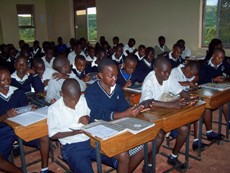 The first of our
trimesters ended on April 22. The second trimester started on May 22.
We managed to bring 54 Samsung tablets over to Uganda in my checked
baggage early in May. Each of our 51 students now has a Galaxy 7"
tablet along with the English, Math and Science teachers. The first of our
trimesters ended on April 22. The second trimester started on May 22.
We managed to bring 54 Samsung tablets over to Uganda in my checked
baggage early in May. Each of our 51 students now has a Galaxy 7"
tablet along with the English, Math and Science teachers.
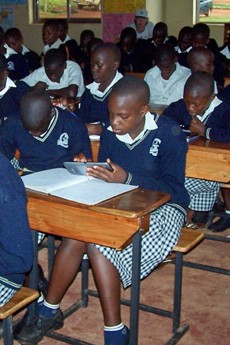 On each
tablet is a book from CK-12 Foundation for English composition writing,
all the Shakespearean plays and other writings, a 900 page Physical
Science book and a pre-algebra text book. On each
tablet is a book from CK-12 Foundation for English composition writing,
all the Shakespearean plays and other writings, a 900 page Physical
Science book and a pre-algebra text book.
We also now have an
extensive library that consists of over 120 National Geographic
Magazines, many books from Time Life covering many countries and regions
and many other advanced science and math text books besides many novels
and short stores for the students to read.
We have begun to
recruit students for next year's class of 50 top athletes with excellent
Math and Science credentials. We have recruiters in the northeast,
north, east, west and central areas looking for the best athletes based
upon running speed and agility. We do not care what sport they
currently play, but we need 25 boys and 25 girls. Our biggest problem
is filtering the best from all those that want to come to the school
because we do not charge tuition or room or board. We know we will be
offered bribes to take certain students and we cannot do that. We need
to find the best athletes who are excellent math and science students
who want to become the best in everything they do through hard work and
maximum effort. Our school classes start at 7:10AM and end at 12:30PM
when we break for lunch. Then from 2PM to 5:30PM, it is time for
sports. Baseball Soccer, running and Basketball. The boys and girls
have already played about 90 baseball and softball games and about 50 or
more soccer games since the last week in January to the first week in
June. I believe that we have the best conditioned 12 year old students
in East Africa, if not all of Africa.
July 2013
Little League
International rescinds tournament invitation at last minute. No
Ugandan team will be playing in any Little League tournament this year,
or maybe even next year unless something is changed.
On the
afternoon of June 20, Uganda Little League was told that the Champion of
the May National Tournament would not be allowed to attend the
European/Africa Regional Tournament in Kutno, Poland that required the
team to be in Poland on July 12. At the time, a Uganda Little League
director and the two coaches expecting to accompany the team to Poland
were in Nairobi, Kenya submitting the required documents to obtain the
EU visas that would allow them to leave Uganda on the night of July 9
that would get them to Poland on the afternoon of July 10, giving them
two days to get ready for the tournament to start. The invitation letter
from Little League Poland was in each visa application, along with about
1100 dollars in euros in visa fees, 1200 dollars of medical insurance
forms for the two week stay, notarized by a lawyer parent permission
forms allowing the children to travel at $50 each, and the plane
reservations since the visas are only good for the day you arrive and
the day you leave. Obviously, each person going had to have a visa which
under normal processing time takes 2 to 6 weeks to obtain. In addition,
Little League requires us to obtain a letter from each primary school
that the player entered first grade indicating their date of birth
according to the schools records to make sure it agrees with the
passport and birth certificate dates. This is one reason why we hold our
National Tournaments in early to mid May.
What Happened?
Starting on May 10, we held our National tournament, a double loss
tournament with 6 leagues participating, with the championship game
played on the morning of May 15. The Allen VR Stanley Secondary School
of Math and Science won the tournament and the names of the players and
coaches were sent to Poland and Williamsport that day so the process of
obtaining the required documents could begin. Several players needed
passports which require the parents and child to come to the Passport
Office in Kampala to apply with a normal wait time of 2 to 6 weeks. We
then began to look for airlines with good fares and connections to get
the team to Warsaw Poland on the dates needed. Several days later,
Little League International comes back to us and notices that several
players on the Allen VR school team played for Lugazi last year. That
may be a problem. Discussions took place regarding Little League rules
and why this might be a problem. These went on for a couple of weeks. I
was told that I would get an answer no later than the week ending on
June 14. On June 16, I booked a non refundable trip on KLM to Warsaw
where I would meet the team in Amsterdam and fly on the same plane as
they would to Warsaw to make sure they encountered no "Child
Trafficking" problems when they boarded the flight to Warsaw, which has
happened in the past. Then came the cancellation of the invitation by
the Little League International Tournament Committee on June 20.
The problem is
that 5 kids played for Lugazi last year and went to Williamsport and are
now playing for a different Little League. That may be fine for the U.S.
and most of the rest of the world, but it is not fine for Uganda. If
these 5 players had never gone to Williamsport last year, there would
have been no problem and the team would be planning to travel to Poland
today hoping to obtain their Polish visas in the next two weeks. In
Uganda, all our Little Leagues are school based as that is where the
players are, the teachers that usually wind up as coaches, and the
fields are. There are government schools and private for profit schools
where most are boarding schools. The Allen VR School is a new
specializing school that require all students to stay at the school from
the first day of each semester to the last day of each semester. Every
school requires school fees for uniforms, books and lunches. If you do
not have these fees, you sit home in government schools and private
schools and you return when you or your guardians have the money.
Everyone wants their children out of the government schools into private
schools if they can come up with the required money. Most private
schools charge about $1000 to as high as $2500 per year for tuition,
room and board depending upon their reputation. If you are a worker for
a foreign government or company where you do not have to come up with
the money, those two or three schools charge $20,000 per year just for
tuition.
All children
finish primary school after the 7th grade and take national tests that
are used by the private schools as one means of selecting their
students. When the school year ends in December, these children are
usually 11 and 12 years old and thus have the next year to continue in
Little League baseball as 11-12 year olds. If they played Little League
baseball at their primary school and want to attend the few secondary
schools that offer them the chance to play organized baseball, they will
try to be admitted to one of these schools. When they do this, under
Little League International rules, they will not be allowed to play in
Little League tournaments unless the school is where they went to
primary school. If they want to play in Little League tournaments as a
12 year old, they cannot attend a private boarding school, or they can
sit home and not go to school at all. Nice choice.
The sad irony
is that children are constantly on the move all over Uganda going from
school to school. There are no school districts in Uganda. It is one
district and any student can go to any school they can afford. Afford is
the key word. Children school fees are paid by mothers, if they are
present and have the money, grandmothers, aunts, cousins, relatives in
the UK or the US or in some cases people like me. They live and go to
school wherever the paying person tells them, not necessarily with the
mother. Fathers in Uganda feel little or no responsibility for paying
for the children's school fees. That is the role of women. Our softball
director is currently paying school fees for 6 students. Only one is a
sister, the others are cousins or not related. She is in her 20s and
when her mother died as a little girl, her grandmother paid her school
fees and an aunt from the UK paid later years. Her education stopped
when the UK money ended and no one picked up. Two of her students will
enter universities this coming year and the others are in secondary
school. None live with their mother. Why is she doing this, because she
can and feels obligated by her culture. She has been doing this now for
several years. I also have helped pay for about 6 different people at
various times.
We have been
playing Little League Baseball in Uganda since 2004. This movement of
players has been and will continue to go on in Uganda. Little League
International only brought this up because the names of 5 players in
boarding schools came to Williamsport last year and are all attending
boarding schools this year that prevents them from playing in Lugazi.
What a shame that they made the decision to attend a better school, a
boarding school, instead of playing for a team that might have had the
chance to go to the World Series in 2013. Instead they prevented 6 other
ball players from going that may have come from other Little League
teams that the Little League International Tournament Committee did not
know about, but would have allowed to play in tournaments. This is what
is going to happen with girls 11-12 year olds.
Our girls
tournament hosted 9 leagues in which we know that at least 5 are primary
schools with no secondary school playing softball anywhere near them. If
they transfer to a secondary school playing Little League baseball, will
Little League International ban them from playing in tournaments when
they are expected to apply next year? If so, then Little League
International is eliminating African countries from developing baseball
in the Little League program and forcing them to organize as one league
which will be the only league in the country. Then no one moves from
league to league and hardly anyone plays. But Little League will still
be able to claim they have another African Country playing Little League
Baseball.
August thru
September 2013
The Little League
World Series is going on without the participation by Uganda. Since
children frequently change locations when going from Primary school to
Secondary school and Uganda Little League is school based. Uganda has
been prevented from participating in Little League Tournament play. All
our Little Leagues are school based, and when they change schools, they
change leagues. Evidently, this violates Little League rules unless
Little League International grants each child permission to relocate.
Ugandan children will continue to relocate without Little League
permission and thus there is the possibility that Uganda may never play
again in Little League Baseball.
Despite this
problem, Uganda Little League will continue to develop the baseball and
softball programs in Uganda. During the past few months, we have
continued to make significant strides in developing the athletic talent
that is so prevalent in Uganda. What is really significant is the
programs and how they are being run, which is making Uganda the center
for African Baseball and softball, and certainly the biggest Little
League program in all of Africa. We would love to host an All Africa
Little League Regional Tournament with the winner going to the Little
League World Series, but Little League International continues to deny
African Little League this opportunity.
In July and August,
the city of Lira is hosting eight very experienced and talented baseball
players. At least seven from the U.S. Three of them just finished the
NCAA season this past May, with two from the University of San Francisco
that lost in the Super Regionals of the NCAA Championships. Others were
graduate students experienced in playing baseball and softball. Their
mission is to develop the Little League program in Lira starting with
the 5 and 6 year olds through the 12 year olds and have them compete in
the Uganda National tournament which will be held in May of next year at
the Little League complex. This is being coordinated an NGO based in
Mbale and supported by Prof. Ron Severson of the University of Oregon.
Prof. Severson will be in Lira thru early September.
The Lira program
joins the Gulu and Soroti program already operating in the northern part
of Uganda, which is supposed to be where all the height is. Also, under
guidance of a Peace Corps Volunteer, a program for girls softball in
Kitgum has been developing over the past 18 months. An All Star girls
softball team representing the Kitgum Little League competed in the
Uganda National Little League Softball Tournament this past May. The
enthusiasm of the girls has now forced the league to start the baseball
counterpart for the boys. This will bring us up to four well organized
leagues in the north of Uganda playing regular games and giving hundreds
of children the opportunity to develop their athletic talents via
baseball and softball.
The future:
If the Lira program
is successful, the NGO operating it has plans to expand it to it's base
city of Mbale which is in the east of Uganda. There it would join the
Lugazi program sponsored by the META corporation that has already built
a Little League softball field, a batting cage, and is working on a full
size baseball field for the older players. This in turn has started a
competitive sugar company in the Jinja area to develop its own baseball
and softball program to compete with the Lugazi operation. In a few
years, we should have at least 3 or more highly competitive programs in
the East of the country.
Meanwhile, the
Little League Complex School team will continue to work very hard in
developing the best student/athletes in East Africa. Hopefully, the
existing programs in the Kampala area will learn that if they intend to
remain viable, they need to really start training their kids in playing
the game. We have several other American supported programs that want to
start baseball and softball in Uganda now that they know the game is
being played in the country, which they did not know about before. We
are continuing to work with them in getting them operating as soon as
practical.
January 2014 Program:
Once again, we will
run our two week coaches training program this January. It is currently
expected that coaches who want to improve their understanding of the
game and also their coaching skills will be reporting to the Little
League complex on Saturday, January 4, 2014. This will be our fifth
annual two week clinic. The participants will be leaving for home on the
afternoon of Friday, January 17. There is no charge for this clinic. We
only want the people who are serious about training baseball and
softball players and they only need to get to the Little League complex.
It is also by invitation only. Last year we had about 80 trainees
attend. They only need to bring their own pillows, blankets and personal
affects. Everyone who attends is required to play in their own
tournament games which are played every afternoon before diner with a
championship game held on the last morning. In addition, there will be
several high level teams playing Little League games in the early
afternoons each day where the trainees will be able to observe the level
of play and which they will be expected to umpire. In the evenings, we
will show DVDs of Major League games. Classroom work will begin every
day at 9AM, with on field drills every morning starting at 10AM. We
already know that at least 4 or more coaches will be coming from each of
our four northern leagues, with many more from our Kampala and Eastern
Uganda Leagues. We may be forced to limit the attendance to about 80
trainees again this year.
November 2013:
With the coming of
the new year, we will once again be running our two week coaches clinic
for those people who want to become baseball or softball coaches and
those coaches who want to become better coaches. The program will start
with the arrival of participants on the Saturday afternoon, January 4.
The actual training will start at 9AM on Sunday January 5 and run for 6
days before Saturday, January 11, which will be deemed a free day.
Instruction will resume at 9AM Sunday, January 12 and end after lunch on
Friday, January 17. Every morning from 9 to 10 will be classroom
instruction. 10AM to noon will be on the field drills and practices.
After lunch at 2PM will be coaching, umpiring actual Little League type
games on the 60 foot diamonds during the first week. During the second
week, it will be games played by the older players on the full size
fields of 90 foot bases. After dinner, at 7:30, it is video instruction
time where actual Major League Baseball games will be viewed and
commented on. Every afternoon, from about 4:30 to about 6PM all the
participants must play in actual games. Since we expect between 50 to
60 coaches attending, they will be broken up into four groups for
instruction and training purposes, but also for game playing in a
tournament environment with the afternoon games. Scores and standings
will be kept with a first week winner playing the second week winner for
the overall Championship on Friday morning, January 17. List year,
these games became quite competitive, including arguments over umpire
calls in the Championship game. Attendance at the clinic is by
invitation only and it will be strictly enforced.
January 2014 may
prove to be a momentous year. Normally, we have had volunteers from the
U.S. and Canada come over to help with the clinic instruction. That
will happen again this year. What has never happened before though is
the prospect of Uganda hosting a very significant visitor from Major
League Baseball's Park Avenue Headquarters and also, for the first time
in the 12 years that Uganda has been a part of Little League
International, a visitor from Williamsport Pa. We know that the US
Ambassador to Uganda and the Uganda Commissioner of Sports are both
looking forward to meeting them when they come.
Allen V R Stanley
Secondary School of Math and Science for the Athletically Talented.
The school is
entering it's last month of its first year. Many things have happened,
both good and bad, but one thing is for sure, we have many boys and
girls that really know how to play the games of baseball, softball and
soccer, besides running. In the new year, we will expand into
basketball and volleyball. To give some sense of accomplishment, the
boys and girls have now played somewhere in the vicinity of 200 games of
baseball or softball and about 150 games of soccer since January 2013.
They know how to play the games. What we are planning on doing in 2014
is to take our 10 best boys and join them with our 5 baseball playing
coaches and enter the team in the adult league. The only way they will
get better is to play against older and stronger competition. Skill
wise, they are probably better than most of the adults playing in Uganda
currently. Now it is time to prove it. We also expect to do the same
thing with the girls, if we can get an adult girls league organized. We
are certainly willing to host games and will be more than happy to
travel to play games. The one thing we are looking for, since travel
can take a lot of time, we would always want to play at least two games
every day that we play to give our players a greater benefit as a reward
to the travel time and cost involved.
In regard to being
prevented from participating in last years Little League Regional
Tournament in Europe, we have been advised that the problem may be
cleared up. At this time, it is still being worked on and we look
forward to once again working our way through the Regional Tournaments
in 2014 and making it to the World Series. We expect to send a team of
13 year olds, and 11-12 year olds in the boys, and quite possibly in the
girls, provided the girl's tournament is no longer held in Italy where
we would have to stay in a hotel and travel by bus to and from the
playing fields. We will continue to press Little League International
to break Africa away from Europe and host our own regional tournaments.
Starting in January
2014, the school will welcome it's second class of 50 students to the
complex. The complex will be opening it's new laboratory building which
will contain, on the second floor the Head Master's new office, an
office for the Managing Director, the school infirmary and an office for
the school nurse. Early in 2014, we will build a new staff building to
move everyone out of the dorms other than the teachers and the cooks.
We expect that building to be finished by the end of May 2014. This
year has been a major learning experience for everyone involved and
there will be many changes made to improve the operation of the school
and to make the school experience for the students more enjoyable than
2013 was.
Medical:
The 3D ultrasound
breast imaging project is on schedule with the clinical trial and FDA
approval expected by the latter part of 2014. The only difference is
how much better the instrument has become in detecting the slightest
things in the breast. With this time table, we have seriously begun to
try and raise the $1 million to build the clinic for Breast Cancer
Detection and treatment and for the HIFU prostate cancer curing. We
are also looking for an additional $2 million so that the clinic can
operate to exam women breasts, do the biopsy if needed, and take
necessary medical procedures to expel a cancerous growth at no cost to
the local women for at least 5 years. We hope to make this clinic a
prototype for all of Uganda and eventually all of Africa. We need to
raise the money, and if we are successful in doing so, we believe any
kind of major surgery on a women's breast will be a thing of the past
provided they make regular visits to this and future clinics that use
the 3D ultra sound diagnostic method. The prostate treatment, due to
our arrangements with the HIFU company cannot be for free, but we would
hope that those revenues would assist in keeping the breast imaging
operation free for ever.
December 2013:
Christmas arrived
early this year at Uganda Little League. Thanks to the generosity of
the Los Angeles Dodgers, Detroit Tigers, Major League Baseball, and many
friends who donated equipment to Uganda Little League through Pitch in
for Baseball, it is going to be another very special Christmas at the
Little League complex. Pitch in for Baseball has notified us that they
will be shipping to Uganda Little League two large boxes of donated
equipment consisting of gloves, baseballs, softballs, catchers equipment
and tennis balls. This will greatly assist the Little League programs
all around Uganda. The LA Dodgers and Detroit Tigers were kind enough
to stock our library of DVDs of their baseball games. Approximately 50
games on 50 DVDs will be traveling to Uganda later in December. Our
intention with these DVDs is to circulate them on a rotating bases
to all our programs so their coaches and players can see how Major
League Baseball is played. We would hope that we will continue to be
recipients of many more DVDs of baseball games in the future. I do know
that there are going to be many more Dodger and Tiger fans in
Uganda starting in the very near future. We thank all the very generous
people who continue to support the children of Uganda with
their wonderful generosity and wish them a wonderful and happy Holiday
Season.
Starting on January
4, and running for two weeks, we will be hosting our 5th annual Coaches
Clinic at the Little League complex. We have tried to hold the total of
number of coaches coming to under 60 that we can break up into four
teams of 15 or so as we will be running, as part of the
training program, a tournament for the four teams. Unfortunately, we
have had more than 80 people wanting to come. As I write this, we have
cut that number back to 66 consisting of women and men coaches from our
15 programs from all over Uganda. The daily schedule will start with
classroom instruction at 9AM, move to the fields at 10AM, break for
lunch at about noon, and resume with more on field instruction and games
at about 1:30. Tournament games will start at about 4:30, break for
diner at 6 and resume with video of more baseball at 7:30 until 10PM,
every day. We do not fool around with this program, but we want to
teach, have everyone participate in the 4:30 games, and have fun while
doing it. Everyone will be taught not only baseball, but also how to
umpire on the bases and behind the plate. The first week will
concentrate on pitching and catching and basic rules and base running at
the Little League and softball fields. The second week will move to the
full size field with the older boys playing with stealing, pickoffs and
everything one finds in adult baseball.
We are expecting
some very significant North American visitors in January and some high
place government officials to visit the complex later in January.
People have heard about what is happening at the school and want to see
first hand what is going on. We are very happy to have these visitors
join us. One very important meeting will hopefully take place between
our American Visitors and the Ugandan Sports Commissioner where we hope
to talk about the progress being made with the Ugandan Government
Secondary Schools who will be playing baseball. Our Little League
program is training the young players who will need a competitive place
to pursue and continue to develop their talents, and this is where the
Secondary School program comes into play, especially if we can get
National Championship tournaments sponsored by the government played
every year. Our hope is to get at least 4 teams playing at the S1-S2
level this year, expand to the S3-S4 next year and eventually go up to
the S5-S6 level shortly there after. With Little League and the
government school program we will be producing hundreds of players
turning 15 every year. With constant competitive competition, that will
develop the talent and bring the Major League Baseball scouts, and once
that happens, the program will take off.
When the American
visitors and the high Ugandan Government officials are at the complex,
the school will be in session which will enable everyone to see what we
are doing at the AVRS Secondary School of Math and Science for the
Athletically Talented. We have recruited and screened many applicants
for our second class of 25 boys and 25 girls at the S1 level. The
tablets, with covers, have been purchased and their Math, Science, and
English books will be down loaded onto the tablets once they arrive in
Uganda. We will make sure that every student plays many games of
baseball/softball, soccer, basketball, volley ball and become excellent
runners over the coming year
Little League
International has informed us that they have modified their rules for
admission to tournament play to include schools, if the players are
active students, officially and actually attending the school. This
will allow Uganda Little League to have no problem with sending our
winning National Tournament teams to play in the Europe/Africa Regional
Tournaments this July. We expect to send teams of 11-12, 13-14 year
olds in boys, and girls if the girls can develop the wind mill pitching
that will make them competitive. The cost for getting each team to
these tournaments is expected to be about $35,000. If we send 4 teams,
that means we will need about $140,000US
Cancer Clinic:
As this is written,
things are developing very fast here. The 3D breast imaging using ultra
sound is making great strides and is expected to obtain FDA approval
later in 2014. With that in mind, it is our expectation that we can
start to build the Cancer Clinic starting in July 2014 and have it
operating by late November 2014. We are very optimistic that we will
be able to raise the one million dollars it will take to build it and
get it operating on that schedule. We believe that we will need another
$2 million to allow us to operate the clinic, fully equip and staff it
to take care of the women in the area for 5 years without charging them
one cent. It is our intention to pick them up, bring them to
the clinic, and bring them back to their homes at no charge. We would
also do the biopsies, if needed, and do the necessary procedures to
eliminate the cancerous growths, again at no charge. We will keep you
informed. Once the clinic is built, we will then also bring in the HIFU
people to set up and help us run the prostate cancer treatment that will
cure the men of this problem. Unfortunately, our agreement with the
HIFU company requires us to charge the men and any proceeds that will
come to the Cancer Clinic for this program will eventually go to support
the breast cancer program.
February 2014:
The new year has
started in a spectacular fashion in regard to the Uganda Baseball and
Softball program. Our usual annual January coaches clinic took place
from Feb. 4 thru Feb 17. While our original goal was to have no more
than 60 attendees, we were inundated with over 80 requests to attend.
We managed to cut it down to about 65, and eventually wound up with
about 70 attendees. This was more than we wanted, but we handled it and
it was one of our best programs. As usual, we started each day with
class room instruction at 9AM, followed by on field instruction from 10
to noon, or a little later. After lunch is was a boys Little League
game from 2PM to 4PM for the first week which was replaced by a 13 year
old game on the full size field during the second week. From 4 to 4:30
was an evaluation of our players, coaches and umpires during the game
and how to fix the problems. From 4:30 to 5:45 two games were played
each day using tennis balls between the four teams in which everyone had
been drafted at our very first meeting by one of the four training
coaches. At 7PM, after dinner, the World Series games between St Louis
and Texas were shown. For training coaches and excitement, this has to
be one of the best training sets of DVDs for baseball coaching in
existence. Everything that could happen did happen in this series
between great plays, bad errors and good and bad umpire calls. This set
of DVDs had the commercials eliminated, which made the games shorter by
a significant amount. On the last Friday morning, the clinic was topped
off by our championship game between the winner of the first week's
games against the winner of the second week's games. All these games
during both weeks were very competitive, and since we used tennis balls,
no gloves were needed and lack of catching skills did not result in
injuries, and it forced everyone to learn how to catch properly using
two hands. We had about 15 women coaches and about 55 men coaches
trained in coaching the game, learning how to really play the game and
in how to umpire the game.
On the last day of
our clinic, equipment was given out to the programs in attendance based
upon the requests they submitted on the day before. A total of 25
programs asked for and were given equipment. They consisted of existing
programs in places like Gulu, Lira, Soroti, Lugazi, Luweero and Kyambogo,
to total new programs where we gave out just 20 tennis balls and some
bats to prove they had the teams to form a league and were actually
playing games like we played at the complex, before we would give
baseball or softballs, gloves and other equipment. In all, we
distributed 200 gloves, 237 baseballs, 187 softballs, 101 bats, 90
helmets, 10 batting tees, 480 tennis balls and 27 sets of catchers
gear. Most of this equipment came last year and this year in two
shipments from Pitch in For Baseball.
On the evening of
January 20, Ms. Wendy Lewis, Senior VP of Major League Baseball came to
visit Uganda for several days, returning to New York on the evening of
January 24. On January 22, a meeting was held with the Uganda Sports
Commissioner and his assistant for about 90 minutes. That meeting was
followed with a meeting with the Uganda Foreign Minister, Mr. Okello
Oryum and the Director of the Ministry of Justice, Mr. Chris
Gashirabacie. Minister Oryum had formally been the Minister of
Sports when we had formally met him several year ago, and the current
Commissioner of Sports worked under him. Our mission was to get
the Commissioner of Sports to get the parliament program of
secondary sport schools, which had passed two years ago, funded and
operating at several secondary schools, as promised about one year ago.
We will equip
them with baseball and softball equipment provided the teachers could be
trained to be coaches and a national championship tournament could be
held each year for the players in S1 and S2, then next year add
tournaments for S3 and S4 players, and eventually for S5 and S6
players. The idea is to have at least 4 teams play at least one game
per week every week school is in session at every secondary school
playing baseball, of which we would start with at least 5 or 6. The new
teacher/coaches will be trained at the complex during the next school
break which will take place in early May and the secondary schools will
begin actually games at the start of the May semester. Two schools are
already equipped as of this January. We were assured that this will now
happen and the Foreign Minister will assist in obtaining the funding for
the Sports Commissioner.
On the following
morning, the Sports Commissioner and his assistant visited the complex.
it was a while since they last came and they were very much impressed by
what they saw. They also had lunch with the secondary school students
attending the AVRS school at the complex. They know we will be building
basketball courts and volley ball courts and wanted to know if they
could possibly use the complex to host soccer, basketball and other
National Secondary School programs at the complex since this is one of
the few places in Uganda that can house and feed the competing teams.
We indicated that we would have no problem assisting in these programs.
The following day,
prior to the Friday evening departure of the MLB VP, we journeyed to see
Lugazi and the director of the sugar company that is sponsoring the
Lugazi Little League. They have built an excellent Little League field,
batting cages and multiple pitching mounds. The director was very happy
to see us and indicated he will next build a full size field for
the boys as they turn 13 and above. He was also interested in the
schools secondary sport program and besides the government school
operating a baseball program at the Lugazi government secondary school,
the sugar company may also operate one at its' company secondary school.
Cancer center:
We met with the Uganda Cancer people at the complex early in
January. We also had obtained an estimate to pave the dirt road from
the main road to the complex. If done by the people rebuilding the main
road currently near the complex, the 3 kilometers could be finished for
under $300,000, provided it is done while the equipment is near by, or
before October 2014. We are now working on this as we believe that we
may also have the clinic built, assuming funding comes before August 1,
by January 2015. Timing is now everything. We need the new instrument
no longer consider experimental within the next month or so which will
enable us to obtain the funding needed to get the building built and the
road paved.
April 2014:
Many things continue
to happen in regard to Uganda Little League Baseball and Softball. We
are preparing to run our three Uganda National Tournaments starting in
early May to determine our representatives to the Europe/Africa Little
League Regional Tournaments. We will be sending a team of 13-14 year
olds that will start play in Kutno, Poland on June 29. Then we will send
a team of 11-12 year olds that will start play on July 12, and finally a
team of 11-12 year old girls that will start play on June 24. These are
the only regional tournaments being held in Kutno this year. The other
tournaments are being held where we have to stay in hotels that we have
to pay for, supply our own meals and provide transport to and from the
fields. In addition, most of the others locations require us to travel
very far to other countries to just a apply for visas, much less obtain
them. This is the hypocrisy of Little League Baseball when they
originally told us the Uganda could not host tournaments because we did
not have a place to house and feed the visiting teams. We have had that
ability now for over 4 years, but yet they allow tournaments to be held
that do not have these facilities.
Once again, the cost
to bring the three teams to Poland this year will cost us slightly over
$100,000 US, or about $35,000 per team. We are the only country in all
of Little League that is annually penalized in this matter and yet is
not allowed to host any tournaments, much less have to fight to get
visas to Poland or other countries. All that disappears if we were
allowed to host tournaments. Uganda attended the Little League Congress
in Minneapolis from April 4 thru 7 and nothing has changed except other
countries sympathized with our plight. That doesn't help in paying the
travel costs. By the way, we were the only African Country to attend the
congress which is held every 4 years now. Yet Little League wants to
expand into Africa. That will not happen until Africa is broken away
from Europe and is allowed to host its own Regional Tournament's just
like Australia was granted this right in 2013.
The Allen VR Stanley
school continues to make great progress and we continue to work with the
Uganda Sports Commissioner to expand the baseball and softball program
to Uganda Secondary Schools. In January, the Uganda Baseball and
Softball Federation people asked if we would join their U15 league. We
did not want to because they would restrict us to playing one game on
Saturdays and we felt we were too strong for that league. We wanted to
play against the adult players. They did not believe us. Since they
claimed to have 6 teams playing, and we would make 7, we finally
negotiated an arrangement where we could play two games on the days we
were scheduled to play. Since they could only play on two fields, only
four teams would play on any Saturday, leaving two teams to be idle. We
agreed to travel to the two idle teams and play each team which would
always force us to travel at our expense, but they would not allow us to
play against the adult teams.
March 15, 2014 was
the opening of the Federation Leagues for U15, Adults, and Women. We
traveled to Luzara Prison grounds to play the home team, supposedly at
10:00AM and then a near by team at 1:30PM. Allen's bus drove the boys
team of 16 members, three coaches and an umpire. We brought our own
bases which we had to use to layout the field which consisted of a
relatively flat ground and supplied the baseballs. The game started late
because the home team did not show up until 9:55. At 12:15, the game
ended during the 4th inning with the score 37, or there about, to 4. The
four runs we gave up was mostly due to our pitchers throwing a lot of
balls into the dirt because they were throwing slightly up hill instead
of off a mound. The second game started on time at 1:30 after we ate
lunch. It lasted less than three innings as the other team quit after
the score got to 26-0 and in no inning did we get three outs. When we
returned home that evening, we were advised that we were the only teams
to play as all the other teams refused to play because their was no
travel money coming from the Federation. It seems what money was there,
disappeared. Teams that three years ago played when no travel money was
available got spoiled by the money via Ruth Hoffman and now refuse to
play anymore unless they get travel money. As of this date, the
Federation has canceled its entire schedule.
The Uganda
Commissioner of Sports advised us of a significant meeting at the
Ministry of Education and Sports. It seems the government is very
concerned with all the Federations not supporting youth sports and wants
to take immediate steps to get the youth sports program going. The Allen
VR School is serving as a model of what can be done with Secondary
School Sport Programs. Thus, the Commissioner and we have agreed to get
6 secondary schools playing baseball and softball that our Little League
programs can feed into. At this moment, there will be two schools in
Gulu, two in Lira and two in Soroti that will start playing with the
second term this year. Each will have 4 teams at the S1-S2 level playing
a game each week. We will supply equipment and train the teachers to
become coaches at the complex during the school break in May, which is
when we will be running our tournaments. In 2015, the complex will host
the National Tournaments for these schools, which will expand to 4 teams
each at the S3-S4 level in a year or two, and then to the S5-S6 level
two years later. This is in line with what the Ministry wants the
Federations to support in all sports, or else there will be a lot
changes in how Federations work.
Back to the Allen VR School teams. On March 29, Allen's bus, leaving the
complex at 7:30AM carried the boys and girls team to Lugazi to play two
games against their teams. Only one of the two expected playing fields
were available to us, but the girls started play at 10:00 AM and after 6
innings, had won the game by a large difference in scores. They then ate
lunch while the boys played. After 5 innings and a difference of about
20 runs, the game was ended, and the boys ate lunch while the girls now
played their second game. At 3:30, the girls game was ended after 5
innings and the boys played their second game. Both of these games ended
with lopsided scores. We arrived back at the complex around 8:00PM.
On Saturday, March
22, and again on Sunday, March 30, the male coaches arranged for 7 adult
players to come to the complex and join them in playing against the 13
year old boys team. Finally, we had competitive games. The first game
ended with the adults winning 7-5 when the lunch time curfew ended the
game in the fifth inning. It had started late due to travel problems.
The second game of the day had the kids winning 11-9. The game of the
following week would up 6-5 with the adults getting just 3 hits for the
game and obtaining 6 unearned runs. The last game was rained out. While
Bernard and three others pitched for the adults, the kids pitching was
superior in the number of strikeouts recorded and hits allowed. While
both teams made numerous errors, mostly on throws, the kids made more.
The kids got an opportunity to hit against decent pitching and learned
about faster runners, while getting pitching confidence by pitching
against adults. They still have a lot of work to do and were scheduled
to play the adults for two more games, weather permitting, this past
weekend. What was demonstrated is that this team of 13 year olds is just
as good and competitive with the adult teams in Uganda. That does not
say much for the quality of baseball in Uganda. We will now have to make
it through the May tournament and then have to see how good they may be
in Poland against European 13-14 year olds at the end of June.
The school continues
to make progress. Since the last news letter in early Feb, the new
laboratory and office building has opened. The nurse now occupies the
top floor next to the infirmary. The Head Master and Managing Director's
offices also occupy the top floor, along with staff meeting room. We are
now constructing bigger toilets for the boys and girls and staff
buildings. Both should be done around May one. We will then redo the
volley ball court and begin working on the basketball courts. By the
middle of January 2015, we will have built an eight room classroom
block. We have invited, and expect to host the LC5 chairman at the
complex. He is the equivalent of a Governor of the district. We met with
him in March and he was very excited about what we were doing and was
trying to assist us as soon as possible in getting our road paved from
the main road to the complex. We also hosted a representative of the
Uganda Investment Authority regarding getting our road paved. Promises
were made and now we will see what happens.
Our first tournament
games will be held on May 10. Mr. Apitta, Omara, the Ugandan Sports
Commissioner has promised that he will be throwing out the first pitch.
The last time he did this was in 2009, before the Sports Commissioner's
Office was created and we hosted an African Tournament for teams from
Tanzania, South Sudan and Kenya. We have high hopes of once again having
Kenya come and play, along with a team from Tanzania in a year or two.
We have been approached by Americans supporting a primary school in
Tanzania who seem to be very serious about getting a good baseball and
softball program going at their school. We know Kenya is already
developing their Little League program. We now need a program in Rwanda
and South Sudan, and then a lot of pressure will be put on Little League
International to break Africa away from Europe. We will work very
closely with the Tanzania program in the coming months.
July 14, 2014:
Polish Embassy in
Kenya completes its mission of refusing all Little League Teams their
visas.
July 15-Girls 11-12 year old Little League softball team is denied visa
to travel to Poland to play in Europe/Africa Regional Tournament by
Nairobi, Kenya Polish Embassy! Reason given is because the person who
put up the $80,000 to get them through all the demands of the embassy
did not send a copy of his passport when demanded by the embassy on July
10, the last day they were opened, even though 10 days before, the
Managing Director at the school was told by this same person that all
the paper work was there and the visas would be ready on July 15.
Needless to say, they were denied, even though when she was asked in an
email as to which page she wanted photocopied, the photo page or the
pages showing that he had been to Poland 6 times already. she refused to
answer. Evidently, she already knew and was just looking for a new
excuse to deny the visas after the reason she gave for denying the boys
visas on July 7 proved to be laughable, which was that she didn't think
they had enough money to pay for the bus fare to get the team from
Warsaw to Kutno, Poland, where the tournaments were held. This after
already having put up over $80,000 to cover the expenses of the
application process She claimed this even though she was told by me and
the Little League Polish office that all those expenses had already been
paid for. The message she has now sent to all of East Africa, which is
controlled by this embassy, is that certainly no Little League team will
ever get to play in a Little League tournament that is being held in
Poland so long as she is there to block the doorway that controls visas.
We do not know if this is her policy or the embassy's.
July 7, 2014:
Poland's Kenya
embassy denies boys 11-12 visas and prevents them from playing in the
regional tournament. After telling them that everything was in
order on July 1st and that they could come and get their visas on July
7th, they were denied the visas on July 7th. The reason being, in the
opinion of the embassy, they might not have enough money to get from
Warsaw to Kutno, Poland, even though they have written assurance that
all and every possible expense was to be paid for by Little League's
Polish office and it would be backed up by Uganda Little League. Poland,
representing the EU, apparently will not let a Ugandan team travel to
Poland because they are Africans even if they over come every obstacle
presented to them.
The questions being
asked now "Will Poland, representing the EU, ever allow a Uganda Little
League team to travel to Poland to play in a Little League Regional
Tournament again?" "Are they refusing the Ugandan kids visas because
they come from Africa and thus depriving them the opportunity to
demonstrate their ability against European teams?" "Is this the policy
of the European Union or the policy of the visa officer at the Polish
Embassy in Kenya?" "Is this an official policy or that of an
individual?"
July 1, 2014:
At this moment, the
boys 11-12, scheduled to leave on July 9 have been denied visas because
the embassy claims they might not have enough money to house and feed
themselves during the stay disregarding the Little League invitation
saying that it is all provided and an email I sent that I would also
support any financial needs they might have. It is the policy of the EU
to not grant visas to anyone coming from Africa and they will look for
any excuse not to give them, even though they have everything they need
to prove everything is paid for. It is just like the U.S. If you
come illegally, you will have no problem, just do not try to come
legally.
June 2014:
Poland Denies Visas
for the Uganda 13-14 year old team, thus preventing them from playing in
the European/Africa Regional tournament that was scheduled to be played
starting June 29, 2014. The biggest question now is will any team from
Uganda ever be allowed to play in a Little League regional tournament as
long as they continue to be held in Europe. On July 1, we will find out
if they refuse to allow either the boys or girls 11-12 year old team
from getting their visas.
This year, we have
learned a lot about how Poland (or is it the EU) tries to keep Africans
out of their country by the restrictions they put on getting a visa. We
now had to apply electronically. We did that on May 31 for this team. As
a result, we were told to send three boys to the Polish Embassy in
Nairobi, Kenya for their visa interview on June 17, nine more on June 24
and the coaches on June 26, when the team is scheduled to fly to Poland
on June 26. Thanks to Little League, they coordinated a meeting for the
team that would require only the coaches to come on June 24, but since
we had children of age 13 on the team, all the 13 and above kids had to
also come to Nairobi to be fingerprinted. To do that and get them to the
embassy for early Tuesday morning, they had to take a bus leaving
Kampala at midnight for the 16 hour trip to Nairobi and stay at a hotel
Monday evening, thus missing three days of school.
Upon arrival at the
embassy on Tuesday, they get told their documentation is missing
something. What is that something? Medical coverage! Little League sent
the embassy documentation that they would have full medical coverage
while in Poland and confirmed they got it via telephone from the person
who sent the email. On Tuesday, we got told we should have purchased a
policy in Uganda. Why would we have to purchase a policy in Uganda for
over $1000 if we were already covered. We know the policy was sent
several days ago because I got an email copy of it in New York.
Then we were told
that the parents consent forms allowing the players to travel to Poland,
and if they were to win, on to the U.S. were not adequate. These forms
have to be notarized by a lawyer in Uganda at a considerable cost. They
all were, but since a couple of kids come from single parent homes, they
were not allowed because two parents didn't sign them. Evidently, single
parent households are not allowed in Europe, but they are common in
Uganda. Basically, no child from a single parent household can be
allowed to play on a team going to Poland. The embassy claimed they
needed a death certificate. Uganda doesn't issue death certificates and
who says that a father was ever part of the family.
The next sweet story
is the visa fee, or about $78 in Euros. The Polish Government web site
says that sport teams applying for visas that are not for profits, (The
team comes from the AVRS Secondary School which is an NGO in Uganda)
participating in a not for profit sponsored program will not have to pay
visa fees. Evidently, the Polish Embassy in Kenya can't read that far
down their own visa application information sheet to find that out. But
it is a program of the EU, or else Little League Tournaments are no
longer a not for profit program. The embassy demanded that each
applicant had to pay the visa fee in Euros, which they were prepared to
do.
The big test comes
on July 1 when we will see if the efforts of Little League can talk to
the Polish embassy in Kenya and get them to follow their own rules and
to allow kids from single parent homes to get a visa.
It has been an
eventual two month at the Little League complex. The school semester
ended mid April and we sent all the students home. After one week at
home, about 15 players for each of the three tournament teams were asked
to return to the school to prepare for the respective tournaments to be
held in May. The first tournament involved the 11-12 year old boys.
Six leagues had their all-star teams come to the complex for a double
elimination tournament. What was interesting this year was the overall
improvement in the speed of each teams pitching. Lira, just starting at
its first tournament and with very young players lacked what everyone
else had, and that was hard throwers that most teams in prior years
lacked. Apac, also making their first appearance at the tournament, had
older players than Lira and had some decent pitching. Soroti, Lugazi,
Gulu and Luwero all had several hard throwers and these led to some very
interesting games. Gulu came with a team entirely of 11 year olds with
the idea of playing for next year. They were tougher than anyone
expected, so look out for them next year. Due to the 7 teams and the
need for everyone to play every day, everyone played four games in three
days and the morning of the fourth day saw the championship game only
played. Allen V R Stanley School won the tournament by going
undefeated, but played some very tough, competitive games in going 5
and 0. The quality of play has dramatically increased as everyone is
learning how important it is to develop a number of good pitches to
stand a chance in this kind of tournament.
The next tournament
was for the 14 and under level. Here only four leagues participated and
it was scheduled as everyone one would play everyone else and the two
top teams would play for the championship on the morning of day 4. Day
four produced a game between Soroti and AVRS School team. The game went
to the 5th inning tied at 1-1. Here the Soroti pitcher tired and AVRS pulled
away to win the title.
The third tournament
was for the girls. Once again, six teams participated in a double
elimination tournament. Jinja and the AVRS team went through undefeated
and faced each other on the morning of day 3. The game was tied at
6-6 into the bottom of the last inning when AVRS managed to push across
the winning run. Jinja then had to go on and play another game to come
out of the loser bracket to play for the championship on the next day.
That game was not close as AVRS won easily against a tired Jinja team
who had to play that extra game the day before.
The first tournament
games were held on May 9 in order to give us time to obtain passports
and visas to get us to Poland. This is part of the rainy season in
Uganda, and while it did rain on a number of the tournament games, the
fields dried very quickly and the ability to use the two Little League
fields enable us to get all the games in on time without missing a day.
The one day it did rain most of the day, no games were scheduled as it
was the day between the first and second tournament.
Poland:
The next stop for
the winning teams is the Europe/Africa tournaments that will start in
Kutno, Poland on June 29 for the 14 and under team. That will be
followed by the boys 11-12 and then the girls 11-12 on July 24 through
July 28. The airfare, which we booked in March for each of the three
teams costs just under $20,000 per team. By the time we get finished
with all the other costs, it will cost us about $100,000 to get all
three teams to Poland and back. We think we have an excellent chance of
winning in Poland and heading to the U.S. in August, but in baseball,
you never know and that is why you play the games.
We are now in the
process of obtaining visas to Poland. Once again, we must travel to the
Polish Embassy in Kenya, a 16 hour bus ride each way. Every year it get
harder and harder to get the visas. This year, we had to go on line and
fill out a visa application for each traveler. Two weeks ago, May
31, we did that for the 14 and under team as they are the first to
travel, leaving Uganda on June 26. When the electronic applications
were finally done, the Polish embassy had three boys scheduled for an
interview in Kenya on June 17, nine others on June 24 and the two
coaches on June 26. How do you let three boys leave school for three
days to get to the Polish Embassy in another country by themselves or
with their parents. If this schedule is the only way visas can be
obtained to Poland, Uganda will never be able to get to a Little League
Regional Tournament in Europe. Little League and its Polish
headquarters is now trying to get the visas for us by having only the
two coaches travel with notarized permission letters from their parents
allowing the coaches to obtain their visas. If they cannot get us the
visas before June 26, we will lose the nonrefundable airfare for each
team. They think they can get it done, and as I write this on June 14,
we are waiting to find out.
Other developments
in Uganda:
In early April, the
ministry of Education and Sports dissolved all the federations because
they were not supporting any programs for children. We were told about
this in late March. They had 60 days to resubmit new operating plans
for each federation. In late May, we sat down with the Uganda
Sports Commissioner to ask his assistance in helping us get passports
for our players going to Poland and to also help the teams traveling to
get by immigration without being stopped from getting on the plane due
to "Child Trafficking" concerns, which happened every year we have
traveled. The other objective of our talk was the startup of baseball
and softball at a number of government secondary schools. Unknown to
us, the Commissioner had brought in two members of his staff to the
meeting that he was assigning to work with us on getting this done and
expanding baseball. What has been officially agreed to is that at least
4 teacher/coaches from each of 8 secondary school will be sent to the
two week coaches clinic at the complex in January. Two schools will be
located in Gulu, two in Lira, two in Apac, and two in Soroti. They will
each have 4 teams of players in S1 and S2 grade levels playing at least
one game per week, every week school is in session. Since all schools
will have to have physical education programs, each school will schedule
a baseball phys ed class at the end of the school day.
Here they will learn
and practice fundamentals such as throwing, catching, hitting, fielding
and other fundamentals of the game. On the weekends, the four
teams, each with their own coaches will play at least one game. Each
May, the school will select the 12 best players to play in a tournament
at the complex for the National Championship The Commissioner will work
out an incentive for the coaches to coach properly. if the coaches fail
to succeed, they may be replaced with other coaches. Travel expenses to
the tournament will be taken care of by the government in some way. The
following year, each school may add four more teams at the S3-S4 level,
and possibly two years later, four more at the S5-S6 level. At this
rate, each school will be fed players out of the existing Little League
programs in their cities and thus should be producing about 25-30
players turning age 15 in about two years or so. Eight schools and the
AVRS school producing 25 fifteen year old experienced ball players each
year will bring the Major League Scouts. The talent is here and
the Uganda Sports Commissioner knows this. It needs to be
developed and this is a major chance to make it happen. Each of
these schools will be part of the Little League program and the National
Championship at each level should be able to move on to the Little
League Regional Tournament if money can be made available. Our
closeness to the Commissioner's office and one of his assistants, who is
a big basketball player/coach, has brought this idea to also doing a
basketball program at these schools. Both of these programs would
be considered a "pilot program" which might be expanded to other schools
in the future
|
New lab, Infirmary and Administrative Offices Building opens February 2014
|
|
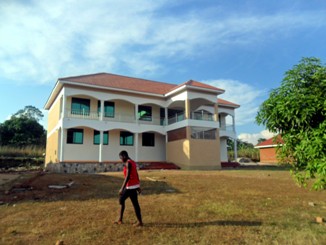 |
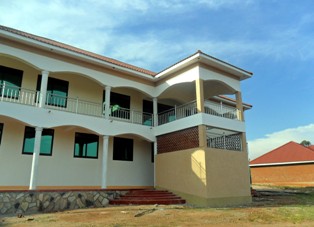 |
|
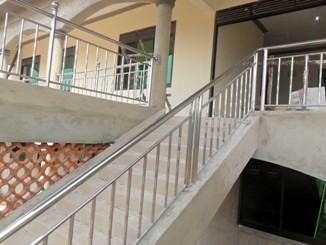 |
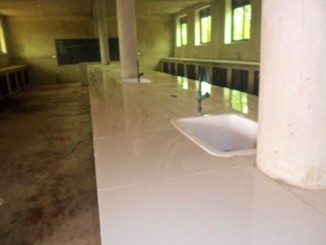 |
|
|
|
July 22, 2014:
Three Uganda Little
League teams expecting to play in European/Africa Regional Tournaments
stopped by Poland.
Uganda Little League held three tournaments in May with the expectation
that the winners would go on to the European/Africa Regional tournaments
held in Poland starting late June through the end of August. Seven
leagues came to the complex for the boys 11-12 year old tournament, six
leagues for the girls 11-12 year old tournament and four for the boys
13-14 year old tournament. The Allen V R Stanley Secondary school
managed to win all three tournaments. Little League headquarters in
Williamsport were notified of the names of the players for all winning
teams on May 22. On May 31, the teams applied for the Polish visas to
allow them to board a plane for Kutno, Poland. The 13-14 year old boys
were to leave on June 26, the boys 11-12 on July 9 and the girls on July
20. Two weeks lead time is the claimed lead time to obtain a visa
according to the Polish Government web site. According to that web site,
a school team going to Poland to participate in a sports event sponsored
by a not for profit would not have to pay visa fees. Also according to
all EU web sites, any group of people under 25 years of age traveling to
the EU for educational or cultural purposes would also be exempt from
visa fees.
All Uganda Little
League teams needed a passport, proof of age, birth certificate, letter
of invitation from a Polish program, proof that they were medically
insured while in Poland, airline reservations because the visas were
only good from the time you land in Poland until the time the plane
takes off. Since we were dealing with children, we would need notarized
statements signed by the parents giving permission to travel to Poland.
If that was done, then in the past, only the coaches would have to come
with all the paper work. New to us this year was that each person
requesting a visa had to do it electronically and print that application
out to bring to the embassy. In our case, we brought the actually
airline tickets that were fully paid for each traveler and photo copies
of everything for the embassy files. Also a letter from the Uganda
Commissioner of Sports supporting each teams travel to Poland to
represent Uganda, and a letter from the school headmaster.
Reality then struck
on May 31 when we filed electronically. When each person did this, they
were given a date to appear at the embassy for an interview. Three
players of the 13-14 year old team, of which we were applying first
because they were to leave on June 26, were told they needed to come to
the embassy in Nairobi Kenya on June 17. Nine others were told they
would need to appear on June 24 and the two coaches would need to appear
on June 26, the day they were supposed to fly out of Uganda. We tried to
call the embassy from Uganda on June 2 to explain that this was a team
and they refused to speak to us and hung up. We were told to follow the
rules. We notified Little League in Williamsport and Poland that there
was no way we were going to send three boys and then nine more on a 16
hour bus ride to Nairobi on their own and asked them to talk to the
embassy. In addition, we found that no buses would travel at night in
Kenya and the only buses available to take to Nairobi left Kampala,
Uganda midnight or 6AM. The embassy is only open on Tuesdays and
Thursdays.
Eventually, the
Embassy informed us through Little League in Poland to have the coaches
come on June 24, but we would have to bring the seven boys who were now
13 years of age because the EU requires anyone 13 and above to be
fingerprinted at the embassy. Thus nine people left Kampala on Sunday
night at midnight on June 22. Stayed at a hotel on the night of June 23
and appeared at the Polish Embassy in Nairobi, Kenya at 9AM on June 24.
I felt they would not be getting any visas because the embassy wanted
several days to process the visa applications, but maybe Little League
in Poland had spoken to them and we could get the visas in time to have
a coach fly back to Uganda from Kenya on June 26 in time to catch the
plane and meet the team going to Poland at the Entebbe Airport, since
this is what happened in 2012.
Results: Upon
arrival at the embassy, they were told no one would be getting visas as
the time was too short. No surprise. But what they were told next is
shocking. Little League Poland had sent their insurance policy that said
all the players and coaches would be covered medically. The embassy said
that wasn't good enough because it was not the original policy and that
we would have to get another policy from Uganda at a cost of $1200 per
team. In addition, they said that several of the notarized parent
consent forms were signed by only one parent. When told many of our
players come from single parent households, they insisted we had to have
a death certificate then, even though no death certificates are issued
in Uganda.
In Uganda, you
die, your neighbors dig a grave on your property and you are berried
within 24 hours. No medical examiner, no autopsy, and no official paper
work.
Also, even though we
presented the actual airline ticket for each traveler, the embassy
claimed that they did not believe that they were paid for. When does an
airline issue a ticket to a traveler when it has not been paid for.
These were the actual tickets, not E tickets. By the time the telephone
calls were finished it was too late for the nine travelers to get the
bus back to Uganda so they spent the night of June 24 in a hotel and did
not get back to Uganda until the morning of June 26. The seven children
missed four days of school for nothing.
Boys and girls 11-12
year old team coaches are told to appear at the Polish embassy in
Nairobi on the morning of July 1. The four coaches appear and present
all the paper work including two medical insurance policies issued in
Uganda covering potential medical expenses in Poland at a coat of $1200
each. Letters from the Local Chairmen indicating which of the players
come from single parent house holds. A letter from the head master of
the school also indicating which students come from single parent house
holds, and the airline tickets for each traveler for both teams. The
embassy tells the four coaches that all the paper work is in order and
the boy's visas can be picked up at the embassy on July 7 and the girl's
on July 15. But before you do that, you will need to send seven players
to be finger printed at the embassy the morning of July 3, even though
they are not 13. Evidently, the new rule at the Polish embassy is they
will be fingerprinted if they will turn 13 in the next 12 months. The
seven children are on put on the bus at midnight July 1 and are met in
Nairobi by one of the boy's coaches on the afternoon of July 2 and
brought to the embassy the morning of July 3, fingerprinted and put back
on the bus to Uganda and arrive in Uganda on July 4. Seven more students
miss three days of school.
Monday morning, July
7, the boys coach arrives at the embassy and all the visas have been
denied. But on July 1, the embassy demanded that everyone had to pay for
their visas, $80 each, even though according the two reasons, there
should have been no charge. The reason given by the embassy was the
embassy visa officer didn't think there would be enough money to pay for
the bus that would take them from the Warsaw airport to Kutno, where the
tournaments were to be held. This, in total disregard to statements by
Uganda Little League and Little League in Poland that all this was paid
for.
Tuesday morning,
July 15. The coach for the girls team comes to the embassy for their
visas. Also all denied. The reason, because the sponsor who put up the
$80,000 did not send a photo copy of his visa when the embassy sent him
an email on July 10 requesting the photo copy. When he sent an email
back indicating that sending a photo copy of a document like this is the
fastest way fraud and identity theft happens and asking did they want
the photo page or the pages that showed he had been to Warsaw a number
times, they sent back "Do not send it".
Obviously, Poland,
the European Union, or the embassy visa officer will never give a visa
to a team of Little League players because they are from Africa. Since
all of East Africa has to go through this embassy, African Little League
will never be allowed to compete in any Little League tournament since
every African Little League team has to play in Poland. Does this cover
all of Africa? My guess is yes, unless the Polish embassy in Kenya is
staffed with racists and their government doesn't know it.
When Little League
in Williamsport after all that happened above was asked if Africa could
host its own tournament separate from Europe, even if Uganda paid all
the expenses, we were told "That will not happen". In the recent
congress in early April, all the European countries participating in
Little League were asked if any would travel to a tournament in Africa,
they all indicated "NEVER!" due to the cost. Evidently, it is okay for
all the African countries to have to pay the $35,000 per team to go to
Europe to play in Little League tournaments, but now it is okay for all
African Little League programs to be excluded from all Little League
tournaments. Under the circumstances, by not breaking Africa away from
Europe, Little League just eliminated Africa from all its programs
despite what anyone at Little League International says.
October, 2014:
While the summer has
been a major disappointment for Uganda Little League, we will continue
to move on and a number of people are willing to help move forward. One
problem we are working on is the question of why the European Union, in
the form of the Polish Embassy in Nairobi, Kenya, denied all three teams
visas that would have allowed the Ugandan teams of 11-12 year old boys,
11-12 year old girls and 13-14 year boys a chance to participate in the
European/Africa regional tournaments this past July. In all three cases,
the three teams would have been favorites to win the Regional titles and
continued on to play in their respective World Series in August. Without
a doubt, they would have all been competitive because they all had the
pitching in speed and numbers and they all had the experience of hitting
against this speed. Would they have won their respective World Series?
That is hard to say, but with a little bit of luck, they certainly would
have had a chance. The 11-12 year old boys would have come with four
pitches throwing at 70 miles per hour and above with the ability to hit
that speed and curve balls. A huge improvement over the team that came
in 2012.
But that is
finished. We are now pursuing the visas for 2015 for all three teams. We
know that the local embassy will follow the rules and policy regarding
visas to Poland. Thus we know that no matter what we do, our teams will
be denied again unless we can change the policy regarding African Little
League teams. If we are not successful in doing this, then no African
team will ever be allowed to play in Little League tournaments so long
as Little League International forces every African team to play the
qualifying tournaments in Europe. Unfortunately, Little League
International has informed us that that will not change any time in the
future.
To over come that
problem, we are asking the Ugandan Foreign Minister to intercede with
the Polish equivalent of their Secretary of State to have the Polish
Embassy in Nairobi to grant the Ugandan Little League teams the visas.
We are asking Little League International to work with the U.S. State
Department to also intercede with their counterparts in the Polish
government to make sure the embassy in Nairobi does grant the visas
sometime in late May of 2015 that allows the Ugandan Little League teams
to travel to Poland for the June, July tournaments. We have assurances
that the Ugandan Government will work on this, but we are awaiting
assurance from Little League International at this moment. We expect it
to come shortly.
Secondary School
program and annual January Coaches Clinic:
Once again, we will
be operating our 6th annual two week January Coaches Clinic starting on
January 7, 2015. We expect a very large group of new coaches this year,
even though we want to limit it to only 60 trainees. On November 21, of
next month, we and the Ugandan Commissioner of Sports, will be meeting
with the Head Masters of eight Secondary Schools, (Two each in Apach,
Gulu, Lira and Soroti.) to get baseball programs running in each school
starting late January 2015. We will expect at least four teachers who
will become baseball coaches from each school to attend the Coaches
Clinic of January, if not more. We expect several coaches from several
relatively new programs for softball and baseball to be sending a number
of coaches as they want to expand the number of Little Leagues, plus
those existing leagues that are growing more than a few teams. We have
already promised two spots for new future coaches of a Little League
program in Rwanda.
In the secondary
program, we expect each secondary school having at least four teams at
each school composed of students at the S1-S2 level. They will expand in
a year or two as these players age into at least 4 more teams into S3-S4
level, and eventually to the S5-S6 level. The players will be trained on
catching, throwing, hitting, fielding and strategy during the daily
Physical Education classes of the normal school day. Each weekend will
see all four teams playing at least one game per week and annual
championships each year for the all star teams from each school. Our
goal is to get Uganda an invitation to participate in the preliminary
round of the World Baseball Classic in October or November of 2016 and
eventually represent Africa at the Tokyo Olympics in baseball and
softball. With what has been happening in the last two years and what we
expect in the next couple of years, I firmly believe Uganda will beat
any other African team in getting to the Olympics and eventually to the
World Baseball Classic.
Other events in
Uganda regarding baseball:
A group of Americans
based at the U.S. Embassy have decided that they wanted to have some fun
and begin to play baseball in Uganda. They expect to play games every
Saturday starting the beginning of November and running to mid December,
and then resume again late in January and play for several months of
Saturdays. They will have a team of Embassy players, another team of
Embassy players from Japan, and two adult teams made up of others,
mostly Ugandans, and two teams made up of our 13-14 year old Little
League students. This is the only way we can find competitive games for
our school players. The U.S. Embassy players feel this is a way to have
young players learn by watching. The rules are a little bit different as
you can have both a defensive team and an offensive team. These rules
are carefully spelled out in formal by laws and rules that have been
written up especially for this "FUN" league The adults will play for
fun, but we will play it straight. I am sure that the games we play
against the adults will become very competitive over time as I believe
the fun loving adults of the U.S. Embassy will want to show that the
kids are not that good. Certainly the two Ugandan teams will not want to
be beat by kids half their age and they will eventually play to win. I
do not how the team from Japan will react. If this becomes serious
baseball, it will certainly help the development of baseball in Uganda
and I expect it to lead to future media coverage over the years as the
interest grows and many more teams join and better quality of play
results.
December 2014
How do you talk
about what went on in Uganda during November? So many things have
happened, and all very positive. Let's start with the AVRS Secondary
School at the Uganda Little League complex.
The end of November
brings to a close our second year of operating the school. All of our
students in S1 and S2 had a wonderful year and all want to come back
next year. The new school year for 2015 will start with the students
reporting back to the school on Sunday, January 25. We have over 100
athletically qualified applicants for the new S1 class as the current S1
moves to S2 and the current S2 moves up to S3. The final selection
process for the new S1 class will be based upon a combination of
athletic ability and academic evaluation and the willingness to work
hard at learning sports and academics. The reputation of the school just
continues to grow and I believe it is just beginning. We will be opening
our new classroom block with the new school year that impresses everyone
who visits the complex. It is just the latest large structure to open at
the complex and it will be joined by the complete paving of the road on
the complex grounds. This is necessary for the students to be able to
travel on a smooth surface from their dorms, eating area and
administrative building to the new classrooms without having to touch
any surface other than a paved surface.
Athletically, the
school teams have proven that they are the best baseball and softball
teams in the country regardless of age. This was proven in two ways. In
mid October, the annual Independence Tournament for Baseball and
Softball was held in Lugazi. It is for teams of age 15 and below. The
AVRS girls absolutely destroyed the opposition. The games were not even
close after the first inning and thus they walked away with the title,
even though this will be the team that will hopefully travel to Poland,
if visas are given, to play in the girls 11-12 year old Little League
Regional Tournament. Yes they will all be considered 12 years old as
none will be 13 before January of next year.
The boys were a
little different. Having to play all the games in one day, they wound up
winning all three 7 inning games played easily. The team that the head
of the Federation brought to play had at least several players that were
17 years old or above. We know that because a number of these players
the coach brought to Poland to play in the 2008 Little League tournament
as 11 or 12 year olds. Add six and one half years to 11 and you get 17
plus, even though the tournament was supposed to only be for 15 year
olds. Rules do not apply to him and that is why the U.S. embassy has
banned him from ever being a part of Little League Baseball in Uganda.
It didn't matter to us as they were eliminated by us and Lugazi early.
We played Lugazi for the championship and won easily, even though we
used two pitchers per game and a total of 6 pitchers as we do not allow
any of our pitchers to pitch more than half a game at a time and only
twice per week. They are all very young and we do not want to see any of
them hurt.
Another measure of
the AVRS player's ability is the results of the League that members of
the U.S. Embassy started playing on Saturdays in November. Starting
November 1, we played on four Saturdays and we entered two teams in the
league to bring the total up to 6 teams with three games being played
every Saturday. Our two teams consisted of 12 and 13 year olds who will
be now turning 13 and 14 respectively. The other four teams were of the
U.S. Embassy staff and Marines, the people of the Embassy of Japan and
two adult Ugandan teams that were supposed to be the best of Uganda.
After the first week, the team of Japan quit when they saw the quality
of play of the two teams from the AVRS School. The two adult Ugandan
men's teams did not show up for the last games scheduled for November 22
against the two AVRS school teams after they failed to come close to
beating them during the games of the first three weeks. Therefore, the
only game played on the 22nd was against the U.S. Embassy team and to
make it even, the AVRS team supplied the pitching for the Embassy and
AVRS teams. During the week end of November 15-16, we played to two
adult Uganda teams and three games on Sunday against a team consisting
of adults and under 15 year old players from Lugazi. Thus we used 10
pitchers over the five games and won them all.
Other major events
of the month involved the meeting in Lira between the leaders of the
Uganda Little League and the Head Masters of several Secondary schools
that are located where we have existing and successful Little League
programs in operation. We had two secondary schools from Surotie, one
each from Gulu and Lira. All have good playing surfaces and will be
starting at least four teams playing baseball at the S1-S2 level
starting when the new school year starts in late January. The existing
Little League programs will now be able to feed its older players into
these schools The baseball players will be trained during the school day
at Physical Education classes that hopefully will be their last class of
the day. By doing this, they will have the ability to extend the school
day by playing games or extensive practices after school normally ends.
They are all boarding schools and are committed to have all four of
their teams playing at least one game every weekend, in addition to what
they do during the week. Uganda Little League, from donated equipment,
will keep them supplied with baseball equipment to get their leagues
going and to expand over the next year or so to four more teams playing
at the S3-S4 level and eventually four more at the S5-S6 level. In
addition, they have selected the week of August 17 to participate in the
First Annual National Championship All Star tournament that will be held
at the Uganda Little League complex. It is expected the Uganda Sports
Commissioner will be covering their travel expenses for this annual
tournament, as we were informed that his office will be receiving
substantial financial support from the government to enhance youth sport
programs. This fits right into what the government now recognizes as a
major goal.
This tournament will
consist of six teams as this is written. The tournament will be for
S1-S2 school programs only. The four schools mentioned above, the AVRS
school team and another Secondary School from the north western part of
Uganda. During our January two week Coaches clinic, all five of these
schools will be sending at least four members each to learn how to coach
baseball. Our coaches clinic will start with everyone arriving on the
afternoon of January 7. It is by invitation only. All the names must be
submitted to the AVRS Coaching staff by December 15. Anyone who comes to
the complex without being invited will be turned away. Our goal is to
have about 60 coaches that will be broken up into four groups of 15 or
so. Any more, becomes difficult to handle because everyone who comes
participates actively in all the elements of the program. We do expect
several visitors from the U.S. and Canada to assist at the clinic.
Anther significant event took place during November at the complex. Dr.
Yusufu Mpairwe and Dani Kireju visited the complex. They are two of the
Uganda board members of the Uganda Cancer Clinic. They came to see what
is happening at the complex. With the new construction, the Cancer
Clinic is being offered two large rooms of 600 square feet each from
which to operate. They were also informed that we have the opportunity
to be part of the Clinical Trial for the new cancer breast imaging
device and were advised of its future. The question they needed to
answer was "Will they be willing to be part of the companies clinical
trial?" They answered in the affirmative and will now be looking for two
things. One will be for a very experienced and skilled Radiologist and
the other is to make sure that the rules of the Ministry of Health are
complied with and to make sure the clinical trial will be successful.
This is the first part of what will become a major advance for the women
of Uganda in regard to breast cancer.
February 2015
The past two months
continued to be eventful for Uganda Little League Baseball. In December,
we attended the Winter meetings of Professional Baseball in San Diego
and had the opportunity to be present for the evaluation of the RBI
players from the area at San Diego State U. We had an opportunity to
interact with a number of scouts from MLB and other teams as they put
the players through the various tests. While the players we saw ranged
in age from 14 to 18, the players in Uganda would have matched up very
well with them, even though the Ugandan players are no older than 14.
When the various scouts were shown the numbers for the AVRS kids in time
for 60 yards and pitching speed, the comments from the scouts was "We
know. Just keep going." Most want to see the AVRS players, but cannot
make it to Uganda. We hope to solve that problem soon by bringing them
to the U.S. as part of the RBI program.
During the meetings,
we managed to share the numbers regarding running and pitching speeds
with Uganda Little League's friends amongst the Detroit Tigers, LA
Dodgers, N.Y. Yankees and Arizona Diamondbacks. All are very interested
in the progress we are making and looking forward to the near future and
the expansion of baseball into the Uganda Secondary Schools in 2015.
They are most impressed by the running speeds as at least 4 run 60 yards
in under 7.0 seconds and several are throwing in the high 70s.
In January, we ran our annual two week coaches clinic at the Little
League Complex. We tried to cap the number of coaches at 65 so that they
could be broken up into four groups. With the help of Ed from Canada
returning for his fourth year, Harry of NJ returning for his third year,
and Evan who has come over to teach American English at the AVRS school
for this and possibly a number of future years, we ran a very successful
program. We start with breakfast at 8:00am, followed by one hour
classroom type instruction at 9:00am. We then go on the field for two
hours, have lunch at 12:30pm, then back on the field at 2:00pm to watch
or partake in a baseball game as coaches or umpires, then have the teams
play a game using tennis balls from 4:30pm to 6:00pm. Each of the teams
play 6 games in the first week and 5 games in the second week. Break for
dinner at 6:30pm and watch actual games played by Uganda at the Little
League World Series in 2012 and the St. Louis-Texas World Series games
from 7:00pm to 9:30pm. The seventh day of the program is a free day, and
the clinic ends with the winner of the first week afternoon tournament
games playing the winner of the second weeks games on the morning of the
last day before everyone goes home after lunch with the baseball
equipment they need to run their programs. This year we gave out over
200 gloves, 40 dozen baseballs, 30 dozen softballs, 100 bats, 80 helmets
and at least 16 sets of catcher's equipment.
This year we had
three visitors from Rwanda who were to go back and advise their
government on getting baseball and softball started in Rwanda supported
by the government. One was a teacher and the other two were paid
consultants to the government. They expect to get the program started
this month in the primary schools and also in the secondary schools with
government support. That means the national governments in Kenya and
Rwanda are putting money into their baseball programs. We hope that
Uganda will soon follow suit. The Ugandan government will get their
opportunity this year as at least 6 secondary schools will be starting
play with each having four teams at the S1 and S2 level playing this
year and expecting to play for the National Championship during the
third week of August at the Little League Complex. Each of these schools
sent teachers to learn how to play, coach and umpire baseball and
softball. They are expecting the government to cover their travel costs
to the National Championships in August. In a year or two, they expect
each school to expand to four more teams at the S3 and S4 level, and
eventually to the S5-S6 level. This is what Major League Baseball is
looking for because it will mean about 250 or more players turning 16
years of age each year with significant baseball experience.
On January 26, the AVRS Secondary School started its new school year
with the admission of its third class of 20 boys and 20 girls. We know
they can all run, but we now will turn them into ball players and soccer
players. With the girls, we start them playing the same way as we teach
the new coaches at the clinic, and that is by throwing tennis balls so
they learn to catch properly with two hands and throw accurately without
needing gloves or getting hurt. We then have them play "T" ball with the
tennis balls and over the course of the week, move them up to softballs
and gloves.
We are now
constructing two basketball courts and two volley ball courts, one for
girls with a 7ft net and one for boys with an 8 foot net. They are next
to the new classroom building bloc so that the security lights on the
building light the volley ball courts. They are expected to be completed
by early March. The new classroom bloc has six classrooms of 600 square
feet each and one double room for video and DVD showings of 1200 square
feet. Since this school year, we will only need three classrooms, we
will be able to turn two of the rooms at the end of the building over to
our breast cancer program. All these rooms are naturally lit with clear
plastic roof panels and are also equipped with solar lights for work
after dark. Obviously new benches have been installed in the three
classrooms.
Early in January, the Uganda Cancer Clinic people met with a prominent
Radiologist and a Uganda Health Commissioner to review the protocol that
has been presented to us called an "Out come study." The meeting
generated a work schedule so that the study would actually happen which
is tentatively scheduled to start around September of this year. It was
agreed that we could follow everything in the protocol, but we would
need to get a digital mammogram into Uganda as none currently exists in
the country. We believe that one can be donated based upon a promise of
a couple of years ago. All the work would be done at the complex and it
would be done in a rather unusual way to collect the women needed for
the study. Now we need to raise the money to cover the cost of the
study. The paperwork required by the Ugandan Government is now being
done and should be done in the next two months, and we are working on
the digital mammogram. Our next meeting should take place in March where
we will establish the number of people needed and come up with an
approximate budget.
Breast Cancer:
Our hopes to build
our Breast Cancer Clinic later this year has failed to raise the funds
in time for us to become part of the three year clinical trial program.
We have not given up on the fund raising. We are still planning to get
it done. The property is there, the utilities are at the location, the
only thing we need is to raise the one million dollars to build the
clinic, purchase the 3D ultra sound instruments and tie us into the
cable so the images will be able to be read anywhere in the world.
CIVUS is going ahead with the clinical trial which is expected to
eliminate 80% of the biopsies that prove benign and catch the earliest
development of breast cancer.. The clinic trial will prove that this
procedure is far superior to any mammogram, unfortunately, we will not
be part of it at this moment.
April 2015
Many things are
happening at the Little League Complex and here in the U.S. that has a
direct affect upon the Little League Complex and the program. The first
thing I would like everyone to do is to make sure you visit the photo
section of this web site and look at the two major buildings that opened
up in January 2014 and January 2015. This is just part of what is
happening physically at the complex. What is not shown yet is the
basketball courts that have just been finished along with net ball and
the two volley ball courts that are currently in the process and will be
done before mid April. Ironically, we are having problems in Uganda
finding nets for the baskets. If we cannot find any in Uganda by the end
of April, I will bring 3 pairs with me in early May when I travel to
assist in running the Little League Baseball and softball tournaments.
The boys 11-12 boys and the 13-14 boys will be played starting on May 8.
We expect 8 teams for the younger boys to be competing and 4 for the
older boys. We will house and feed them all at the same time for the 6
days they will be at the complex. We expect that next year, we may be
housing as many as 16 teams. Following the boys tournament, the 8 teams
of 11-12 year old girls will be coming to the complex for their
tournament. We are working to send three teams to the Little League
Regional Tournament in Kutno Poland during the month of July. Our major
problem is getting the visas to travel to Poland. Last year, the Polish
Embassy did everything possible and beyond to make sure no visas were
issued. This year, we are going to start the process before the end of
May so that we can battle every problem they can think of to deny the
visas in an attempt to overcome them.
Should all three
teams travel to Kutno, Poland this July, we feel that each team has an
excellent chance of winning and coming to their respective World Series
in August. The girls would be in Portland Oregon I believe, the older
boys in Taylor Michigan and the younger ones in Williamsport. But in
baseball, as in most sports, the best teams do not always win, but we
will do our best.
During our
tournaments, we will be playing at least 4 games for the younger boys
and the girls every day of their tournaments. No one wants to sit
around. For the older boys, we only have 4 teams, each team will play at
least one game per day. With our two full size fields, it would have
been easy to play 4 games per day also. We will probably play a double
elimination tournament, but even if a team is eliminated, they come to
the complex to play and every one will be playing every day, except the
last day when the championship games will be played in the morning when
everyone will leave after lunch on those days. If your team is
eliminated in the first two days, you will still be playing on day 3 and
day 4.
In regard to the
school, the first semester of the three semester year is about to end in
two more weeks. We brought in a new science teacher and have set up the
biology and chemistry labs with all kinds of equipment. We have with us
a volunteer American Teacher teaching English to our third year students
so they can become used to American English in their talking and
writing. He is also heavily involved in teaching and coaching the boys
baseball and the girls softball. We are very fortunate that he seems to
be enjoying what he is doing and we hope he stays with us for a number
of years. We have expanded our library by down loading as many as 95
classic litature books from the Internet on to a flash drive. Now each
and every student can down load any book they want to read, or have to
read onto their tablet. How the world has changed. We will be bringing
over copies of some recent New York State Regents exams in math, science
and world history and geography that our teachers might use to make sure
our students come up to or above the standards demanded to obtain a New
York State Regents Diploma. While they probably could be down loaded in
Uganda, these will be hard copies that the teachers can use as a tool.
We have witnessed
the start up of baseball programs that consist of several teams at about
8 schools that we know of this spring. Each program consists of 4 teams
or more at each school with each team playing at least one game or more
per week while school is in session. The schools expect to bring their
respective All Star teams to the complex during the third week of August
to play for the National Championship. Within a year or two, we will
bring the program from the current S1-S2 level to add an S3-S4 level,
and eventually to the S5-S6 level, with each participating in their own
National Championship Tournament. As more and more baseball players are
approaching 16 with experience, we expect to see the Major League Scouts
coming to Uganda. When the first Ugandan is signed to a professional
contract or receives a full scholarship to an American University to
play baseball, we will know that we are beginning to accomplish one of
our goals.
BREAST CANCER
OUTCOME STUDY
As everyone is probably aware of, we have been trying to start up our
program to assist in diagnosing and treating breast cancer in the women
living in the area of the Uganda Little League Complex. We now have a
large area to operate in (2000 square feet) with utilities and security.
We have what will be the first digital mammogram instrument in Uganda
being donated to the program. It will arrive any month we suggest after
May 31. We are in the process of who and where the technicians will be
trained to operate it. Two of our American Directors have a series of
meetings with potential donors this coming week. We hope that will give
us the money to get the program operating fully for the next couple of
years or longer. We are ready to go with the right people in Uganda to
make it happen, we have the FDA approved Out Come Study Protocol, now we
just need the money to get the new breast imaging instrument into Uganda
along with the Mammogram instrument and get everyone trained and get the
program going. It is our hope that this will be the prototype for all of
Africa within the next two years and go a long way to greatly reduce the
incidence of breast cancer that leads to unnecessary biopsies, breast
removal, early death and all the other cultural problems that breast
cancer can lead to in the African Community for afflicted women.
June 2015:
Once again, May and June
have been very busy at the Uganda Little League Complex. As most of you may
know from the Facebook on Uganda Little League, we held three tournaments at
the complex in the beginning of May. The first ones took place on May 9 thru
May 13 for boys 11-12 and for boys 13-14. The 11-12 year old tournament
hosted 8 teams and had several teams turned back by failing to win in
preliminary games that for the first time were used to keep the number of
tournament teams to eight. At the same time, we hosted the 13-14 year old
tournament for four teams. The younger boys tournament was a double
elimination tournament, but even though two teams were eliminated after two
days of play, they still continued to play a game for the next two days as
the purpose of the tournament was to have everyone play a game a day. The
games were played at 10AM and at 2PM on field 1 and field 2.
At the same time, the older boys tournament was being played on field 3 with
a game at 10 and one at 2PM. In this tournament everyone played everyone and
then played single elimination. Thus, every day, we had three games being
played at the same time. Three in the morning and three in the afternoon.
Fortunately, we had enough umpires to cover all the games, with four on both
championship games on the last day of the tournaments. Teams came from the
far north, Gulu and Arura, the East from Jinja and Lugazi and the Kampala
area and slightly west of the complex. In both tournaments, the championship
game came down to Lugazi and AVRS School. In the first case, Lugazi had to
work its way out of the loser bracket which they managed to do and to put up
a competitive game in the championship game by carefully handling their
pitching staff constrained by the Little League pitch rules. On two days, we
had heavy rain. On the first day, the rain ended by 8AM and all the fields
were playable by late morning. On the championship day, the rain stayed with
us until 10:30AM, but the fields drained well and since Lugazi did not have
that far to travel to get home, both games were played at 2PM. Some of the
more distant schools had to leave in the morning because they had 8 to 12
hour bus rides facing them in order to get home.
On the day the boys were going home, the girls were arriving to play their
tournament that started on May 14 and ended on May 18. We had to move it up
because some schools were starting classes on May 17, but the boys
tournament prevented us from moving it up any more than we did. Once again,
we had eight teams involved in a double elimination tournament, but as in
the earlier tournament, every team played games every day. The championship
game was once again between Lugazi and AVRS with Lugazi coming out of the
Loser Bracket again for the right to play in the championship game. This
time, there were no rain delays during the five days of this tournament, and
it was again won by AVRS School. In the three tournaments, AVRS won all
their games and are now proceeding on to getting visas to play in the
Europe/Africa tournaments in Kutno, Poland in July.
Our visa experience keeps getting bigger and bigger. This year, we were told
that we should meet with the Polish Council in Kampala, which we finally did
get a chance to set up a meeting with him. We went to what we were told was
his office to find that he was the Uganda Minister for Water and the
Environment and that the office had moved to another location outside of
Kampala. We could not find him via his telephone and his office told us he
was in a meeting somewhere in Kampala. With no where to go, all our coaches
and school administrators sat at the Serena Hotel while we tried to locate
him. As we were about to give up and head back to the Complex, we get
notified that he would meet us at the Hotel in about 10 minutes. He was true
to his word of arriving in 10 minutes, but that was already 90 minutes after
the scheduled time. But this is Uganda. In any event, we showed him all our
documents, including the invitation letter, visa application forms and
notarized parent consent forms, and 303 Development Foundation Financial
statements. He liked what he saw and said he would write a recommendation
letter for the three teams to get visas. We asked if he could arrange a
meeting for the teams in Nairobi, but he couldn't. He could not tell us if
we would need additional medical insurance over and above what Little League
in Poland would provide. He told us it was not up to him, but the visa
officer in Nairobi. Not much was accomplished other than a letter of
recommendation.
In any event, for everyone's information, the parent consent form and the
visa application form which must be obtain electronically, must be signed by
all parents or guardians. Since our students come from all over Uganda, that
means sending them all home to get these signatures. For some, that is a 10
hour bus ride each way. But it has to be done by all 36 players. Then the
consent forms have to notarized by a lawyer at considerable cost. Medical
insurance has to obtained to show that each traveler is covered up to 30,000
euros in case of an accident. Also at considerable cost. Then letters have
to be written by the school administrators and then proof that there is
significant money available to permit these teams to have it in Poland, over
and above the travel, feeding and boarding costs. That is where the
financial statement of 303 Development Foundation Corp and a letter from its
president had to be duplicated for the Polish Embassy. Once we get an
appointment for the team, we have to get them on a bus for the 16 hour bus
ride to Nairobi to have everyone finger printed. They do not keep these
records supposedly, and everyone needs to fingerprinted at the embassy every
time you apply for a visa. That forces each team to miss 4 days of school.
Is the cost and time worth it? At the moment, the 11-12 year old boys have
their visas, and the 13-14 year boys hope to have their on Tuesday of next
week in time to make their scheduled plane departure of June 27.
In regard to the school, we now have brand new basketball courts with six
baskets and three volley ball courts. As a result, we are now training our
students in basketball and volley ball. Once again, our goal is to produce
school teams that will win in National Competition. Our next project is the
building of an arena with seating for about 1500 spectators for indoor
basketball, volley ball, net ball and even badminton tournaments. The area
is going to be built with the help of the President of the Uganda Basketball
Federation. He wants it to be the best in Uganda so the complex can be used
for International events and for the training site for National basketball
teams. In addition, starting next May, the AVRS school will be participating
in the NBA Junior league for both boys and girls basketball for Secondary
Schools. It will be one of the best and is scheduled to begin construction
early in October with a late January, early February 2016 completion date.
The Uganda Commissioner of Sports wants the complex to host all the National
Sports Tournaments in the very near future as he knows our goal is to
produce the best sport facilities in the country where competitors can be
housed and fed. This area will also serve as a theater and place to hold
significant events, including parties and dances.
Europe/Africa Little League Regional Tournaments.
Boys 13-14 July 2 thru the 9th at Kutno
Poland World Series at
Taylor, Mich. August 16 thru 23
Boys 11-12 July 16 thru the 23rd at Kutno Poland
World Series at
Williamsport, Pa August 20 thru 30
Girls 11-12 July 27 thru 31 at Kutno Poland
World Series at
Portland, Org. August 13 thru 19
July 2015 Headlines.
Stories follow:
● Uganda sends three teams
to Kutno, Poland to compete in the Europe/Africa Regional Tournament. The 13-14
year old boys lose in the final Championship game to Czech Republic, even though
in everyone's mind, they are clearly the most talented team of the 10 competing.
● Uganda 11-12 year old boys will be returning to the Little League World
Series with their first game scheduled for August 20 at noon. Strongest team
Europe has ever sent to the World Series in most peoples opinion. May do
some serious damage in Williamsport.
● Uganda 11-12 year old girls become the first girls team to ever make it to
a Little League World Series as they beat Italy in the Championship game.
Uganda coach suspended for two games when all our subs play three innings,
but one does not bat because we are the home team and we do not get up in
the 6th inning. Under little league rules, 5.5 innings is a complete 6
inning game. If she allowed the team to score another run, the losing team
would not have gotten up in the 6th inning but been embarrassed by the
score, three of our players would only play one and one half innings, but
our coach would not have been suspended and possibly assaulted as happened
to the boys coach in their championship game..
● Crazy things happen in all three tournaments and some of the things will
lead to significant changes and one mostly certainly should.
The winning boys team romped through the 14 team tournament undefeated. Made
many friends, but some unhappy losers. In Little League, they have a mercy
rule which if a team is ahead by 10 or more runs, the game is over after the
losing team bats four times at the 11-12 level, and 5 times at older levels.
Uganda mercy ruled every team it played but one. It entered the tournament
with a lot of very good pitching, speed, good hitting and excellent fielding
and demonstrated that in every game but one, where the opponent had an
excellent pitcher, that being Italy, which they faced in the game featuring
the last two undefeated teams in the tournament with the loser having to
come out of the loser bracket and beat the winner twice on the final day in
order to win the tournament. Every other game ended via mercy rule after
less than 4 innings. Italy removed it star pitcher with the score 0-0 after
3 innings after reaching 50 pitches to save him for the Championship game in
three days. Uganda, in the fourth inning hit a two run home run and in the
fifth a three run home run and won 4-0 on a no hitter. A walk being the only
blemish. How does a three run home run and a two run home run total 4 you
may ask, but it did because this is what happened in the 5th inning. Runners
on second and third with no outs, and the batter hits it over the fence,
which results in two runs and one out. It seems the runner on third base
decided to wait to touch home so he could shake hands with the batter and
had the runner on second touch home before him. One out for passing a runner
and only two runs. The rest of the story continues as Spain beats Italy in
the game to get the winner to play against Uganda. The best pitcher doesn't
pitch and Uganda faces Spain for the championship. After Uganda is ahead 10
to nothing, the Spanish coach, instead of stopping at the third base
coaching box heads for the Uganda dugout to assault the Uganda coach because
our kids were still running and he did not like it, especially after we hit
three consecutive home runs in the inning. Fortunately, the umpires stopped
him and the game ended at 16-0.
The winning girls team has a related story to the winning boys. In girl's
play, a pitcher can only pitch in one game per day and since there were only
five countries represented, each team had to play four games in three days
with the top two teams playing for the Championship on the fourth day. On
the first day, Uganda played Poland and won by mercy rule where in the first
inning, the umpires were using common sense umpiring to get the game over
with That means the strike zone for Uganda greatly expands, and any
opportunity to get an out is taken advantage of. In any event, the favorites
were Czech to repeat as they were last year's winners, Italy who had won for
several years before, and the Netherlands who probably have one of the best
club programs in Europe. On day one, Czech had to play Italy in their
morning game and the Netherlands in the afternoon game. What was probably
the best pitcher in the tournament was used by them to beat Italy. Against
the Netherlands, they lost by a score of 13-0 because of pitching weakness.
On day two, Uganda
played the Netherlands in the morning and faced their best pitcher, and then
played Czech in the afternoon. The score after three innings of the morning
game is 9-0 in favor of Uganda. Since all our players play at least half of
the game, the manager put in the three subs to play the last three innings.
But now it is time to get the game over with before the score gets worse.
With Uganda the home team, only 8 batters get up in the fourth and fifth
innings and since we are the home team, the game ends after the top of the
sixth inning. Because one of the subs would be the lead off batter in the
bottom of the 6th inning that did not happen, the manager is pulled away 30
minutes before the start of the 1PM game against the Czech and never to
return and Uganda is not notified that she is suspended until we ask the
umpires not to start the game 10 minutes early until our coach comes back.
We then find out that a guard is assigned to her to make sure she does not
get within 600 feet of the playing fields for Uganda's next two games. The
Czech is a well played game going into the 5th inning at 0-0. Uganda wins
2-1 in six innings, defeating the tourney's best pitcher, and goes on to win
the Championship game against Italy to become the first African Girls
Softball team to make it to the Softball World Series.
The faiths were against the Ugandan 13-14 year old team. Clearly the best
team at the 10 team tournament, as they scored more runs than anyone,
allowed fewer runs, stole many bases without anyone being thrown out and
never allowing any one to steal a base and picking off two runners. Mercy
ruled every team played, including the eventually winning Czech team. Why
aren't they champions, because of spotty defensive play and a strange umpire
call. Czech and Uganda were the last two undefeated teams in the 10 team
tournament and met in an afternoon game scheduled for 1PM. The morning game
went long and the ground crew was still fixing the field during what our
manager thought was our infield time, as the visiting team, and thus thought
he was not allowed after his normal time had expired during the field
fixing. Winning 5-3 in the sixth inning, a couple of bad errors and other
problems led to bases loaded and a 5-4 score with two out. A hard hit ground
ball to our third baseman causes the ball to bounce off his throwing hand,
which he then picks up, takes a long time to finally throw to first and by
the time he does, the runner is safe and the score is tied. He now lies in
pain on the grass and is medically attended to. After about 5 minutes, he
sits up and tells the coach he is fine. The coach lets him stay in the game
without a test throw. Needless to say, the next batter hits a routine
grounder to the third baseman, who, with plenty of time makes a throw to
first that should end the inning with the game tied. Unfortunately, the
throw sails at least 15 feet over the first baseman's head that brings in
two more runs and that is the last throw he makes the rest of tournament as
he eventually winds up at the hospital and a heavily taped hand. He is our
number three pitcher. We then go to the losers bracket to mercy rule Italy
again and then mercy rule Czech the next morning by 10-0.
That forces the final
game to be played for the championship that afternoon at 4PM. Once again, we
are the visiting team in the afternoon. It rains from about 12;30 to about
3. All the fields are muddy and the grounds crew works to get the main field
playable which is done about 3:40. As the visiting team again, we are
supposed to be first for infield practice, but our other inexperience
tournament coach is told by the umpire to hurry up as they want to start the
game on time. He immediately pulls the team off after about 1 minute. The
Czech team ignores the umpire's request and takes their normal infield
practice time. Winning 2-0 in the third inning, bad plays by second base and
shortstop bring the score to 2-2 with two outs and the bases loaded. This
time a ground ball to the shortstops right gives him the opportunity to make
a short flip to an unsuspecting third baseman who is not on the base and
also drops the ball as the score goes to 3-2 against Uganda. In the top of
the 6th, using our speed, we tie the score at 3-3. Then due to pitch counts
Uganda is now forced to bring in our number 5 pitcher as 4 pitched the day
before and 1 and 2 pitched today, and 3 is hurt. He gets the first two outs
easily, but the next batter singles. He then hits the next batter and walks
the following on 4 pitches. Now comes the strange umpire call. The next
batter, who has already struck out twice in this game, with an 0-2 count
then falls across home plate and gets hit in the upper back with a ball that
was about knee high. He lies across home plate for several minutes with his
head in the other batters box in obvious pain. Our pitcher wants to know how
he can do that. The umpire then awards him first base to force in the go
ahead run. A wild pitch follows and then a two run single and we lose 7-3.
The writer of this piece was supposed to be a coach for all three teams to
assist our inexperienced coaches who had never been to this type of a
tournament. Two weeks before the start of the first game, he is told he is
not allowed to be the coach, cannot eat with the players or stay in the
dorms. He must find and pay for his own hotel room and meals. Why. It seams
the reason, according to the Little League Rule book is that if you run a
tournament, which I have been doing every year since 2004, you cannot coach
a tournament team. The same goes for league presidents, or country
directors. I must now resign from all three of these positions. Since not a
single Ugandan parent ever comes to see any of our tournament games, this
may now result in some serious problems for Uganda Little League. My job as
always has been to coach the kids and to coach the coaches and umpires so
baseball and softball can flourish in Uganda for the benefit of the
children. Time will tell. All our people interested in the sport want to be
coaches, not administrators.
September 2015:
We have come through a
very eventful June, July and August and now things are beginning to settle
down at the school in Uganda as the students are all returning for the third
and final semester of this year. June saw 36 students travel to Nairobi,
Kenya to apply for their visas to Poland and get finger printed, basically
losing a week of school. Then those same students traveled to Poland in
July, losing two weeks of school, and then two thirds of them traveled to
the U.S. in August, but still missing the last days of the second term. It
is expected that this term will be much more normal as all students should
be at school for all the days of the semester.
August became quite an experience for many people besides the players that
managed to travel to the U.S. to participate in their respective
tournaments. There are many adults at the school, at Little League
International and the U.S. Embassy in Uganda that would not like to go
through what happened a second time. The kids had a great time in Portland,
Oregon for the girls and Williamsport, Pa for the boys and everyone learned
a lot. I think everyone would like to see some changes made in the timing of
July events and August events, but I doubt that they will be able to be
made. The real solution would be to give Africa its own regional tournament
with the winner going to the respective World Series in the U.S.
Unfortunately, Little League International will not let it happen now.
The problems regard
timing of European Tournaments and travel and U.S. visa timing. The girls
did not get home from Poland until the evening of August 3. On August 4,
they paid the $4500 payment for the 28 US visas required so that they could
make the next day appointment at the U.S. embassy that the players and their
parents and the coaches had to attend for the visa interview. The U.S.
embassy told everyone that they would get the visas but they would not get
their passports back until August 12, but the girls had to leave Uganda on
August 10. Little League International would not authorize it's travel
agency to purchase the airline tickets for either team until they were sure
the passports with the visas were in the hands of the teams. The U.S.
Embassy visa section claimed they were over worked and never want to see
this happen again. Finally, they did return the passports on Monday
afternoon, August 10, and only then did the travel agency begin to look to
book flights for 15 people to get the softball team to Portland, Oregon in
time for Tuesday afternoon, with opening ceremonies scheduled for Wednesday.
Those tickets did not materialize until 6:30PM Uganda time on August 10 with
the coaches now notified you have less than three hours to get your team
together and to the airport when the travel time from the school to the
airport is about 2 hours when there is no traffic.
The Managing Director of
the school is also the head softball coach of the school and she had to get
to the school and get the bus to take them to the airport. Upon arrival at
the airport, they found there was no ticket for one of the coaches.
Fortunately, she had significant dollars on her that she had intended to use
to purchase things for the girls in Portland that he now had to use to
purchase the ticket for the coach. Fortunately, I was to meet the team in
Portland and I had booked a motel room for myself and rented a car and had a
charge card with me. While the girls had a wonderful time in Portland, and
made many friends amongst the players and spectators, they were starving.
These are not American girls. They do many athletic activities, which they
enjoy, but they also eat. What was being served for meals with no seconds
was barely an appetizer for them. Since they were staying in a hotel with
each room having a small refrigerator and micro wave oven, we could do
certain things to supplement their meals, such as pizzas, frozen microwave
able meals, chicken pieces and lots of soda that I was able to purchase at
super markets and at Domino's pizza, and bring these items to the hotel with
my rented car. The girls went to the zoo when some one arranged for their
transport. A Portland family brought them to their home for a very extensive
barbeque, But then problems surfaced as the head of the neurology department
at the University Hospital invited them for a tour and a lunch.
Unfortunately, at the time of the lunch, they were supposed to at the
airport, that due to miss communication, they were not aware of and thus
missed their plane. Again the new adult friends took care of them for
sleeping, feeding and getting them to the airport the next day. They were
very generous and adapted the head coach as their daughter.
The boys only found out that they were going to be traveling early on
Thursday morning from Uganda on Tuesday morning and thanks to the Managing
Director, were able to arrange for their travel to leave the complex before
3 AM to get to the airport on time. Once again, they were confronted with no
ticket for one of the coaches. This time, Allen was not there with dollars
as she was in Portland, Oregon. The coach now had to travel back to the
complex and I arranged for him to fly on Sunday where I would meet him in
New York and bring him to Williamsport on Monday. The boys, because of no
seats on such a late date, had to fly south to South Africa, sit there for
12 hours and then fly to New York where a bus took them to Williamsport.
From the time they left the complex to the time they arrived in New York,
what should have been about 20 hours became 33 hours, again sitting in South
Africa for 12 hours with no dollars or Euros to purchase things to eat or
drink. Coming through Europe, the between plane stay would have been 2 hours
or less and no need to purchase food or water. Going back was the same
route.
The last time an Ugandan team came here was 2012. We were able to bring them
to Trenton, N.J. to play against a West Windsor Little League team and then
go to a Trenton Thunder game in the evening. Unfortunately, that Little
League game was rained out and we wanted this team to come and play the game
this year. In 2012, they also played a game north of Philadelphia, went to a
Phillies game, then to Yankee Stadium for a Yankee game and then with the
North American Ugandan Society hosting them, to the United Nations for a
tour of the General Assembly and Security Council and a visit to Major
League Baseball's Offices. Due to the lack of our input into the scheduling,
we had to pay $2400 to change the airline ticket to delay their departure so
they could once again come to Trenton to finally play that game. The West
Windsor Little League has been one of our equipment donors and you can see
West Windsor Shirts on some of the players on the web site pictures taken at
the school in Uganda.
Several years ago, we had said we wanted to get the Ugandan teams to the
Little League World Series, but not only to get there, but to win. While we
did not win the World Series, we did show that we can and did win. The girls
became the first European team to ever beat an American Regional Winner and
just fell short of making the championship round. The boys got the first win
in the regular tournament and showed that they were certainly competitive on
the International level. While we are the best in baseball and softball in
Europe and Africa, we are certainly competitive in the world. Now we need
the rest of Africa to come and try and beat us, because we can now be their
measuring stick as to how good they have to be in order to compete on the
world stage. We hope they do that.
To avoid all the headaches at Little League International, their travel
agency, the U.S. Embassy and for any African team coming to the Little
League World Series, Little League needs to break Africa away from Europe.
We could host our tournament in June and have plenty of time to get U.S.
visas, airline tickets, and have African input regarding travel
arrangements.
Finally, Uganda needs to evaluate the benefits of paying $35,000 per team to
participate in the regional tournaments which consists of about 2, or at
most 3 competitive games. That is a very high price to pay per competitive
game. Ninety five percent of the cost disappears for African teams if the
tournaments were to be held in Uganda.
November 2015:
We have very interesting
happenings taking place in Uganda involving baseball, softball and the
school. As some people may know, Major League Baseball has been running a
one week program in South Africa for the last 3 or 4 years the first week of
every December. This has replaced the effort MLB used to make in bringing
some Africans to their three week camp in Italy each August. In any event,
for the first time, two of our older players will be attending that camp.
What is special about this is MLB has not seen these two players but are
taking our word for it that they are amongst the best in Africa, even though
they have only turned 15 recently. We have been notified that a number of
Major League Baseball scouts will be at the program and they are looking to
see these two players.
In regard to scouts, the
Little League Complex will be hosting two scouts from the Cincinnati Reds
during the early days of January. They are coming to check up on all our
players at the school, including those that went to Williamsport for the
Little League World Series. We have already been told the drills that they
want our players to go through, including an actual game. In addition, Allen
and I will be meeting with a number of teams in Nashville during the Winter
Meetings taking place the week of December 6. We hope we can convince Major
League Baseball to support the baseball programs we are working on with the
Uganda Commissioner of Sports. While most Major League Teams operate
baseball academies in the Dominican Republic, we feel that we have a better
proposal for them. Everyone knows that the Major League teams cannot touch
our players until they turn 16, but they may have the thought that they can
then send them to their academies in the Dominican Republic. That has been
suggested to us and we have shot it down. All these players speak English
and they all need to go to school. With the help of Major League Baseball's
Office, we could set up a lot of secondary schools as baseball academies
that is also supported by Major League Teams without anyone being signed to
a contract until they graduate secondary school. It is possible for the
teams and Major League Baseball to take a school for young players and when
they graduate they come into that team's program, so that each school
becomes like an academy but allows the kids to continue their education
without a contract. Since the schools in Uganda are not confined to taking
students from within certain boundaries, each school can recruit players,
possibly aided by their companion Major League Baseball team. The associated
team could also train the coaches and have some significant control over
them at the same time.
Starting on January 16, secondary school all star teams will be arriving at
the Little League complex to compete for the Uganda National Championship
for the S1-S2 level teams. In a year or two, we will add a National
Championship tournament for S3-S4 and then S5-S6 a couple years after. This
will be the first National Tournament at this level and is being run with
the great assistance of the Uganda Commissioner of Sports. This will be a
double elimination tournament, but no matter what happens, every team will
be playing a game each of the first four days with the championship game
being played on the morning of January 21. This tournament, and the eventual
other two National Championship Tournaments, will always be held in January
of every year.
Prior to the Championship tournament, starting on January 10, we will be
running our annual coaches clinic for about 60 to 70 coaches, both new and
old. We are going to concentrating on the new coaches going into the
Secondary School program and our existing Little League programs. We will
try and accommodate additional coaches from programs that we believe will be
series in putting together a serious program.
Girls have not been left out of our program. It seems there is an
International Tournament that is going to take place in British Columbia in
July 2016. Ruth Hoffman, a Canadian, has come to look for players to
represent Uganda in this tournament. For the first time in a couple of
years, she stopped by with a couple of Canadian coaches to look at our
girls. They were impressed and asked for five of them to join the National
Team they are putting together. I believe before they are through, they will
be taking more. Even though these girls are only 13 years of age, they are
amongst the best in Uganda and it is my understanding, this Canadian
tournament has no age limit. This gives you some idea as to how far behind
the sport is amongst the older players in Uganda. They are also taking our
coach, Allen.
At the school, we have a prior visitor who is going to be coming to Uganda
for January 4 to teach a program at the school for movie making. This is a
pilot program for 20 of our older students. She intends to also film the
program as a possible documentary, and if it is successful, it will be a
part of the school curriculum. Jennifer has visited the school three years
ago and she intends to run the three week program prior to the start of
classes on January 24. Hopefully, it makes to your local television station
sometime in 2016.
January 1, 2016:
The new year will be here in a few more days after I write this news page. A
number of significant things are going to be taking place during my trip to
Uganda, which will begin this evening, because a significant number of
events have and are taking place in a number of areas.
Baseball: As most people are aware, the baseball winter meetings took
place during the first week of December and they were very eventful as far
as Uganda was concerned. We were invited to spend some time with Mr. Eric
Lee, the assistant GM of the Cincinnati Reds. This was brought about as a
result of their Global Scouting Director working with us to arrange for two
of their scouts to come to the school the first week of January. Due to
time, we are bringing 20 players back to the school to go through certain
drills and play a couple of games under the sharp eyes and stop watches and
radar guns of the scouts. This is very significant for us and the baseball
program in Uganda. It marks the first time for actual MLB scouts coming to
Uganda to evaluate the talent that we have been trying to develop.
Prior to 2016, Dave Dombrowski had told us that if we could get about 150
players turning 15 with some baseball experience, scouts would be coming.
While we are not quite at that number, Cincinnati is the first of what we
hope may be scouts from all the Major League Teams. While they can only be
in Uganda during the first couple of days, we hope that future visits will
allow us to take them around Uganda to visit all our schools playing
baseball on a regular basis so they will get to see hundreds of players. It
is wonderful that Cincinnati has seen fit to send their scouts, and I am
sure others will be following. Where is Major League Baseball International?
We have been trying to get to them to begin to work with the Uganda
Commissioner of Sports on rapidly expanding the talent pool of Uganda
baseball players. Five years ago, during what was then our first clinic, and
two representative of MLB's envoy program working with us wanted to know how
serious we were in Uganda. Their question to me was what would happen if
something stop me from coming to Uganda. The short answer at that time was
that it would collapse. That is why Allen Vivian was brought to Nashville in
December.
Allen Vivian and I spent time with the International Scouting people and GMs
of Boston, New York Yankees, Detroit Tigers, LA Dodgers, in addition to
Cincinnati. Her comments and speech answered many of the questions I got
five years ago and said Uganda is very serious about baseball and softball,
and we are doing it now! We also spent some time with David James of the RBI
program of Major League Baseball. David and us are trying to work on getting
a team of 15 year old players to come to the U.S. this year, possibly in
April. The object would be to do something in regard to Jackie Robinson Day
and have the Ugandan kids play 8 to 10 games in as many days so that more
scouts could see some of the young kids. While the RBI program would not be
in full swing in April, we are hoping to fill in the schedule with local
Varsity High School teams.
In the meantime, starting on January 10 in Uganda, we will begin our seventh
annual two week coaches clinic for 60 to 70 coaches and umpires. Part of
that clinic will include the first Secondary School National Championship
Tournament for kids in S1 and S2. It will be a double elimination tournament
starting on January 17, with the championship game played on the morning of
January 21. This tournament will be run every January under the direction of
the Uganda Commissioner of Sports and Uganda Little League. It consists of
the all star teams of eight leagues coming to the Little League Complex to
compete. Possibly as early as next year, a second National Championship
Tournament will be added to this one when the players move up to S3 and S4.
A third will come shortly after that as the kids move to S5 and S6.
Thousands of kids will be playing to get into these tournaments every
January. When that happens, we expect to see many visitors from Major League
Teams watching these tournaments.
Softball: The annual January clinic is also for softball coaches and
umpires. This year, Uganda is expecting to send a team to the World
Championships in British Columbia in July. While there is no age limit, it
is expected that the Uganda team will consist of more than half of the
players from the AVRS school team that went to the Little League World
Series in August of 2015, even though they will only be turning 14 in 2016.
A statement like that demonstrates the progress we have made, but also how
far we still need to go. But it is a start and Allen Vivian has been asked
to be one of the coaches.
School: In late January, the AVRS Secondary School of Math and
Science for the Athletically Talented will begin its fourth year. With what
we have accomplished in athletic competition and academic program, we are
developing a significant following and many more applicants are applying
each year. What this means is that both are academic ability and athletic
ability is improving each year as we become more selective. In turn, we
continue to make great strides with our capitol structure so that are
facilities both athletically and academically are the best. We are getting
there as great progress is made every year. We are in the process of being
accredited by the Middle States Organization out side Philadelphia. It may
take longer than 18 months, but we are in the process.
Starting on January 3, one of our past visitors to the complex of two years
ago is coming with a crew to run a three week program on film making. It
will be for half of the students entering their fourth year at the school
They will be shown how to write, act, direct and film a short movie. At the
same time, I have asked them to make a documentary of what they are doing so
that maybe that will make it one day to American Television. Look for it
late in 2016. It is possible that they may also film the drills that the
Cincinnati scouts put some of the baseball players through during their
visit to the complex.
Breast Cancer: The Uganda Breast Cancer Clinic Directors will be
meeting in Kampala early in January to plot our future course. We currently
believe that we will be opening the Breast Imaging Clinic sometime after
July 1, 2016. How we want to operate and when is up for discussion. The new
instrument that we fully expect to replace mammograms and thus eliminate
benign biopsies is in the final stages of FDA approval. Supposedly, it is
better than originally imagined and is constantly being improved. The
instrument is available for us to obtain as of January 1. How and when and
where we operate it are the questions that need to be answered. Three years
ago, we thought we would need to raise $3 million to operate it as a free
clinic. The people who thought they could obtain the money found it very
difficult to do. We were originally going to operate it as part of a
clinical trial. That is no longer needed, but money is still hard to obtain.
After this January meeting, we should have a pretty good idea of what we
need to do to become the first African prototype program that may eliminate
benign biopsies and enable breast cancer to be detected long before it
requires any major surgery. We will keep you informed of our progress. If
you wish to join us, please feel free to contact us.
info@UgandaLittleLeagueBaseball.org
February, 2016:
During the second and third weeks of January, we held our annual Uganda
Coaches Clinic for our usual 60 or so coaches who were already coaching
programs or were just starting to coach their programs. It was a very
eventful two weeks and very different in some ways from the past. For new
coaches, we certainly distributed simplified rules, ran our usual tennis
ball training sessions in catching and throwing and our usual tennis ball
"T" ball tournament the first week and our pitching tournament the second
week with the respective champions meeting on the final morning of the
program to decide the eventual winning team. But what was different, we
broke up the teams into half new comers and half experienced coaches and
mentors. The idea being that not only would the new coaches learn from the
formal instruction, but the experienced mentors were now responsible for the
training of the new members on their team. In addition, a great deal of
effort was spent on getting everyone to actually umpire games and learn from
actual drills that the S1-S2 local team was going through. The ultimate goal
was to have everyone learn from the first annual S1-S2 National Championship
tournament.
January was marked by some very different and significant programs taking
place. On January 4th and 5th, we entertained two scouts from the Cincinnati
Reds. We tried to get them to stay at the complex, but they claimed they
already had a hotel booked in Kampala, but after seeing our guest house, the
next time they will be staying. We brought 20 or our better players to the
complex for two reasons. The S1-S2 boys were going to be playing in the
National Tournament later in the month and the 10 S3 boys were going to be
taking part in a very special program for the three weeks before school was
scheduled to start. As a result on January 4 and 5, the 20 boys participated
in four baseball games, one each morning and one each afternoon for the tow
days, put on for the benefit of the Cincinnati scouts. The older students,
composed of 10 girls and 10 boys from formally S3 were to be taking part in
a three week program designed to teach them how to write, produce, and
actually make a movie, which they did do. That movie will be shown at the
Kampala film festival during June of this year. At the same time, the
instructors were also making a documentary on how they ran the class. That
we look forward to seeing on International television. During the scouts
visit, they were filming some of the baseball games being played in the
morning and afternoon of January 4 and 5 and were going to send those clips
to the Cincinnati Reds scouting bureau.
During the coaches program, we distributed over 12 full sets of catcher's
equipment, 20 dozen baseballs, 8 dozen softballs, over 100 baseball gloves,
300 tennis balls, over 50 baseball and softball bats, and at least 70
helmets to the 12 programs who were represented at the coaches clinic. Our
tournament for the S1-S2 Championship did not go off as planed. While the
government was supposed to provide the transport for the teams, the head
masters of 3 of the respective schools did not want to send the teams
without the money in advance. Thus, three teams did not come. One of the
teams from Soroti did come. Thus a very serious problem solving session
involving the officers of the Head Master's Association and the Uganda Sport
Commission and us took place to make this program work smoothly in the
future. What was resolved was that we would attend a serious meeting upon my
return to Uganda in March with four very serious Head Masters who will make
sure they provide four coaches each that will make sure this program works.
This meeting will also involve me and the Uganda Sports Commissioner and
several other people. It will be limited to only four schools at the start
because there will be money involved for each school's winning coach.
Private schools will also be able to compete in the tournament but would not
be able to obtain any government aid in travel. In May, the coaches of these
schools will be at the complex during our tournaments and they will be
trained on what is expected of them in running their programs. They will go
back at the start of the second semester and continue through the third
semester in running their respective leagues. In December, they will select
an all star team of their league to come to the Little League complex next
January to compete for the National Championship. We already have more
applicants than we need right now. I am confident that this will work this
time. All these championship tournaments in the future will take place in
January of each year, expanding soon into the S3-S4 bracket and then into
the S5-S6 level. Everyone is committed to making this work. We expect the
scouts of many teams coming to Uganda every January for these tournaments in
the near future.
During the month of January, we held our annual Uganda Little League
meeting. It was decided that we would not send an 11-12 year old girl team
to the regional tournaments since that would require the players to make a
16 hour bus trip each way to Kenya to be fingerprinted for the visas. We
would allow the boys 11-12 year olds to do that. The girls we are planning
on entering them in the Europe/Africa tournament for the 14 and under girls
that will be played in Italy this July since Italy has an embassy in Kampala
where we would have to apply for their EU visas. For the older boys, we are
working on having them come to the U.S. directly and try to have them
involved with the RBI program in Cincinnati this August. If that cannot be
worked out, we then may decide to have them play in the 15-16 year old
tournament that will also be played in Italy. What is ironical about this is
Italy has no place to house or feed the teams during these tournaments. We
were told about 8 years ago, Uganda cannot host these tournaments because we
had no place to house or feed these teams, which ironically, we now do, but
still cannot host any of these tournaments. Africa is still forced to keep
paying the $35,000 entry fee cost to play in each regional tournament and
thus all of Africa is excluded from playing in Little League Tournaments,
unless they can find a foolish person who thinks paying $10,000 per
tournament game played is good economics.
The last program of interest is that our annual meeting of the Uganda Cancer
Clinic was held during January. Dr. Rosemary was selected to travel to San
Francisco to partake in viewing the, operation and training of the Ultra
Sound Breast Imaging device that will change the diagnosis and treatment of
breast cancer around the world. While our original goal was to start the
clinic operating this July, it will now be put off until the start of 2017.
This will allow us to get use to the ultimate design of the instrument that
will ultimately come on to the world market. The science is now proven, but
the esthetics will be greatly improved over the next couple of months. We
look forward to the future of taking down breast cancer in the world
tomorrow.
April, 2016:
Spring is upon us in the U.S., but in Uganda, the weather remains the same
as does the length of day. But other things are really changing rapidly. The
recent presidential elections in Uganda forced us to delay opening the
school by four weeks. Our first term will thus be lengthened until May 6,
extended by three weeks to partially make up for the late start. Our annual
welcome to the school party for the forty new students in this years S1
class thus was not held until March 18, four weeks into the new term. It
still was a big hit with all kinds of performances put on by the students.
It started at 2PM and did not end until 11PM. It ended at that time because
there were several games being played the next day against visiting teams
and the Head Master felt it was time to get to bed.
During March 12, the winning athletic/academic teams for last years S2 and
S3 classes were treated to a day at the beach and a lunch and dinner away
from the school. A great time was had by all, which is a great incentive for
the teams in this years S2, S3 and S4 classes to work on their weak
teammates in academics and athletics in order to win this year's
competition. The teams were reorganized this year entirely by each classes
designated captains.
Baseball and Softball:
This years National
tournaments will take place starting on May 9 for eight teams of boys 11-12
years old and 4 teams of boys 16 and under. This week of games for the boys
will be followed by the girls tournaments starting on May 16. Once again
there will be a double elimination tournament for the eight teams of 11-12
year olds, with a championship game scheduled for Friday morning. The older
teams will play each other for the first three days and their championship
game will be played on Thursday morning amongst the two best teams.
It is our expectation to send three teams to the Europe/Africa Little League
Regional Tournaments. The only team we will send to Kenya for EU visas will
be the 11-12 year old boys so they can play in Kutno, Poland. We do not want
to make the 16 hour bus trip each way to Kenya just to have everyone
fingerprinted. The boys will be playing in the 16 and under tournament which
will be played outside Milan, Italy. We expect to send the girls to the 16
and under tournament in the Netherlands, even though most of them will be
only 13. We are doing this because they are the only tournaments where the
embassies for the EU visas are in Kampala, thus avoiding that long bus trip
to Kenya. All these problems would go away if Little League International
would allow Africa to hold their own Regional Tournaments. We know the
countries surrounding Uganda have Little League programs that would supply
us with at least 3 or 4 teams other than ourselves, not counting South
Africa, Cameron, Ghana and Nigeria. We could host them all at no cost to any
of the countries other than to travel to Uganda. Unfortunately, none of them
can afford the money to get them to Europe and thus their competitive level
remains very weak.
Speaking of Baseball, there is a Japanese program to start a baseball league
with no age limit and it started about three weeks ago in Uganda. There are
about seven teams, of which 6 are composed of adults and the AVRS composed
of 13-15 year olds. The problem is the program will pay for half the
transport of 13 participants per team, much better than nothing, but
basically, each team plays only one game per month through November. We do
not want to travel any distance to play only one game as it disrupts what we
are doing at the school the day we are supposed to play. We asked to play
two games on the same day, saving some travel money and allowing us to bring
two teams, so at least 20 of our players can play on that day while the rest
of the boys stay at the school and play amongst themselves. Well Friday was
our fist scheduled games, and even though we only allow our pitches to pitch
three innings, thus using three pitchers in each game we play, and having
two different teams represent us in the two games, both games were won
easily, with the second game being mercy ruled. That may sound that our
players are very good, but it is more a reflection of the quality of play of
the adults in Africa. Right now, our AVRS team of 14 and 15 year olds is
probably the best in all of Africa. But since there is no Africa Little
League tournament, we may never know for sure. We will welcome any team that
wants to play us to come to the school. We always feed our opponents lunch
when they come, and we will do the same for those that want to come to beat
us in boys or girls. We just want good teams to come to give us an incentive
to get better.
Construction:
On May 1, construction
will start on the arena. The plans have all been approved and this will
probably be the best area to watch a game indoors anywhere in Uganda when it
is finished. The main building for playing surface will be finished by
December with the locker rooms, meeting areas and VIP suite done by early
2017. The facility will have 4 locker rooms and two sets of toilets and
showers so one game can immediately follow another without anyone sharing
locker rooms. It will also have a deep stage at one end for plays to be
performed, dance recitals, movies to be shown, music concerts and other
large gatherings. We expect it to be the home for the Ugandan National
basketball team and other potential Ugandan Olympic teams. After this
construction we will work on the 400 meter eight lane running track and then
a swimming venue for International competition. In the mean time we are
drilling bore holes to increase our drinking water supply and fencing for
fields and site security. We still have a lot of things to do yet, but we
are getting there, year by year.
Our reputation is spreading as we continue to make progress. During the
tournament we expect to host at least 4 teacher/coaches from each of 4
government secondary schools to train them to become good coaches. We and
the Uganda Sport Commissioner and their respective Head Masters expect them
to go back during the second and third school term and each have four teams
of S1and S2 students playing at least two games per week and practice during
the daily Physical Ed. classes. Thus each school is expected to have a four
team league where at the end of the year, they will have a league winner.
The winning coach will collect a prize of cash and will bring a team of his
best league all stars to compete against all the secondary schools at the
Little League complex for the National Championship each January. The goal
of the Head Master's Association is to have at least 40 government schools
eventually participating, plus all the private schools that wish to join at
the S1-S2 level, then the S3-S4 level and eventually to the S5-S6 level.
In January, 2017, we are planning to finally start up the breast cancer
screening clinic using the new Ultra Sound device that will eliminate the
need for 80% of the unneeded biopsies. We had a meeting with the USAID
people at the U.S. Embassy in March and they were very helpful in their
suggestions. While congress will only allow them to support communicable
diseases, they were not restricted from offering advice on other sources. We
look forward to continued communications between us and the embassy people.
We are looking forward to possibly hosting the new U.S. Ambassador at the
complex sometime in May or early June.
May, 2016:
Will any African team make it to a Little League Regional Tournaments, much
less the World Series?
On Monday, April 25,
Uganda Little League was informed by Little League International that the
Allen V.R. Stanley Secondary School would no longer be allowed to
participate in any Little League Regional Tournaments because Little League
International has determined it to be a "Sports School" and according to a
rule that took them four years to find, "Sport Schools" are not allowed to
participate. Since this has been the only program in Uganda willing to
overcome the $35,000 barrier and visa problems that Little League puts in
front of African Schools to participate in their regional tournaments, I
doubt you will see an African team in any of their tournaments again unless
they suddenly agree to break Africa away from Europe and hold tournaments in
Africa.
A little bit of history is in order here about Little League International
and their knowledge of how the AVRS school operates. Back in January 2013 is
when the AVRS school started. Our goal was to find the best
academic/athletic students and develop them so they might be able to obtain
scholarships to US universities to study to be scientists and engineers. We
would hope to do this via half athletic scholarships and half academic. In
order to obtain those scholarships, we would need to produce the best
academics and athletes possible in any sport. We would bring these students
to the school, house and feed them and train them at no cost to them or
their parents. We wanted the best student/athletes in a number of sports
where scholarships are given out. All this was published and can be found in
our history section going all the way back to the fall of 2012. Little
League International knew this, because in 2013, they banned the school from
participating because we had several students from Lugazi that had played in
the World Series in 2012 and they came to the school without Little League
International's permission. They then changed a rule that allowed students
at a school to be a league. That allowed us to participate in 2014.
Unfortunately, that year the EU refused to grant the three teams we were
hoping to send to Europe visas because they claimed that we did not prove we
had enough money to travel the 50 miles from the Warsaw Airport to the
tournament site even after having already shown the embassy the $60,000
worth of airline tickets we had to pay in advance for to bring to the
embassy.
We overcame that barrier in 2015 by showing the embassy that there were
funds available to the school worth over $4,000,000 that would cover any
costs the embassy could possibly dream up that would prevent the players
from returning to Uganda. Thus, we were expecting to do the same thing this
year for three teams for this years tournaments. That was until April 25
when Little League suddenly found this rule that they have chosen to
suddenly enforce. They knew we are going to be going to these tournaments
back in February. What took them so long to find this rule and why did they
decide to enforce it now and not in 2013? I am sure we will never know the
real reason.
Enough of the bad news. Starting May 7, the AVRS school will be the site of
the boys 11-12 Uganda National Little League tournament for 8 teams. It will
be a double elimination tournament, but even so, every team will be playing
games every day from Monday to Thursday, even though they may already be
eliminated from the title game early in the week. The title game will be
held at 10AM on Friday, May 11. At the same time, we will host an under 16
tournament for boys, also starting on May 7 with every team playing each
other and then the second and third place team playing each other for the
right to play the first place team for the championship.
Starting on May 14, we will have 8 girl softball teams, age 11-12, playing
for their championship with the title game played on Friday, May 18. Also at
the same time we will host an under 16 tournament for the girls, just like
the boys tournament the week before.
With Africa no longer participating in Little League Regional Tournaments
leading to the respective 8 Little League World Series, we may host our own
All Africa Little League tournaments. As we have always promised, if we do
this, we will house and feed the teams at the Uganda Little League complex
at no cost to the teams. Back in 2007, we were told by Little League
International that one of the reasons the Middle East Africa regional
tournament had to be held in Poland was because we had no place to house and
feed the visiting teams in Uganda. Well we have had that ability since 2009,
but still we are denied tournaments while Chez Republic, Italy and the
Netherlands are hosting regional tournaments this year where, if we went, we
would have to pay for our own hotel rooms, food and even be forced to hire a
bus to get from the hotels to the fields to play a game. How come they can
host tournaments and Africa cannot? Another good question that will never be
answered.
At this moment, and it is still very early, if we host the All Africa
tournaments, we would expect Kenya, Rwanda, Tanzania to join us as we know
they have government supported programs. South Africa, Cameroon, Nigeria,
and Ghana may also join us in Uganda, since they supposedly have viable
programs, but we are not sure of them other than South Africa. The only
thing they would have to do would be to travel to Uganda. We would cover
their transport from the airport to the complex, house and feed them for the
week and expect them to be prepared to play games every day they are at the
complex. The visa problems any African team has in trying to get to the EU
disappears as a number of African countries do not need Ugandan visas, and
the few that do, would get the visas when they arrive at the airport.
One last thing about this which in my eyes is very funny. Finally, after 10
years of invitations, one of the Little League International officers was
planning on finally coming to watch the Uganda tournaments and visit the
complex and possibly learn about the school, at least that was what was
being planned for until April 25. Suddenly, even though we were still
hopping he would come, he was stopped from coming. How pathetic.
Potentially really good news regarding our Cancer Clinic. By the end of this
year, an instrument that may replace mammograms and unnecessary biopsies may
have final FDA approval and possibly be ready for sale early in 2017. If
that happens, we will be ready to begin operating our clinic with this
instrument sometime after July 2017. This clinic would be a prototype for
all of Africa. The results might eliminate any cutting of women's breasts in
the future due to cancer. We have applied for a significant grant via USAID
to get the clinic operating. We would need to purchase the instrument, train
the operators and the technicians who would maintain it before it can start
up. Our eventual goals is be the training center for all of Africa and
possibly, if done right, maybe eliminate disfiguring surgery of African
Women's breasts due to cancer in the near future.
July, 2016:
This year marks the first time in the existence of the AVRS school that it
has been told that while you are not banned from Little League Tournaments,
they are going to make it impossible for us to participate with any team
unless we change the goals and means of operating the school. We can send
teams if the players only come from Kampala and from no where else. Our goal
was to send a number of teams just as we did last year. The new hurdle is
created because our students come from all parts of Uganda, not just from
Kampala. Everything is supplied to the students at the school free of charge
as we never wanted financial concerns to interfere with a student coming to
the school as we always wanted the best student/athletes from all over the
country. About 10% of our students come from Kampala, or currently about 15
students. We have boys and girls in approximate equal number that make up
that number and the ages currently range from 11 through 15, which means we
could theoretically send as many as 6 teams to Europe/Africa tournaments
this year. How to you staff six teams from a total of 15 students? No one is
allowed to play baseball or softball with 3 players on a team. Thus Little
League makes sure AVRS doesn't go anymore because we will not change the
objectives of the school.
We still held our tournaments in May. The AVRS girls won theirs, but the
11-12 year old boys did not, and to our surprise, the school that did win
claimed they had a sponsor willing to put up the money to get them to the
Regional Tournament in Kutno, Poland. When we informed Williamsport about
this, they were shocked that anyone in Uganda could beat AVRS, much less
they had the money to go. We also told them the players had their birth
certificates and passports and were ready to get their visas from the Polish
Embassy in Kenya. All they were waiting for was their visa invitation letter
from Little League. One month later, the school was still waiting for the
invitation letter when Little League International decided that they did not
know enough about this league and thus would not allow them to come to the
tournament and would not send an invitation letter. What is Little League
International afraid of? There are lots of possible explanations as to why
was AVRS basically banned after four years, and now no one from Uganda is
going to be allowed to go. But of all those explanations, none of them speak
favorably of Little League International.
On Saturday, June 25, the people who ran our three week film making class in
January came to Uganda for the premier of the movie the students had made in
January. The students wrote the script, directed the movie and acted in it.
The instructors brought the raw footage to New York to be spliced and edited
and brought it to Kampala for the premier. The movie is a little over 40
minutes and it was a big event in Uganda which is now competing with Nigeria
to be the film making center for all of Africa. All the important people
were there, including the entire class of 20 students who made the film.
They are now working on a full length movie.
On July 17, we will be hosting Mike Randall at the Little League Complex for
a day of baseball.. Mike is coming to look for possible future professional
baseball players to invite to the program that has been held each December
for the past 3 or 4 years in South Africa. It is sponsored by Major League
Baseball. This will be their first visit to the complex as the local
federation, who they normally work with, wouldn't even tell them where the
school was since we refused to give them any money they always demanded from
us. Mike knows about us and they are coming on their own. It will also give
us a chance to talk to them about what we are doing with the Uganda
Commissioner of Sports and getting baseball into government secondary
schools and holding annual National Championships every January at three
different age levels. This January will have the first National Championship
Tournament for the students in S1-S2. Nest year, we hope to expand upward to
a second tournament that will be for students in S3 and S4.
On May 5, construction started on the Allen VR Stanley Pavilion, It will be
finished in time for the January 2017 school year to make use of it for the
two basketball courts it will have, volley ball courts, badminton courts and
a large stage for various performances. It will be the most modern indoor
arena in Uganda, and possibly all of East Africa. It will have four locker
rooms and a large private suite for VIP visitors, in addition to being set
up for televising events. As this is written, construction is well ahead of
schedule. It will also be the home for the Uganda National Basketball team
and possibly other National events.
The second semester will end at the school during the first couple of days
of August. In the meantime, the boys, playing in the adult league being
supported by a fund out of Japan, has continued it's play of about one game
per month since early March and the first half has now ended. The AVRS
school composed of its students of which none is older than 15 is in first
place by a large margin of the seven team league. They have played the other
6 teams, and are 5-1. The team they lost to by a score of 5-3 was beaten by
two other teams that AVRS beat. Most of their wins were by mercy rule. The
team always plays two games when they play, which means we played two
different teams on the three days we played. We also restrict our pitchers
to only three innings, and thus we may use as many as six pitchers on the
days we play. We currently have, according to radar gun readings, two
pitchers throwing at 86 miles per hour and five others in the lower 80s.
What we are trying to do is to teach the others in Uganda that you must
develop pitchers if you want to play in a tournament and win. The only way
you can do this is by giving them all a chance to play.
September, 2016
It has been a different summer this year from the past, but the future looks
interesting. As everyone by now knows, Uganda was not allowed to participate
in the Little League Regional Tournaments held in Europe. Will Uganda ever
be allowed to participate again, we do not know. In any event, we are moving
forward. With a series of visits by various people, we are already making
plans to get Africa into its own Regional Little League program. In late
July, a visitor from South Africa Baseball and softball came to Uganda to
help Mike Randall evaluate young Ugandan baseball talent to bring to the one
week MLB program held in South Africa each December. For the first time,
they came to the AVRS School and were very much impressed by the ability
they saw there compared to everything else they have been seeing in Uganda
in the past years. There is nothing that can develop talent in baseball, or
for that matter in any sport, like playing many competitive games. In any
event, we were informed that South Africa dropped out of Little League a
couple of year ago, but really liked the idea of Africa running its own
Little League Region and hosting All Africa tournaments. When informed that
we intend to run a double elimination tournament in May 2017 for any Africa
country that wants to compete, we were informed that South Africa would be
one of those teams. We would expect Kenya, Tanzania, Rwanda, in addition to
South Africa to attend, and possibly Nigeria, Cameroon, Ghana, and possibly
some others. We would host the tournament at no cost to anyone other than
getting themselves to Entebbe Airport. The last three would encounter
significant airfare costs, but those would be their only costs contrary to
the European tournaments that require Uganda to pay for hotels, meals and
even bus transport to and from the fields. When the tournaments are over,
will Africa ever be invited to the Little League World Series. I do not
think so initially, but how can they keep a continent of over one billion
people out of the Little League World Series. We are very tired of them
studying what to do with Africa for over 12 years and doing nothing. How
long do you need to study something before you do something?
During late July, Mr. Bill Bavasi and Mr. Garth Iorg of Major League
Baseball came to the complex, along with Mike Randall. We subsequently sat
down with Mr. Bavasi along with the Ugandan Commissioner of Sports and spoke
about what is going on with Baseball in Uganda. Mr. Bavasi wants to do
something, and thus received a lot of information and many directions as to
how MLB might want to get involved with developing the talent in the
country. Uganda is definitely going to do what it has planned and that is to
introduce baseball into many government secondary schools. Already, we have
five schools, each with four teams playing in their own leagues at the S1
and S2 grade level. The Uganda National Baseball Tournament for these
schools will be held at the Uganda Little League Complex in January of 2017
with each school selecting and sending their respective all star teams to
the tournament paid for by the Ugandan Government. Next year, each school
will be expected to have four teams added at the S3 to S4 level, and
eventually to the S5 to S6 level. Thus each school will have 12 teams
playing at three different levels with National Championships held every
January for the respective all star teams. Other private schools are free to
join in the tournaments. The government goal is to get at least 40 schools
participating with qualification tournaments around the country, plus any
private school would be free to participate, the only thing is they would
have to pay their own travel expenses. Will we produce players? You bet we
will.
Arrangements have been made to bring our older AVRS players to New Jersey to
play for 7 to 10 days in the Black Sox Foundation program. The exact dates
are to be worked out, but they will be here in the later part of August. The
things that will affect the dates is what else will these players be doing
at that time. We were told earlier this year that Uganda would be part of
the RBI program tournament in Cincinnati in August 2017. We hope RBI will
also allow the girls to play. We are working to verify that this will
happen, but are not positive at the moment. We hope to send a junior team to
a junior softball tournament in Florida in July 2017. We are also working
with the Federation on getting them to join the Uganda Olympic Committee and
thus begin to work our way into competing our way into the 2020 Olympics in
Baseball and Softball. The Uganda Olympic Committee wants to see baseball
and softball as part of its program, but the Federation needs to officially
join the Committee and follow its rules. We hope they are smart enough to do
that. That would also open the door for Uganda to participate in the 2021
World Baseball Classic. These are just some of things going on.
The AVRS School continues to build. We hosted the Mpige district track meet
for the first time. The school came in first and there for represented the
district at the National Championships. We sent 14 participants in boys and
girls. One of our S3 students ran 100 meters in 11.03 seconds with very
little training in track. We definitely have talent at the school, what we
do not have is experienced coaches, but we are working on that.
We are proceeding with the building of the arena. It will be completed by
March 1, 2017, when we will have a ribbon cutting ceremony. It is one of the
best in all of Uganda, if not the best currently. We will be using it
starting in December of this year for the students. In any event, we did
enter a team in the junior girls basketball program. They went 8-1 and are
now scheduled to be in the finals early in October. They just started
playing basket ball in May. We have a pretty good coach here and we expect
to have the boys playing in the program next year. Our new arena may be the
center of many big tournaments in the future, not only for basketball, but
volley ball, badminton, and possibly even net ball. We continue to make
progress.
During October, we expect to register all our current S4 students to take
the SAT exams in early December. This will be the first true test of what
our school is doing academically and is extremely important for our students
ability to obtain even partial athletic scholarships. The results will be
very significant. If the results are good, we will continue. If they are not
good, then we will have to reexamine what we are doing. We will know in
January 2017.
November, 2016
As the year is drawing to a close, we continue to make significant progress
playing baseball and developing the school. In December, four of the AVRS
Secondary School students will be attending the Major League Elite training
program in South Africa during the early 10 days. Two of the players are in
S4 and are about to turn 16. The other two are in S3 and are about to turn
14 and 15. Are they our best players? Not necessarily. But they are players
that the Major League Baseball people responsible for this program invited
when they stopped by at the school in July for a couple of hours. Even
though they will be among the youngest at this program, we believe they will
be making a significant impression on the scouts there. We do know that
Cincinnati will be watching very closely one of the players they liked in
January of this year when they spent two days watching our young players. He
is one of the four selected to go next month.
We have been advised that Major League Baseball will be hosting a continent
wide meeting for the heads of the respective African baseball federations in
Kampala around the 10th of December. Another item that is beginning to show
that Uganda is on its way to becoming the center of African Baseball.
On this Saturday,
November 11, 2016 the AVRS student team will be playing their last two games
of the year in the Uganda adult baseball league supported by a charity based
in Japan. This will bring them to a total of 12 games spread over 10 months.
If they win both, they are definitely the champs. Right now they are 9 wins
and 1 loss where everyone they play is on the average several years older
than everyone of our players. We are also the only team that will play two
games every time they play as the other teams only play one because they use
only one pitcher, where we use at least two pitchers for each game and
sometimes three for each game.
We are in the final stages of bringing a team of players from the school to
spend about 10 days playing many games here in the U.S. We expect this
program to be played in the early part of August 2017, based around the Toms
River area of New Jersey. We are also trying to expand that visit to play
some RBI teams in the Cincinnati area.
Unfortunately, under the new interpretation of Little League rules, they
have declared that the AVRS school will not be allowed to participate in any
Little League tournaments since we have students at the school from all over
the country. They want us to only allow players from Kampala to play, which
we refuse to do as that would be unfair to all the other students from the
rest of Uganda. They have little idea about how schools in Uganda operate.
On January 9, 2016 the Little League complex will be hosting the first
annual Uganda National Baseball Championship for secondary school teams of
S1 and S2 students. We expect in January 2018 to be hosting this tournament
and one for the next level up. That is teams of S3 and S4 students. We
expect eight to be playing in the double elimination tournament. We expect
two games being played starting at 10AM and two games each afternoon at 2PM.
The Uganda Commissioner of Sports will cover the transportation costs of the
traveling schools and a trophy. Uganda Little League will be housing and
feeding all the players and coaches.
Also starting on January 9 will be running our eight annual two week coaches
training clinic. We expect around 60 coaches to be attending. The program is
by invitation only as Uganda Little League covers every ones housing and
feeding costs. All they have to do is come to the complex. This program has
been a major contributor to the expansion of baseball in Uganda over the
recent years and we expect it to continue to do this in the future.
This year, as the AVRS school starts its' fifth year, two major components
are being added to the school program. A young American from the U.S. is
coming over as a volunteer to set up a film production school for all our
students. In about 6 to 12 months you will be able to see a movie written,
produced, directed, acted, edited and distributed by the students of the
school. This will be the first film school in Uganda and we hope you will
see a number of their productions in the future. They will also be using the
new Pavilion where theatrical productions of various play rights will be
preformed, possibly including plays written and acted in by the students.
The final touch will be a musical band that will be developed amongst the
students starting with the new school year in January. Will it be a marching
band? We are going to be working to that as the next step. As we indicated
earlier, lots of things are going on.
Keep watching this web site, because we expect to be putting on videos of
some of the baseball games, softball games, basketball games and soccer
games that are being played at the school. We also expect to post some
theatrical productions on the web site. If you would like to assist in some
way, we would welcome you to the school.
January, 2017
The start of what may turn out to be a very special year brings a number of
significant events in Uganda and at the AVRS Secondary School. As most
people already know, we will once again run our two week coach's clinic
starting on January 8. Once again, we expect to host only the 60 or so
invited baseball and softball coaches to attend. Others will be turned away.
What is different about this year clinic is that it will host a double
elimination tournament for 8 secondary school all star teams from all over
Uganda. The teams will be made up of S1-S2 students who actually are
attending their school and will be playing for the Ugandan Sports
Commissioner's Trophy. This is the very first tournament of this kind and we
are expecting it to rapidly expand in future years. Next year, the plans are
for the tournament is add a program for S3-S4 students and we will host next
January two National Tournaments. While only eight schools will be coming to
the National Championship Tournaments, we expect many schools to begin
competing for the title, but they will eventually have to qualify for the
National Tournaments by going to and winning regional tournaments. That is
the future. Will we get there? We will find out as the years go by.
What is also in the future is what happens to the secondary school girls. We
expect to work on their National Tournaments during the year so that we host
girls National Championship tournaments each year in the future.
All of this is being done to expand baseball and softball programs to all
parts of the country with the goal of producing many very good ball players
by the year 2020 to make up a Ugandan Olympic Baseball team and a girls
Softball team. The ultimate is to make it to the Tokyo Olympic games of
2020. Is it realistic? Yes. Currently, I believe that the young players of
Uganda, meaning those just turning age 16 are some of the best young players
in Africa. They are growing and playing which is something that was not
being done before. The various programs are beginning to understand that we
need to develop young pitchers, hitters and fielders and the only way this
is going to happen is by playing many competitive games. Based upon the
young players that we are now sending to the MLB South Africa elite camp
program, more of those better players are in Uganda than any where else, and
Major League Baseball is realizing that. We just need to keep growing and
through the Uganda Sports Commissioner's program, many more are going to be
developed as the programs expand.
The major plan for this year at the AVRS school is to bring the older boys
to the U.S. during the first week of August. We do know that we will bring
the team to play about 12 or so games during 7 days in Toms River N.J. They
will be playing among the best young U.S. players as a show case for College
Coaches who hopefully will consider offering them baseball scholarships to
play on their teams at their respective colleges. They are not going to
offer any scholarships unless the coaches think they can help their teams
win. Will they be good enough? We definitely think some will be, but
hopefully all will be. If a couple of players do wind up in getting
scholarships as a result of that visit, thousands of students will come out
to play on school teams in Uganda. The importance of this trip cannot be
appreciated unless you really know what happens in Uganda. In preparation,
all our current S4 students are registered to take the SAT exam this
January. Those scores will be traveling with the team that comes to New
Jersey.
As everyone is aware, Uganda has basically been banned from participating in
the Little League Regional Tournament that they would need to play in if
they wanted to get to the respective World Series. At least the AVRS school
is because we are too good supposedly and would constantly knock European
teams from the World Series. Little League cannot afford for that to happen.
As far as we are concerned, we will live with that by sending the boys
directly to the U.S. for this August show case. The problem is what that
does to the girls. We are thus looking for a program where the girls can
come to the U.S. directly and compete so college coaches can see them play
and possibly result in college scholarships for them. To come 8,000 miles
for three days is hard to justify. We would love to come for at least 7 to
10 days of play. We would have no problem playing 3 or 4 games per day and
we would have no problem playing one weekend followed by another tournament
within a day or two of the first one. If anyone can help us with that, it
would be greatly appreciated. Once again, they would all have their SAT
scores with them, but would be looking for full scholarships for athletics,
or for half athletics and half academic.
To help with our senior players, we are now instituting a film making
program at the school. One of the side benefits of this program is the
ability to film our students during our games at the school. We are trying
to set up a program where we will be able to put clips of our players on the
Internet and have athletic coaches at the colleges see them in action via
these clips. This is what has been going on in recruiting athletes for a
number of years, and it is time for us to try doing it also. We intend to do
this in baseball, softball, soccer and running to start. We will eventually
expand as our playing ability increases in volley ball, basketball and
possibly other sports.
One of our friends of the girls team that went to the Little League World
Series in Portland, Oregon in 2015 got married awhile back. It seems her
husband works for a company that matches donations made to legally organized
charities. While 303 Development Foundation Corp has been legally organized
and compliant with all the laws since 2007, we are now officially registered
with an organization that coordinates companies that match donations with
charities registered with them. As of early December, 303 Development is now
registered. If anyone knows of anyone working for a company that matches
charitable donations, please let them know about us and hopefully they will
support us in what we are doing.
On January 23, the AVRS school starts is fifth year of existence. This year
sees the opening of the new arena for basketball, volley ball, badminton,
performing arts, the start of a band program and a very large enclosed area
for all kinds of events. The building obviously has a full stage for plays,
dance, music concerts, and other activities. But what is also interesting is
that it is expected to be the home for the Ugandan National Basketball team.
The building has offices, a VIP box, and has two full size basketball
courts. It is now known as the Pavilion. We will get pictures of the total
finished building and of the ribbon cutting when it takes place in March.
March, 2017
As most people are aware, the National Championship for the S1-S2 program
was held at the school on January 9 thru 13. We also ran our coaches
tournament at the same time and beyond. The coaches were there from the
early morning of January 9 thru January 20. We had the help of three long
time assistants who help run the coaches clinic and coordinate the umpiring
for the tournament. Two come from Canada and one from the U.S. It ran very
well, including the end of clinic party that was held on Thursday evening,
January 19, followed by the championship game between the two top coaches
teams on Friday morning. We had our usual sixty coaches for the coaches
clinic.
The championship tournament had eight teams. Several other teams were
eliminated via regional tournaments. It was a double elimination tournament,
but everyone played each of the four days regardless of their records. Two
games were held at 10 in the morning and two at 2 in the afternoon. There
were probably 5 very competitive teams at the tournament and three teams
that were somewhat weaker. The top team was Luwero. They went through the
tournament undefeated, but the games they played against AVRS and Lugazi
were highly competitive in which anyone could have won. Since they played
AVRS on Tuesday, that meant AVRS had to come our of the losers bracket by
beating Lira on Wednesday and then Beating Soroti on Thursday morning and
then beating Lugazi on Thursday afternoon. AVRS lost the afternoon game to
Lugazi in the bottom of the eighth inning when they scored to break the tie.
On Friday morning, Luwero broke a tie in the bottom of the next to last
inning to walk away with the trophy supplied by the Uganda Sport
Commissioner.
The tournament used pitch counts for all games. We allowed a strict limit of
no more than 30 pitches, that person could pitch every day, 55 pitches
required one days rest. 70 pitches required two days rest and or less
required 3 days rest. 100 pitches and you were done for the day and for the
next four days as a pitcher. It was strictly enforced during the entire
tournament.
It was agreed by all the coaches present to work on expanding the program to
the next level of S3-S4 students. Thus, next year we planning on hosting two
National Championship tournaments. A committee of coaches was formed to set
up some rules for these tournaments, especially regarding eligibility
regarding age. In Uganda, even though you go to a government school, if you
do not have money for books, uniform and some lunch money, you do not go to
school until you have the money to pick up at the level you missed. Thus, it
is possible to have a 17 or 18 year old in S1 where most students are 12 or
13. Thus the need for some kind of agreement. No one wants 17 or 18 year
olds playing with 12 or 13 year olds.
Future:
Good and Bad. First the
good. The AVRS school has been invited to send a team of our older players
to come to the U.S. late July to early August. This will allow the team to
play as part of Major League Baseball's RBI program in Cincinnati and also
in the Black Sox Foundation program in Toms River New Jersey. We will bring
12 to 15 players with two or three coaches. We must arrive in Cincinnati by
the evening of July 30. On the following three days, we will be expecting to
play five games against other RBI teams competing in the RBI Championship
Tournament. We will also have the opportunity to see a Cincinnati Major
League Game during the evenings. On Thursday, we will travel to New Jersey
where we will expect to be playing two games a day for seven days starting
on the Saturday and going through to the following Friday, August 11. That
weekend, we may be playing other RBI teams from Newark NJ and/or
Philadelphia, possibly in the Trenton Thunder home Stadium. Those last two
days are yet to worked out. The team will travel back to Uganda starting on
the afternoon of August 14. We hope that these players will be seen by many
college coaches and may be offered college scholarships to play at U.S.
colleges. The players will have with them their SAT scores from the exams
that they have taken earlier this year. Once again, or goal was to get at
least half athletic and half academic to make a whole scholarship. If we get
one, our past efforts will have been well worth it. If we get three and four
scholarship offers, all I can say is "WOW"
During this trip, the young lady who is teaching film making and performing
arts at the AVRS school will be traveling with the team with the goal of
making a television documentary movie of the entire trip. That would make
this trip very significant.
The bad part of what has happened in Uganda is the opportunity that I
believe is being missed by the Uganda Baseball and Softball Federation (UBSA).
There is an international girls under 19 softball tournament being held the
last week of July in Clearwater, Florida. It required a $3000 deposit to be
sent to them by February 28. AVRS girls softball team, even though they are
no older than 14 and 15 years old, has beaten every softball team,
regardless of age, who have been willing to play them over the past 2 years.
They are without a doubt the best. If Uganda was to be represented in this
program, they would have to represent Uganda and thus have the okay of UBSA.
AVRS, since any Uganda softball team would be composed of mostly, if not all
of the girls from the school, offered to pay all the expenses to get to this
tournament and back. The cost of visas, airfare and hotels and meals was
expected to exceed $30,000. The problem came about when UBSA decided that
the AVRS female coaches could not go as part of the team and UBSA insisted
to put in a male coach and two other strangers to coach this team. AVRS
absolutely refuses to allow a Ugandan male coach to travel with these girls.
None of these UBSA coaches ever had a team that won any competitive games in
their life. The AVRS female coaches took the team when age 13 to win the
Little League Regional Tournament in Poland in 2015 and also to the World
Series in Portland, Oregon, where they became the only team from Europe or
Africa to ever beat a US regional champion. They are the best softball
coaches in Uganda and know all the girls and their ability. Thus trying to
force coaches, especially a male coach who has never met the AVRS girls to
suddenly become their coach is ridiculous. AVRS's offer to pay for the
entire trip was thus rescinded, and thus, Uganda will probably not be
represented at this July tournament. The major loses in this are the AVRS
girl softball players as they will not have the chance to be seen by college
coaches via this tournament.
We are now looking to bring this girls team to the U.S. to get them seen by
college coaches. They would be eligible for college scholarships just as the
boys are as they have also taken the SAT exam this year. If anyone can put
together a program where we could play a tournament on one three day weekend
and then the following weekend in the U.S., please let us know via this web
site. It is only worth it if the girls can spend a full week playing games
to come to the U.S. Not playing on a Monday thru Thursday may not be ideal,
but if that is the only way to get seen by college coaches, then we would be
willing to do it.
May, 2017
We now enter a busy time of year for the baseball/softball program at the
Uganda Little League complex. Starting on May 6, the boys 11-12 year old
championship for Uganda Little League will be decided by our annual eight
team double elimination tournament. On May 12, we will do the same for the
girls with eight teams being at the complex to contest for the 11-12 year
old Uganda Little League girls championship via a double elimination
tournament. All the Little League rules will be enforced regarding pitch
limits and play requirements. The unfortunate thing about these two
tournaments is that the winners are banned from participating in the formal
Little League regional tournaments that lead to the respective World Series,
thus the teams can only play for the Uganda title and can go no further. In
our opinion, it comes down to sponsor money, or the fact that Little League
International will lose European sponsorship if Africa keeps representing
the Europe/Africa region. This is why we have been fighting for now over 10
years to get Little League International to have Africa as its own region
with a regional tournament with the winners going to the respective World
Series. According to Little League International, there are now many African
countries participating in Little League, but none go to the European/Africa
Regional Tournament.
On May 18, we will host two four team tournaments for the older players of
both boys and girls. We have invited the so called best teams of each gender
to round out two four team tournaments where each team will be playing two
games a day for the first two with a championship game on the third day for
boys and for girls. That means for May 18 and 19, there will be four games
going on at the same time in the morning and also in the afternoon. The
Little League complex in Uganda is the place to be to see softball or
baseball on those two days. On May 20, you are going to have to decide
which championship game you want to see as both will be played at 10AM on
that morning. For the first two days, we are going to have some busy
umpires.
Early in June, we have an appointment at the U.S. Embassy to appear for the
interview part of the U.S. visa application. This involves 14 players
amongst our older boys. They are arriving in the U.S. early on July 30 in
Philadelphia from where they will bus on to Cincinnati, arriving that
evening. Why Philadelphia? Because the plane leaving Uganda that we could
have possibly taken to Detroit via Amsterdam and bus down, had no more room
for our traveling party of 19 as of early March. Booking groups out of
Uganda during our summer is not always easy which we had learned several
years ago. The boys expect to play a single game on the Monday in
Cincinnati, two on Tuesday and two on Wednesday with teams playing in the
RBI tournament. They will then bus to Toms River N.J. on Thursday where they
expect to be playing two games per day from Saturday thru Friday. On
Saturday and Sunday, August 11 and 12, they will be playing teams in
Philadelphia before flying home on Monday, August 14. What is currently up
in the air is what happens on Friday, August 4. We are trying to set up a
showcase soccer demonstration as all these boys are also excellent soccer
players and we are looking for athletic scholarships to any college or
university to get them a good education and give them an opportunity to play
under good coaching to hopefully enhance their skills.
The trip to the U.S. is very significant in several ways. Should some
players be offered a full scholarship via entirely athletic or half athletic
and half academic, that would have a huge impact on the number of students
who would want to get to schools that offer a baseball program for students
where they can develop their skills to possibly obtain college scholarships
knowing that it is possible. We want to do the same thing for the girls in
Uganda via softball or soccer or running.
The talent is in Uganda,
the programs for the young participants are not there and we are working
very hard to get a formal program working through the Uganda Commissioner of
Sports and the Uganda Ministry of Education and Sports to develop these
programs in the secondary schools. Major League Baseball recognizes that
there is great potential for talented players coming from Uganda, but the
youth programs need to be put in place to develop the young talent. Thus, if
this team puts on a great performance via these showcase events in
Cincinnati, New Jersey and Philadelphia, we may really kick start this
program.
Mr. Bennett Shields of the Major League youth program is working very close
with us on the team coming to the U.S. While we have been part of the RBI
program for over two years, we have not been invited to participate in their
annual tournaments for boys 18 and under, 15 and under and girls softball
for 18 and under. The major problem that currently exists, no international
teams are allowed to participate. Will this change? We are working on it for
2018. What we would like to see is a tournament like the Williamsport Pa.
Little League Tournament. That is a six to eight team U.S. tournament and at
the same time a six to eight team International Tournament, with the winners
playing for the World Championship. This now fills an opening Little League
has given to the RBI program since they have dropped their 18 and under
tournaments for both boys and girls
July-August, 2017
May and June are always very busy periods for Uganda Little League. Having
been banned from participating in Little League Regional Tournaments that
they refuse to schedule in Africa, none the less, we continued holding our
own Little League tournaments for boys and girls age 12 and under and for
older boys and girls. We started in early May with our double elimination
tournament for the boys first, followed by the girls. The quality of play
has dramatically improved in a number of leagues. AVRS still won the
championships in both the boys and the girls tournament, but the games are
getting closer and the overall play is improving. The Gulu, Lira and Soroti
programs held their own elimination tournament to try a cut down on the
total cost of coming to the complex, and thus sent only the winner of the
program to the complex.
In the older boys and girls program, AVRS did prevail in the boys program,
but the girls tournament was in a 2-2 tie in the fourth inning when heavy
rains came to end the game. Teams from Luwero are becoming very competitive
with AVRS, while Lugazi is always putting together competitive teams.
In other baseball and softball news, the Uganda federation continues to try
and run their program for the adults. They started in March of this year
trying to have teams from various parts of the country play about one game
per month for a total of 12 games. They were trying to do the same for the
girls in softball. The Japanese charity gives them money to run this league.
We refuse to travel to play only one game, so when we do play, we play
against two different teams on that day. The girls softball program lasted
until the first week and then no one wanted to play any more. I believe that
the main reason was that the AVRS girls destroyed the supposedly two best
teams the one day we actually played back in March. Now evidently, no other
softball programs exist in Uganda for older girls.
The boys program does continue. There are seven teams playing in the boys
section. In the first six games that we have played in, four ended with us
winning by mercy rule. The only games that ended after 9 innings was the
games we played against Lugazi and Luwero. We won both of those games by a
margin of 6 runs each, but they are somewhat competitive because they are
running legitimate Little League programs feeding into their adult teams and
they are being run by coaches who care about teaching kids how and play and
developing their talents. Those two teams contain a lot of young teenage
players. The other 4 teams are mostly Federation people with mostly 20
something players, and winning there by 21-2, or 10-0 or 14-3 in 4.5 innings
accomplishes nothing. But this is what the federation wants to do.
Unfortunately, most of these games are played at the field the Japanese
built several years ago, and it is deteriorating, and also getting
dangerous. The Japanese know this, and are trying to get money to fix it,
but have not been successful. In summary, the only place the girls can play
competitive games is amongst themselves at the complex. The boys are the
only team in this so called adult league undefeated at 6 and 0 as this is
writing having played half way through the 12 game schedule.
A very Sad Note: In late May, we lost the most memorable of all
umpires. Chan, who came from Taiwan about 9 years ago to teach baseball to
Ugandans and umpired all our tournament games in January and May, and also
umpired and coached all the boys and girls at the AVRS school and lived at
the school, passed away unexpectedly. He will always be remembered at the
school and by many others as the only umpire that would umpire baseball
games with only a mask. The four championship games that were part of our
four May tournaments, all the umpires agreed that he should be given the
horror of umpiring them from behind the plate. I had the pleasure of having
him as my partner for the older girls tournament and thus worked with him as
a partner on the last 4 games he umpired.
On July 29, a team of 14 players from the AVRS school will be coming to the
U.S. to play a number of games. The team will consist of boys no older than
16. We cannot thank the U.S. embassy enough for how nicely the team was
treated in obtaining their U.S. visas. Their only request was to send them
pictures, and an invite to the ribbon cutting ceremonies when we open the
new arena at the complex in a couple of months.
Last May, we were invited to come for a 7 day program in Toms River that
would be held starting on August 5 where the boys would play 2 games per day
for the seven days. They would be housed and fed by the local people upon
their arrival. In Late 2016, Major League Baseball found out about this and
asked if we would be willing to come a few days earlier and travel to
Cincinnati, Ohio to play a number of games against teams in their RBI
program. Uganda has been a member of the RBI program and we know they run
tournaments for boys 18 and under, 15 and under and for girls softball 18
and under. Our problem is no foreign teams are allowed to participate as we
cannot participate in a qualifying tournament. While the tournaments are
being held in Cincinnati, we would be able to play some teams there and
possibly go to the championship game at the Major League Stadium while in
Cincinnati. We agreed to do this and now we are trying to work with Major
League Baseball on getting them to allow International teams to play in a
true World Series of RBI teams for boys and girls. Can this happen in 2018?
We do not know that at this time, but Uganda would certainly love to
participate and we could use the Uganda Commissioner of Sports National
Championship tournaments, held each year, as qualifying games. This would
really expand baseball and softball in the Ugandan Secondary Schools much
faster than currently and develop a lot more athletic talent in Uganda.
Along those lines, the Commissioner had 11 head masters who are serious in
developing baseball and/or softball in their schools come to the Uganda
Little League complex to obtain donated equipment. On the day they came, we
gave out 20 sets of catchers equipment 200 bats, 240 gloves, 20 dozen
baseballs, 12 dozen softballs 70 helmets, and believe it or not, over 700
tennis balls. We have players play with tennis balls when we do not have
gloves or helmets or catchers equipment to distribute. Our biggest needs are
catcher equipment and gloves, then come softballs and baseballs and helmets.
Back to team travel. The team will leave Uganda on July 29 and arrive in
Philadelphia on Sunday morning July30. They then travel to Cincinnati and
play a game on Monday, two on Tuesday and two on Wednesday before traveling
to Toms River N,J, on Thursday. On Friday, August 4, they will work out in
Toms River, take part in a soccer showcase and attend a Trenton Thunder game
that night. On Saturday, the Toms River program starts and they will be
playing games there through Friday, August 11. On Saturday and Sunday,
August 12 and 13, they will be playing games in Philadelphia again as part
of the RBI program. On Monday morning, August 14, they will board a plane in
Philadelphia to head back to Uganda with an afternoon arrival at Entebbe
airport. All these events are what is called showcase events. The main
purpose is to show their talents and hope to convince college coaches to
give them scholarships to play baseball or soccer, or both, at their
colleges or junior colleges. Every Major League team knows they are coming
and will certainly have scouts at these events. The most important thing for
Uganda is to get the scholarships as that will bring more government support
for developing athletes in the school program in Uganda. Getting an
education is something that no one can take away, while making it to a Major
League "is very difficult, if not almost impossible." Our
goal is to get coaches of all sports to learn that there is great athletic
talent in Uganda and they need to begin to recruit there.
September, 2017
We have had a very
interesting two months with a number of significant things happening. In
July, 2017 we had the opportunity to meet with people at the Pennington
School. A very highly rated primary and secondary boarding school. We met
with the dean, who is also the coach of the currently rated top high school
soccer team in the country. As a result of those discussions, we may be able
to place a student, or two, or possibly more at the school at no cost to the
student. The school is doing this now for a number of students from foreign
countries and would like to include Uganda. Naturally, they are only
interested in top students who are tops in academics and good athletes. They
are interested in both boys and girls. Their goal is after a year or two,
they can place these students at good colleges on full scholarships while
bringing diversity to the school. We think this can become reality starting
with the September, 2018 class. A similar program may start at a private
school in near by Pennsylvania. This is not a boarding school, but housing
would be taken care of at a near by home for a couple of boys and possibly a
couple of girls. Once again, they want top students who are also good
athletes. There goal is the same. Have winning teams that can feed the
student/athletes into good colleges and universities on full scholarships.
Once again, the plan is to start in September 2018. As a result of these two
possible programs, a person will be coming in March to evaluate our
education program and meet the potential student/athletes so that they can
be placed into the proper education cycle when they come to the U.S. at these
schools.
July 30, 2017:
14 baseball players and
two coaches landed in Philadelphia to start a 10 hour bus ride to
Cincinnati, Ohio where they would be a special invited team to play baseball
for several days at the invitation of Major League RBI program. The team
played two games on July 31, two on August 1 and two more on August 2. We
played against teams of boys about to be seniors in high school or who had
just graduated. No one knew how we would compare to the six teams we played
against. We soon found out, as no game was close as the Uganda boys
dominated in every way. In fielding, hitting, running and pitching. In the
six games, I believe the total runs given up by the 12 pitchers we used was
3 runs while we scored at least 60 or more. The RBI people realized that
they needed to get better teams to play against us. The boys had a great
introduction to playing in the U.S. They stayed at a top hotel and had
buffet breakfasts, lunch and dinners at every meal. Eat and drink as much as
you want of what ever you want at each meal. A great experience of what
professional ball players go through in regard to long bus rides and playing
many games.
The next team we played against involved with the RBI program was on August
12 where we played against the senior RBI team for Philadelphia, which was
supposed to be more competitive. Originally scheduled for nine innings
regardless of the score, the game ended after seven with Uganda ahead at
16-2. At the request of a Baltimore Orioles scout who had come to see the boys play, we used a new pitcher each
inning. A Philadelphia Phillies area scout put the players through a couple
of timed drills prior to the game and was very impressed. None of our
players were older than 16, What does Major League Baseball do with us now
is very much up in the air. We hope that next year we will be able to
participate in the actual RBI tournaments for boys 18 and under, 15 and
under and for girls 18 and under. The only thing we know at this time is that
Major League Baseball wants to bring the boys back again next year, and also
the girls. What they do next year we will soon find out.
August 4, 2017:
The boys traveled to the
Pennington school for a soccer showcase. Remember, this is the top rated
soccer program in the U.S. at this moment. The coach put them through some
drills and then split them up and added a player of his own to play a soccer
game, which was being videoed which would eventually be sent to some college
soccer coaches. Who knows, I am sure a soccer or baseball scholarship that
gives the players a chance to play at a high level and an education at the
same time is of equal value. The American football coach at the school was
also present. Upon being told that the boys had not seen an American
football game, he brought out a football and ran the boys through a couple
of drills. After seeing them in the drills, he wished he good have a couple
of the boys on his team now. He also gave a brand new football to a player
he thought would help him win a championship this year if he played American
football instead of soccer. After the show case, the players went to a minor
league baseball game at the Trenton Thunder. Prior to the game Reggie
Jackson, a roaming coach for the New York Yankees, and a baseball hall of
fame player, came over and spoke to each of the players, one at a time. Many
pictures were taken of this.
August 6, 2017:
The team began playing
games in Toms River where they were housed by local families. Once again,
they demonstrated their superior baseball talents in two games on Sunday,
rained out on Monday, played a game on Tuesday, Wednesday, Thursday and
Friday. At the same time, the families were taking them all over south
Jersey, including the famous Jersey Shore and the Atlantic Ocean. They all
had a wonderful time and the families that hosted many of them are inviting
them to come back for Christmas and again next year.
Upon their return to Uganda, the Uganda Federation for Baseball and Softball
was running tournaments in baseball and softball for secondary schools at a
location east of Jinja. The program was supposed to run from August 26 thru
August 31. The AVRS school swept all the games by lopsided scores. One was
26-0. The tournament ended on August 29 with AVRS taking home both the
baseball and softball trophies.
Our concern before we
went to these tournaments was that they would be a waste of time and money.
Our fears came true. The good secondary schools from the north of the
country that are part of the Uganda Commissioner's Secondary program, to the
best of my knowledge, did not come as the costs to participate in travel
expense and food were too high, It is unfortunate that the Federation seems
unable to run any competitive programs that develop baseball and softball in
Uganda. The future of baseball and softball is through the secondary school
program in the Commissioner's program which we will continue to support and
we hope all others will join in supporting. The Federation fails to
encourage people to play many competitive games. They do a lot of talk and
bring a lot of training programs to supposedly train coaches and players,
but fail to get people to play the games. The expenses that allows trainers
from outside the country to come and run training programs in Uganda turns
out to be a waste of money since no one follows up to find out if anyone
plays on a regular bases.
November, 2017
The past couple of
months have seen some very positive developments at the Uganda Little League
Complex. In regard to playing baseball and softball, nothing much has
changed. The boys and girls still remain amongst the very best teams in all
of Africa, if not the best. The federation's adult league finished up this
past month as far as the AVRS school was concerned, as they played their
last double header and won both games. They finished the season undefeated
once again. The girls if you remember, started the season with two massive
victories and as a result, no one wanted to play them anymore and the
softball league disappeared. The federation did hold a secondary school
program for several days in the eastern part of the country about two months
ago, where once again the boys and the girls came back with all the trophies
and were undefeated. A number of the girls games ended with scores of 26 to
nothing. Our problem with baseball and softball is that there is no
competition other than when we play our selves at the school. Traveling to
play in federation tournaments become expensive and accomplish basically
nothing in regard to development of talent. We are questioning the worth of
constantly playing in games that end with us mercy ruling the opponents.
The future events at the school does look promising in some ways, but is
proving a problem in other ways. On November 18 and 19, we will be hosting
in the guest house two scouts from the San Diego Padres baseball team. While
they do have an interest in one of our young players, they are coming to
learn about what we are doing at the school regarding developing baseball
talent. They have been informed that we would very much like to see our
players getting scholarships to play at American Colleges and Universities,
they believe they can work that out with our players via their connections
with some schools in the San Diego area, or in the future as part of a
contract if they were to sign a particular player.
The problem we have is obtaining scholarships for our student/athletes. So
far, despite promises, especially one that encouraged us to come to the U.S.
with a team last August, no offers have materialized. The trip to N.J.
attracted few, if any college coaches. The only attractions that trip drew
was from the Major League Baseball aspect and a couple of other
opportunities that we were aware of before the trip to New Jersey. We
continue to work on those with the scouts from the Cincinnati Reds that were
here in 2016 and other people who know about our program. We hope we may
still obtain a couple of scholarships for the school year starting in
September 2018. We will keep everyone informed.
In January, we will once again host our 9th annual coaches clinic while at
the same time hosting, in conjunction with the Uganda Minister of Sports,
the annual Secondary School National Championships in baseball and softball.
We have scheduled the first girls softball tournament for January 8, to be
followed by the second annual boys baseball tournament to start on January
15. Both tournaments will be double elimination, but every team will play at
least four games, win or lose during the 5 day tournaments. While these
tournaments are going on, we expect to be hosting some visitors from Major
League Baseball who are coming to Uganda to evaluate athletic talent in the
country and what we are planning to do with developing it. These visitors
may also involve bringing a team of boys and a team of girls to the U.S. in
August 2018 as part of the baseball and and softball RBI tournaments. At
this moment, how they participate in the RBI tournaments is still up in the
air.
In regard to the breast cancer medical clinic: Things are moving along at a
steady pace. As you probably already know, the FDA has approved the Ultra
Sound imaging device that is a major breakthrough in breast cancer
diagnosis. Out goal is to set up a clinic here in Uganda which we anticipate
will be the prototype for all of Africa. Our responsibility before the end
of this year was to make sure we had enough transmission ability to send the
images we produce here in Uganda back to the U.S. That has been obtained in
a letter to the company guaranteeing that it is currently available in
Uganda at the location where we intend to start the clinic. The companies
responsibility was to make the instrument easier to maintain so that the
company would not need to send people to Africa to trouble shoot problems.
Now, in a meeting scheduled for November 17, the African Clinic will hold a
board meeting to lay out the schedule of our next activities. for 2018. We
will be sending our radiologist to California sometime in the first quarter
to learn about the set up of the clinic there and its operation and to
inform the company that we will be able to appropriately treat what we
diagnose in Uganda. Once that is accomplished, we will be sending people to
be trained on taking the machine apart and putting it back together to make
sure we can trouble shoot, maintain and repair without involving any company
people coming to Uganda. It is expected that this may take as much as a
month in California for people who have an appropriate instrument
background. Then the next problem is getting the money to set it up and
operate the clinic. We know where it will be located, now we just have to do
what we need to do in 2018 to get it operating before the third or fourth
quarter of 2018.
January, 2017
The past two months have been extremely eventful months with many
significant things happening in a number of areas.
November marked the last month of the 2017 school year at the AVRS school We
had received a request from Mr. Chris Kemp of the San Diego Padres asking to
come and see one of our young players that he had seen in the 2015 Little
League World Series. It was agreed that the best time would be the weekend
of November 18 and 19. According to Chris, he was at a program in Florida
where he was told about Uganda's visit to Cincinnati and it was suggested to
him that he might want to see more than one player. Thus he and Trevor
Schumm arrived at the Entebbe airport on the night of November 17 and
watched the boys play four games on Saturday and two more on Sunday morning.
They were impressed enough to express a desire to return in March of 2018.
Late Sunday morning, both Chris and Trevor took part in a meeting with the
Uganda Commissioner of Sports, the Director of the Justice Department, one
of our AVRS coaches, and myself to explain to them what we were doing about
baseball in the secondary schools in Uganda. They were impressed with the
plan and wanted to assist in making it come to fruition. It was agreed that
they would go to their owner and to the International Scouts Organization to
push for financial help in regard to equipment and other means. I would also
approach the people I know in Major League Baseball with the same message to
hopefully organize a ground swell of support.
On to the winter meetings in Orlando Florida in early December. The message
of above were carried to several other teams. One major one was the LA
Dodgers. Their President, Mr. Stan Kasten spent some time with us and
offered to do something based upon what he heard from his people that he
decided to send to Uganda. He is now sending Galen Carr, LA Player
Development, and David Finley to Uganda in January to learn as much as they
can and report back to him with their recommendations. They are now coming
on January 15 for several days to scout the young players that will be
playing in the Uganda National Baseball Championships for the young
secondary school players. This is the program that is run jointly with the
Uganda Sports Commissioner and Uganda Little League Baseball, and now is
beginning to expand rapidly, but we have a problem with getting the needed
equipment into Uganda to allow the schools that want to join the program to
be properly equipped. This is one of the places where we need help.
Prior to our visitors from the LA Dodgers coming, Mr. Bill Bavasi Jr of the
Major League Baseball International Scouting Division is bringing two MLB
international scouts to Uganda. They are expected to arrive on January 13
and stay through January 19, the duration of the National Baseball
Championship Tournament for the younger secondary school players. Once
again, this is a unique opportunity to demonstrate the needs of this program
and the potential the program has to produce talented baseball players in
the near future.
Education program: We have work to do here, but we are making
progress. I was invited to a program that Hillside College was running in
New York City early in November. At this event, I had the opportunity to
speak to their Director of External Relations for Athletics about our
student/athletes at the AVRS school. He was very much interested and I was
invited to come to the college to talk further. That happened on December
19. I brought a lot of data with me from running speeds of players to SAT
scores of our older students. The conclusion, the school would love to have
as many as four of our students each year on full scholarships, including
room and board, but they need to attain a combined score of 1200 on the SAT
exam in English and Math. I was informed that they have been bringing in a
number of Kenyans via a program that is being run in Kenya for
underprivileged females. They do this by working diligently on taking the
SAT exams several times. Something we need to work on very hard. As most
people may know, Hillsdale is one of the better academic schools in the U.S.
They are also a good division II athletic school and want athletically
talented students, where the students of AVRS would fit in. One other
outcome of this visit was a meeting with the Hillsdale track coach. They are
in the process of building a new outdoor track closer to their indoor track
building. Both these tracks will be fit for International meets with
electronic timing. I was shown the equipment we would need and how it is
hooked up to underground cables for meets at the indoor track facility. The
track coach will forward to me a copy of the plans for their new outdoor
track with the requirements for the proper surface in the near future so we
can then build our own track suitable for International Competition.
The last part of the education program involves possibly sending several
students to several secondary schools here for one or two years to work on
sports and SAT exams as fully sponsored students. We were required to
provide the syllabuses for our classes and they were approved. We are
working on trying to get a number of these students accepted into these
schools, once again, because they are excellent athletes that should be
awarded full student/athlete scholarships to good colleges after the one or
two years at these secondary schools. Once again, these schools want to be
competitive in various interscholastic sports, and our students can do that
while the schools prepare them for four years of study in the math and
sciences at good colleges here in the United State.
March 2018
Things in Uganda just keep on happening. Some good things and some not so
good things. On Wednesday evening, March 21,, we were notified that Uganda
RBI, the AVRS School was officially accepted into the 2018 RBI program. This
means it is now official and we can say it. Uganda RBI is now going to
participate in the Caribbean Regional RBI Tournament in Vero Beach Florida
for three different teams. The boys 18 and under, the boys 15 and under and
the girls 18 and under softball team. We have submitted our signed statement
that we will adhere to all the rigorous requirements of the application. The
first games will be on June 28, 2018 with a champion determined in each
program on July 1, 2018. Should any of our teams win the tournament, they
would participate in their respective RBI World Series in Minneapolis,
Minnesota from August 5 - 10 for baseball, and August 11 - 16 for girls
softball.
We will now begin to plan for the days after the Florida tournament. We hope
to spend an additional several days in Florida to play a number of other
games over the following several days before returning to Uganda around July
10 or so.
Football (soccer) The annual program leading up to a Ugandan national
secondary school champion in soccer began with an area tournament for the
AVRS school on March 9 & 10. The people running this tournament demonstrated
how corrupt secondary school programs can be in Uganda and how little sense
of responsibility for the welfare of the students some adults have in
Uganda. We were told to be at a particular school at 9AM to check into the
tournament. At the time, no one had any knowledge about what games we would
play or who we would be playing, but we had to have the entry fee in two
days before. By 10AM, we knew we would have to play against all the teams in
our pool of six teams. The top two ranked in our pool would play the top two
teams in the other pool on Saturday. We would play 5 games in two halves of
15 minutes each on Friday on one field and the other pool would do the same
on another field. The first game did not start until 11:20. We did not play
in the first game, nor the second. The second game did not start until
12:30. We played the third game because our opponent didn't arrive at the
field until 1:45 with no penalty. At 3PM, the next game started, and then we
played again at 4:00. Sat until 6:00 when we played again.
Why so long between games, no
one knows, but everyone just sat for literally 30 minutes doing nothing
between games. We were at the school from 9AM almost to 7PM. No food, no
benches, no water other than what we brought and no idea in the morning as
to how long this would take. We were then told, we needed to come back at
9AM on Saturday. Over the time from 9 until 4:30PM, we played two more teams
in our pool and did not finish until after 4:30PM. again, we played two 15
minute halves in each game. We did not lose, and the last team we played
only lost to us, so we finished first in our pool, and they finished second
in our pool. Now the shock that we now had to come back at 8AM on Sunday. A
day that was not planned on and now we had to scramble to arrange for the
bus to bring us back. A one and one half day tournament was now being turned
into a three day tournament at the last moment.
Okay, we would come back and play the semi final and championship games on
Sunday. When we arrived early Sunday morning, we were told that now we are
going to play a quarter final round and a semi and then the championship
game. We ask why a sudden quarterfinal. Not getting an answer, we saw why.
The home school would not be in the semi finals, but would be in the
quarterfinals at position 4 in the 6 team pool. Now the games were at least
two 30 plus minute halves. What was unique about this quarterfinal was that
the home team at number 4 in its bracket got to play number 4 in the other
bracket, while 2 in one pool played 3 in the other pool, and we being number
1 played number 1 in the other pool. Not only that, but we played the second
game of the two games on each field, so our game ended at about noon, and
then we were required to play the semifinal at about 12:30. No time to eat,
but only to get a drink of water. Now the biggest surprise. The four teams
from our pool beat all of the four teams from the other pool. Thus we
expected as number one, we would play number 4 in our semi. We were all
prepared to do that when we were suddenly told that we were going to play
number 2 and 4 would play 3. Needless to say, we did protest, but were told
"Too bad". We lost that game 2-1 and then were told, at 3PM that they wanted
us to play a consolation game. Why? For three days, we were at that field
for over 9 hours, 8 hours and now already 7 hours. We had played over 120
minutes on this day and our kids had not eaten a decent meal in three days.
No one plays a game, rests for 2 hours, plays again and rests for another 2
hours or so only to play again. Do much the same the next day and then play
120 minutes plus on a third day only to appease the home team, only to play
another 90 minutes and claim they care of the kids welfare. These people
running this tournament should be put in jail for child abuse.
The school is back running as of early February and will run to the end of
April. We have a significant challenge this year as the first year students
have a number that have a hard time understanding and reading English. This
is going to be an interesting problem, but we intend to work very hard, and
with every ones help, we expect to bring them around and make them good
students. It will require a lot of hard work on everyone's part to make it
work.
This year, the S1,S2,and S3 students are together in athletics. They give us
four teams of boys and four of girls consisting of about 14 players each.
The S4,S5 and S6 students are together, but here we have only four teams of
about 9 or 10 players each. As a result, we have four teams of the older and
four of the younger in each of two leagues of boys and two of girls. We will
play our usual 3 or 4 baseball and softball games per week and 2 or 3 soccer
games per week during the school terms.
On the first weekend in March, the boys played the first double header in
the adult league. We are one of the four so called best teams which we will
only play this year, while five other teams play in a so called weaker
division. The games ended due to mercy rules of 10-0 and 12-2. We gave up 2
hits in the first game and 1 hit in the second. A couple of bad errors
allowed the only hit to score and a hit batter to score. Dennis, the catcher
in the first game and the right fielder in the second had a great day.
Picked off a runner at second base in the first while getting a double and
triple against the fence, and a single, along with a home run over the
center field fence, the only ball that people have ever seen clear the fence
at this field, and another double and single. Every time he swung, the ball
was hit solidly and on a line to all fields.
The arena is finally back on schedule that will see it being finished with
the ribbon cutting taking place on June 10, 2018. It will be one year late,
but will now allow us to put into place a good basketball program along with
volley ball and even netball. It will be a major addition as we can use it
from 7AM to 10PM regardless of weather. With its full stage, it will also be
used for many other programs which will also allow us to introduce a
possible 40 or 50 piece marching band, and certainly a stage group of
dancers and singers. The singers are already there and the band instruments
have been at the school for over a year now, just waiting for the arena to
be finished.
July 2018
It has been a long time between updates on this page and so many things have
happened. The school is nearing the end of its second semester as this is
being written. We have had a number of discussions with our head master
about some changes we need to make in how the school runs academically.
Several meetings were held with the teachers in mid May about opportunities
that are available to us that would require changes in how and what we
teach. Everyone is committed to making some changes. The main changes are
how we teach English and the need to work on "Reading Comprehension", and
how we also teach math. The reasons for these changes is to work on
improving our students SAT scores. In addition to the math and English
changes, we are now also instituting classroom work on taking SAT exams.
This will assist us in obtaining U.S. scholarships.
The arena is now mostly complete. The floor, which had held things up for
many months is now installed. The only item left to do is to install the
bleachers. That will be done over the next couple of weeks. The last
question here is "When will the Ribbon Cutting" ceremony take place.
I am told that the head of the Uganda Football Federation finally came to
visit the complex. He was very much surprised by what he saw and duly
impressed. He has now vowed to work with us on binging International Soccer
programs to the school to develop players and other things. We still have a
long way to go with our facilities, but we are getting there.
In June, we have reached formal agreement with a very close neighboring
school for Dentistry and Medical Practices being run by an American Dentist
who is a native of Uganda. This school only opened about three years ago.
They want to use our ball fields to have their student/faculty soccer team
practice on three evenings per week. In addition, it will give their team
and our teams an opportunity to occasionally play friendly, competitive
games against each other. In turn, they will give every student health
examinations, dental exams and treatment free of charge every semester. In
addition, it gives our students an opportunity to learn about and possibly
enroll in this school as a career choice.
Little League:
In early May, we ran our usual Little League Baseball and Softball
tournaments with eight teams participating in each double elimination
tournament. You could not miss the huge increase in the ability level of all
the teams, especially in the girls program. Each team had windmill pitching
with some speed. I certainly believe that the seventh place team this year
would have been playing for the Championship only one or two years ago. The
AVRS teams did win both tournaments, but many of the games were very
competitive.
In regard to Little League, a meeting of all the program coaches and
directors were held during the tournament time, and it was agreed that
Uganda Little League would only concentrate on the age 12 and under in
baseball and softball. Each Little League would work with the secondary
schools in their area to feed the Little League graduates into the Secondary
School program being coordinated by Uganda Little League and the
Commissioner of Sports. At the urging of Little League International, we
have chartered all the Uganda Little Leagues that want to follow Little
League Charter rules and organize to participate in Little League
Tournaments. With this in mind, the AVRS school will no longer charter as a
little league as we are not going to be allowed to play in any tournaments
as a chartered member. Thus the school will be a place that runs the Uganda
Tournaments, but does not participate as a chartered Little League in the
tournaments.
RBI Program:
In late June, AVRS school sent three teams to Vero Beach Florida. A boys
team of 18 and under, a boys team of 15 and under and a girls softball team
of 18 and under. While the older boys team oldest player was 17 and the
girls oldest player was 16, all played well and demonstrated that our
programs are competitive on an International Level. The 15 and under boys
team won their tournament and will now be playing for the Championship
against 7 other teams from the U.S. starting in the first full week in
August. That tournament will take place in Minneapolis. We were the first
program from a foreign country to participate in this program. Several
scouts were able to see our players and a number were very impressed by the
talent exhibited.
In mid July, I was invited to Los Angeles to meet with Stan Kasten, his GM,
and several other people involved with scouting for the Los Angeles Dodgers.
Based upon earlier discussions and a visit to Uganda by Galen Carr and David
Finley, the Dodgers want to do something to advance Baseball Development in
Uganda. The discussions lasted a couple of hours. The Dodgers recognize the
talent potential in Uganda and also the facilities and goals of the AVRS
school. In summary, it was agreed that we would work together to advance the
goals of the school and what we are doing with the Commissioner of Sports in
getting Baseball into a number of secondary schools, so that it becomes a
major sport for Uganda. If we are to follow the guide lines that the
Commissioner and AVRS have been working towards for the past several years,
more than just the AVRS school may become participants in the RBI program,
basically, because each school in the program is required to basically meet
the same standards that RBI requires of four teams at each age level playing
a number of games at each school.
The Dodgers recognize that Uganda needs baseball equipment as none is sold
in Uganda. They have agreed to assist in helping us in obtaining that
equipment so that more people can actually play the game at many more
schools. They have also told me that they will be coming to Minnesota in
August to watch our players. They were in Vero Beach and were very impressed
by what they saw. Discussions with the Dodgers will be on going over the
next several months, and with possibly more visits to Uganda in the future.
September 2018
The last semester of the AVRS school 2018 has now begun. The year 2019 may
see many changes at the school as we are working with the Los Angles Dodgers
and the Ugandan Government on vastly improving both the athletics and the
academics for the new and future years at the school.
Baseball:
As indicated earlier, we do
expect to actively be involved with Little League Baseball in 2019, and we
do anticipate sending another team to participate in the Europe/Africa 12
and under tournament in Poland for boys and girls this coming July. In order
to do that, we expect the school to host the Ugandan Little League
tournament for both these programs early in May. The AVRS school is no
longer a chartered Little League member as that would prevent the tournament
it hosts to be recognized as a legal Little League Tournament, or so we have
been informed by Little League International. That results from Little
League International telling us in early 2016 that the AVRS school is not
allowed to participate in tournaments, and thus, if we host any, those
tournaments are not recognized and any participant is not allowed to go to
play in the Regional. Where these special Ugandan Little League rules came,
we do not know, but we will live with them for now. The AVRS school is
banned from Little League play because the AVRS school recruits players from
all of Uganda, so we have been told ever since we won the boys and girls
tournaments in Poland in 2015. We have our own opinion of this.
We have had a very successful experience with the Major League RBI program
this past summer. As was previously mentioned, the AVRS school did
participate in the June qualifying tournament held in Vero Beach Florida.
The Boys 18 and under and the girls softball team did not win their
tournaments, but the boys 15 and under did win theirs, and as a result
traveled to Minneapolis during the first week of August. They played, won
one game and wound up losing three. The pitching was fair, but the fielding
and hitting left a lot to be desired in the three games they lost.
Inconsistency was a big problem. But they have learned a lot about winning
and what needs to be done to become effective. All the teams left a huge
impression about the talent in Uganda. As a result, one of the players from
the senior team was invited to travel with the Junior team so more scouts
could look at him in more depth during the workout day that was held in the
middle of the August tournaments. He has impressed enough people so that he
is now coming to the U.S. the first two weeks of October to the elite
baseball program being held in Phoenix. I also believe their performances
led to the Los Angles Dodgers to get involved with the AVRS school to assist
the school in developing more players, and also to assist in expanding the
Ugandan Secondary School Baseball program.
A major outcome of our trips to the U.S. this summer has been the education
that our Best Ugandan Baseball players received from seeing the baseball
talent in the U.S. and how they compare and play. When you have never lost a
game in Uganda and find that there are a lot of good players in the rest of
the world who can beat you, it means you now have to go back and work on
getting better. But, they have also seen that they have as much as, or even
possibly more basic talent than good U.S. players, which give everyone hope
for the future.
School:
We are now working with the Ugandan UN Ambassador about the curriculum at
the AVRS school. It is his opinion that we need to move away from the basic
Ugandan Curriculum and more towards an American Curriculum, especially if we
are looking to place a number of our students in U.S. Colleges and
Universities. I have always felt that way, and tried to do that over our
first four years. But to comply with Ugandan rules, and parent objections,
we switched to the Ugandan Curriculum two years ago. Now with his help, and
his assistance with the Ugandan Ministry of Education and Sports, we believe
it now may be possible. We are beginning to work on it and we may be able to
phase it in starting in early 2019. We are going to try and see if it can be
done.
November 2018:
Progress is continuing to be
made at the school. In the next couple of days, there will be a significant
meeting that will take place between the AVRS school, the Uganda
Commissioner of Sports and three members of the Los Angels Dodgers. This
meeting will take place on Tuesday, November 6. It was planned over two
months ago. The representative of the LA Dodgers are coming to inform the
Commissioner about what the Dodgers are planning to do to enhance the
development of baseball and softball in Uganda. Currently, no information is
being discussed publicly, and will only be make known after the meeting. The
one thing that can be made public is that the Dodgers will be doing a number
of things at the AVRS Secondary School starting January 2019, and continuing
on for a number of years, depending upon how successful 2019 turns out to
be. This activity, along with the education aspect of the school,
potentially will make it the most unique school in the World.
November marks the end of the school year in Uganda. As such, our first
group of students to enter the school in January 2013 will be taking their
last exams and will be leaving the school to hopefully advance their
education at various universities in 2019. One of our students will be
advancing his education in the United States. Based upon the baseball
talents he displayed on the trip to Florida in June and in Minneapolis in
August, he was invited to spend two weeks at a special program in early
October. While there, a college baseball coach has offered him a full
scholarship to attend his college and play baseball for the school starting
in January 2019. While our goal was to get a number of our students
scholarships to attend Universities based upon their athletic and academic
abilities, he is the first one to do that at a U.S. college.
This being November, the AVRS school has once again visited the north
country in our quest to find good students who can potentially do well
academically and athletically. They will help make up the class that will
start at the AVRS school this January. This time we sent two coaches and a
teacher to evaluate the applicants. We fell that this incoming class will be
much better then some prior ones. We will find out over the next six years
with the help of the LA Dodgers.
This coming January, we will once again be hosting our January tournaments
for the best Secondary School baseball teams from the S1-S3 students and the
best softball teams for students S1-S6. This year, we expect to be adding a
tournament for the S4-S6 boys. This will be the first one for the older
boys. We will announce the dates and tournament order in the very near
future. All three tournaments must be finished by January 21, the first day
of classes at the AVRS school.
January 2019:
The new year is going to start
out with major changes. The first item of business is the three
National Championship tournaments that will be held at the Little League
Complex starting on January 4. This year, for the first time, a National
Championship tournament will be held for the S4-S6 boys. The three
tournaments will start off with the girls second annual S1-S6 softball
tournament. The next tournament will be the boys third annual S1- S3
tournament followed by the first annual S4-S6 boys tournament. During a
meeting in early November, the Minister of Sports agreed that these
tournaments must be played every year and the Ministry of Education and
Sports will support the government schools financially in making these
tournaments part of Ugandan Sports program. In turn, the Little League
Complex has agreed to offer the winning coaches prize money for winning,
along with some cash for the second team coach. We want these teams to be
the best eight teams at each level in Uganda, and we want many teams playing
for the championships each year. Once again, the Little League complex will
continue to host the eight teams playing in each five day tournament at no
cost to any team qualifying for the tournaments. They just need to get to
the complex, which is where the Ugandan government comes in with its
support.
On January 7, the first of the LA Dodger coaches arrives in Uganda to come
and live at the AVRS school. He will be making sure the operation is up and
running for when the other two LA Dodger coaches arrive on January 15/ These
three coaches will be living at the complex while working out their program
to train the students and the coaches with the most advance techniques to
produce truly highly skilled players and coaches both for the boys, and the
girls playing softball. A lot of things are changing from the use of videos,
batting cages, pitching mounds, and even the nutrition of the students. The
goal is to develop the native talents in the players that U.S. colleges will
want to recruit to give them winning teams on the intercollegiate levels in
the U.S. while letting the students get an excellent education in the math
and sciences at these American Institutions. Along those lines, all three of
these coaches were here for a week in late December to help select the
incoming class of S1 students.
Along those lines, the Dodgers want to assist us in improve the facilities
at the complex. New batting cages and pitching facilities are being put up,
along with another 20 by 40 foot building. Two pitching machines are coming
for the two new batting cages. These are included in a number of other items
that will identify the AVRS school as a LA Dodger facility in the eyes of
the students. What is so special is that the AVRS school will probably be
the only secondary school in the world with Professional Baseball coaches in
residence to be developing the skills of students who's ages rain from 10
years of age to 16. While baseball is not the only sport at the complex,
every student will still be required to play competitive soccer, track and
basketball while they are at the school The key difference at the AVRS
school is that the students will have the best facilities, equipment,
coaching and opportunities of getting an education of any school in the
World.
Along those lines, we are extremely happy to announce that the Allen VR
Stanley Pavilion is now finished and ready for use. It is expected that the
official ribbon cutting will be taking place sometime in early March, which
should be quite an event. We are told that there is no other facility like
this one anywhere in East Africa at the current time. It will be used for
basketball, volley ball, and possibly other events, maybe even indoor
soccer.
Our next project is to finally begin to construct a 400 meter, eight lane
International Level track equipped with electronic timing. I had paid a
visit to the Hillsdale College in Michigan last December and meet with a
number of officials. One was the track coach for the college. He was very
impressed with some our running times for 60 yards by both our boys and
girls. Hillsdale was installing a new outdoor track to go along with their
terrific, modern indoor facility that also had electric timing. During that
discussion, I learned it was not difficult to do the electronic timing. He
promised at that time, when he was done, he would send me the plans for his
track that we could use for ours. He also pointed out that there are
currently only two types of surfaces for the track that are wanted and told
me which was the newest and best. Here in the U.S., I have seen some of the
new facilities over the past year, and they are all with the surface he
mentioned. As I write this, he has informed me that the plans are on the
way. Sometime in March, we will be looking for a Ugandan contractor to build
the track. Hopefully, we will then be able to post the running times of our
students obtained via electronic timing and open them up for track
scholarships.
The most important item that everyone must be aware of is the following.
While at Hillsdale, they were enrolling at least three Kenyan female
students at the school on full scholarships every year for the past several.
They would like to offer a similar program for our Ugandan students, and
would be willing to do it for up to four students, boys or girls, because
they know, our students are good athletes. The condition was that they
needed to produce a combined English and Math SAT score of at least 1250.
This is what the Kenyan program is doing. Unfortunately, at this time, the
AVRS school has only gotten at student who scored 1050. We have a long way
to go to get to 1250 or above, but the teachers and head master and everyone
involved knows that we must change our ways to start producing these
student/athletes. I firmly believe that if we can get our students over
1250, we can get them into the best Universities and colleges in the U.S. on
full scholarships. We need to produce the athletes who are top level
students. We have set about to make that happen.
March 2019:
As I write this, the new
school term is in its 6th week. In early January, the first of the two
Dodger coaches scheduled to be at the school arrived. On the 15th, he was
followed by the two others. They saw what changes were made at the request
of the Dodgers and were very happy to see that what they were told would be
done had been done. During their first week, they asked for the batting
cages and pitching area be covered and a carpet installed over the cement
floor to protect the baseballs. Arrangements were made to get this done, but
first of the 11 pallets and the container had to be cleared so they could be
delivered. The 11 pallets the Dodgers shipped air freight arrived and were
cleared in a matter of three days. The many boxes of equipment was delivered
to the complex and unloaded. It took the container until early February
before we could get that cleared. The amount of money it took, and the time
it took was unbelievable. The cost was three times the invoice value, but
this is what happens in Uganda when you are not a big shipper of containers.
Either pay the fee, or lose everything.
Needless to say, the batting cages were erected, carpets put down, pitching
machines set up, and everything is now functioning, including the weight
room. When school started, the new schedule was put into effect which has
all the students playing sports during the afternoon, with everyone involved
for 2.5 hours each school day and a good part of Saturday and the boys on
Sunday. The weekday sessions are broken up into two sessions. All the
students are now equipped with Dodger uniforms, have their own gloves and
new shoes, amongst other things.
One of the major changes has been the starting time of the first school
class at 8AM instead of 7AM. This was a big controversial change, but it
appears to have made many people happy, including the students and teachers.
The arena was finally officially finished and the students are now
instructed in basketball for 2.5 hours per week. We hope to put together a
competitive girls team of age 15 and under and a boys team of the same age.
Those teams will begin to play in a competitive league starting in early
June. We will find out how good we can coach shortly.
Our soccer coach has been contacted about what we might be able to do in
regard to making an excellent soccer field for the Ugandan National age 17
and under team to practice and play on. As you may know, our next project
will be the construction of the 400 meter track. The Football Federation
wants us to put in a first class grass field inside the track. We have to
obtain the detailed plans for the track and figure out where we are going to
put it. We were hoping to obtain the plans that were used by Hillsdale
College in installing their new trackfor this track, but so far they have
yet to be sent to us. We had hopes of starting the construction of this
track by sometime late summer or early fall with completion early in 2020.
We may still get it done by that time.
A very significant event took place this past Saturday, February 23. The
team that will represent Uganda in the East Africa tournament, a part of the
qualifying round for the 2020 Olympics came to the complex to play a game
against the students at the AVRS school. The score was 22-5 in favor of AVRS.
The first pitch thrown to an AVRS batter was deposited out of sight for a
home run. Why they managed to score 5 runs off us, I do not know. All I can
say, in the six years, there is not a team in Uganda that has yet to beat an
AVRS team in baseball or softball. It is expected that the National team
will probably go on to win the East Africa tournament as they are heavily
favored to do so. How far they will go, no one knows, but they are certainly
not the best team in Uganda in regards to baseball. The best team in Uganda
is still located at the AVRS school. The so called National Uganda Softball
team still refuses to play the AVRS girls even though they have been invited
to play the school team for the past year. Undoubtedly, they do not want to
suffer a defeat like the one suffered by the baseball team.
May 2019:
Things keep moving forward
with our program. The Ugandan National Baseball team is trying to qualify
for a spot in the 2020 Olympics. The team went to South Africa and is
playing for the championship of Africa which the winner will then enter into
the Europe Africa tournament where that winner will advance to the Olympics.
The team has 7 players from the school on it and two of its coaches.. In
late March and early April, it came to the school to play three practice
games against the school team and lost all three games. It just goes to show
you the young talent that is at the school, and it is getting better with
the great help of the people from the Los Angeles Dodgers.
In mid June, the school, which is a member of the RBI program of Major
League Baseball, will be sending a girls softball team and a team of boys
age 15 and under to play in the RBI Caribbean qualifying tournament at
Dodger Town in Vero Beach Florida. These tournaments will start on June 19
and end on June 23. The winner of the tournaments moves on to the World
championships in August. Those games will be played in Minneapolis.
Meanwhile, the boys will be playing in the Wilson Premier Tournament near
Orlando from June 22 through June 26.
Starting May 7, we will be hosting our Uganda Little League Tournament for
boys age 12 and under to be followed by the girls age 12 and under. The
winner of these tournaments technically should have the right to move on to
the European/Africa tournament in Poland. Unfortunately, they probably will
not be able to get there. The last African teams to make it to those
tournaments were from the AVRS school, in 2015 which won both by going
undefeated when we were expected to lose. Ever since, we have been banned
from playing there again and probably no African team will get there again
due to the problem getting EU visas and the high travel and other costs.
Ever since 2004, we have asked Little League to break Africa away from
Europe and host an African tournament where the winner would go to the U.S.
for the Little League World Series. They claim they are still studying it 15
years later.
At the school, things keep advancing. Beginning this week, the Uganda
National Netball team is practicing at the school. They expect to be doing
this over the next month. In addition, the Ugandan National Basketball
Federation wants to use our arena as their training site for the 17 and
under National team in May and early June, and then for their senior team in
June. Both programs have recognized that this is the best facility in the
country. During my stay in Uganda over the next five weeks, I will be
meeting with the head of the Uganda Football Federation about a new facility
we will be building starting in late May. This will eventually turn into a
400 meter eight lane track built to International standards whose infield
will be a football pitch. The football pitch must be grass according to the
Federation so they can use it as the training base for the Uganda National
17 and under football team, and maybe even for the Uganda National team. We
will also be building our last currently planned major building which we
will start in July and expect to finish by the time the new school year
starts in January 2020.
This will allow us to set up a
computer class room for 50 computers, more offices, and will be known as the
Reception Building. During the next two months we will also be working on
making field 5 into the best baseball field in Africa, and building another
softball field.
One very special thing that has happened at the school this year, is the
wonderful involvement of the LA Dodger instructors. We have learned that
they have dreams that match ours and that is to make the facilities at the
school the very best found anywhere, especially for baseball and softball.
Bringing all the dormitories up to western standards may be a pleasant
surprise for our current and future students. But it is something that
should be done as we want to be known for the best of everything, not just
for the best athletic facilities.
July 2019:
The past two months of seen
some significant progress and some problems. Starting with what has happened
in May and June, the complex held its annual Little League tournament for
boys and girls of age 12 and under. Advances have been significant in the
programs that are serious about developing baseball and softball in Uganda
and it showed in the tournament's championship games. The boys game was
between AVRS and Lugazi. They had Lugazi jumping out to a 2-0 lead in the
first innings. It went to 2-1 in the third and eventually AVRS won the game
with 2 runs in the bottom of the fifth. The game was completed in under 70
minutes. Very few walks and really fine baseball was played.
In the girls championship game, AVRS played against Lira. While AVRS won the
game 9-7, the game could have easily been won by Lira if they had made a
couple catches on routine fly balls to the outfield. The Lira pitcher had
AVRS on its heels the entire game mixing in change ups with fast balls. It
was the most effective game pitched by the LIra pitcher seen at the complex.
Better fielding support would have given her the victory without a doubt.
The young competition is getting better and better in Uganda as coaches are
learning how to win in tournament play.
On June 12, the school was paid a visit by the Vice President of Uganda.
This was a major event in the school's history and hopefully the school and
baseball and softball in Uganda will benefit from the visit in the future.
The Vice President was amazed by what he saw as far as the school and the
athletic facilities at the school. What everyone is learning about AVRS is
that the school is unique in having excellent athletic facilities and
academic facilities. Everyone, including the Vice President, is amazed at
the arena, noting that it is the only facility like it in all of East
Africa.
One of the problems encountered in Uganda is how the government treats the
athletic programs. The arena is the only facility in the country that has
the proper floor for Net Ball to be played on. Uganda is ranked as the
number 7 team in the World in this sport, a big sport in the UK and
especially in Australia. The World Championships are being held in mid July
in Liverpool, UK and the Uganda National team expects to be able to increase
its world ranking. They came to the complex on May 10 with a request to use
the arena for the National Teams preparation for the World Championships. We
agreed they could use it when the school was not using it, which was every
Monday, Tuesday, Wednesday and Thursday from 9AM to 1PM, and all day Friday,
Saturday and Sunday starting in Mid May. Their problem was that they would
have to travel from Kampala to the complex each day. While money was in the
budget for that purpose which was being funded by the Government, the
government never released any money to the team to travel back and forth
from Kampala, and thus as of early June, they have yet to use the facility.
Will this hurt them at the World Championships, only time will tell.
In mid June, AVRS sent three teams to play in Florida. The junior boys, 15
and under and girls softball, 18 and under went to Dodger Town in Vero Beach
Florida to play in their respective RBI tournaments. The winners would
proceed to the World Series in August. Uganda made it to the championship
game in both tournaments. They did not win, even though both teams were in
position for victories, but really questionable calls by home plate umpires
wound up preventing their victories. The boys lost 5-4 to Puerto Rico and
the girls lost 7-6 to the Dominican Republic. During the tournament, Stan
Kasten, President of the LA Dodgers, and Mark Walters, principle owner and
Chairman of the Board of the LA Dodger came to Dodger Town to see and talk
to the boys and girls. They saw a game played by the boys and also a game
played by the girls. They were very impressed by what they saw and heard. It
was a great day for the future of the students at AVRS and the complex
itself.
AVRS also sent the senior boys to play in the Wilson Premier League
Tournament with about 60 other teams from the U.S. The purpose of this trip
was to expose the boys to college coaches. That was accomplished with a
number of coaches interested in getting some of the boys admitted to their
schools on full scholarships. Unfortunately, talk is cheap, so we will have
to wait for action, which always speaks louder than words.
September 2019:
The AVRS school has begun its
last semester of the school year last week. The next couple of months will
see a number of changes taking place at the Uganda Little League Complex.
One of the major events has been that the NGO Board of Uganda has finally
agreed to renew our NGO for another number of years. As we continue to learn
from our experiences over the years, we will now be able to formally apply
with the Uganda Revenue Service concerning our current status, and that
should eliminate some of the taxes we have been asked to pay in past years.
This has to be done formally, which in the past we had failed to do. By
having this renewed NGO, we can now continue with getting our Memo of
Understanding with the Uganda Commissioner of Sports moving to
implementation. This has been held up since June of 2018 due to the fact
that our old NGO had expired and we had not been able to get it renewed
until August of this year.
We have begun construction of the last major building at the complex in
July. This is a reception building which will have two floors. The bottom
floor will have offices for the school and the Dodger coaches, in addition
to being the official reception center for all our visitors. It will have a
wide open room on the top floor that will have potential seating for about
150 to 200 students to watch videos and other presentations. The completion
date is expected to be by the start of the 2020 school year, about mid
January. This will allow us to convert the current room that we use for
videos to be converted to a large computer classroom with about 50
computers.
The Dodger coaches have already worked out a plan for recruiting the
incoming S1 class of January 2020. They will be working in October and
November on the final selection of incoming students. The change is that the
Dodger organization is working on the bases of the schools original intent,
and that was to bring students into the school regardless of their family's
economic conditions. They are going further, and that is to not only give
the students complete scholarships to cover their tuition and room and
board, but also to pay for their travel expenses of getting to the school
and returning home after each semester in the school. Once the students are
selected, they want nothing to get in the way of the students attending the
school for the full six year program.
In regard to the baseball program, we have had discussions with the Dodger
organization in August. The wish is to build a complete locker room facility
and also an enclosed structure to house 6 or 8 batting cages and 8 pitching
mounds where the most modern electronic equipment will be set to monitor
pitching motions and spin and speed of the pitched ball, in addition to
monitoring the swings of the batters. The intent is make this equal to or
better than the academy they run in the Dominican Republic. Nothing like
this exists any where in the world for students as young as 11 years old who
are just coming to secondary school. The discussions also focused on
teaching methods we need to change in order to get these students producing
top results on the SAT exams that they will be taking over the course of
their secondary career at the school. While we would like every incoming
students to reach 1600 on the combined Math and English scores, we are
currently putting in place a program that we expect will get them to a
combined score of at least 1250.
Starting in January, we will continue to work on getting field 5 ready for
planting the right kind of grass. We need to get it to the standards that
major league baseball has for its fields. Once this is done, we will be able
to work on improving the conditions on field 4, and finally on field 3. In
November, we hope to have a meeting with the head of the Ugandan Soccer
Federation in how they would like the field that they wish we put in which
will be surrounded by the eight lane, 400 meter track. We hope to be working
on this also starting in January. We need to have the expertise of growing
and maintaining the best grass fields in Uganda, not only for baseball and
softball, but also for soccer people as they want to base their U17 team on
this new field we will be building under their guidance. Our goal is to have
the best athletic facilities in all of Uganda. We already have that for all
the indoor sports, now we need the best facilities for the outdoor sports.
While we currently have the best baseball and softball fields in Uganda,
they are far from being good enough. The same goes for soccer. We need to
make them equal to the best in the world. The netball people want to hold
international tournaments in Uganda, and the only place in Uganda where that
can happen now is at the arena at the complex. It is also the best place for
basketball, volley ball and other indoor sports and activities.
November 2019:
It has been a relatively quiet couple of months. The school is back in
session and we are beginning to plan for next year. The LA Dodgers wish to
continue our relationship as do we with them. Due to the changes that are
contemplated, it is expected that we will have to enter into a more formal
agreement, one that is in writing. We are now in the process of putting that
together and we hope to have a formal signing taking place at the Winter
Meetings in December. It is expected that there is a lot of work that will
be done to bring the facility up to the standards of the best Major League
Academy anywhere in the world. That means club house and batting cages and
pitching mounds along with first class playing fields. Here the goal is to
have three full size fields with first class grass that is both fertilized
and irrigated.
In working for next year, the Dodger coaches are at the moment recruiting
potential students to enter the school to start the new school year this
January. We will also be modifying our teaching techniques with this class
to greatly increase our student's SAT scores in future years. That means we
need to emphasize reading, writing, speech and math for all our students.
One major accomplishment that has occurred this past month has been the
acceptance of one of our female students to attend college here in the U.S.
She will be on a full scholarship starting in January and is expecting to
play on the college softball team and soccer team. She has spent time with
both of those coaches and they are looking forward to using Uganda as a
potential pipe line for future athletic/academic recruits. The school
program will require her to start the college program on January 13. This is
the first student of the school to be going to college in the U.S. There
will be a lot of people watching what happens in the next year, not only in
the classroom, but also on the ball fields.
In the next two weeks, we will be working very hard to coordinate the
January tournament schedule for the secondary school program. This will be
the fourth year of us running this program. Last year, we hosted the S-1 to
S-3 program for the third year and the S4-S-6 boys baseball program for the
first year. We also hosted the S1-S6 girls softball program. We will be
working with the Ugandan Commission of Sports to extend this program in 2020
and beyond.
March 2020:
A number of significant things have happened in the past couple of weeks. I
represented Uganda at the Europe/Africa Little League District
Administrators meeting which was held in Warsaw, Poland on February 20 and
21. At the meeting, which was attended by most European Countries, but only
Uganda and one other African Country, I was told that Little League
International had no intention of breaking Africa away from Europe at any
time in the near future. In the conversation with the Little League
International Representative, it was mentioned that Uganda should host an
All Africa tournament with the winner then traveling to Europe to play in
the Europe/Africa tournament. I then asked who would pay the $35,000 for
that teams travel to Poland for that tournament. I was told they would have
to. It is so nice that only an African Little League team is asked to pay
that amount of money to play in a tournament that might get them to the
World Series. No other Little League team in the world is asked to pay that
amount of money to play in the Little League tournaments. Why not just bring
the team representing the second most populous continent in the world
directly to Williamsport?
In any event, Uganda has decided to host a boys and then a girls All Africa
tournament in May of 2021 at the Uganda Little League Complex. Uganda will
cover food and housing at no cost to the visiting teams. Uganda will also
offer to meet the teams at the Entebbe Airport and bring them to the complex
at no charge. Each team will obtain their visa to Uganda, if needed, at the
Entebbe airport upon arrival. These facilities do not exist in Europe,
except at Kutno, while Netherlands and Italy host little League tournaments
where the teams pay for their own housing and food and transport to the
fields from their hotels.. Each African tournament winner will have the
option to travel either to Poland at the cost of about $35,000 pee team with
the problem of finding a Polish Embassy in Africa that will give them a visa
to Poland upon them showing that they have paid for the airline tickets,
have paid for medical insurance in Poland and have proven to the Polish
Embassy that they have several hundred thousand Euros that they might need
to cover their costs in Europe. Only them might they get the visa to Poland.
Thanks Little League. Why don't they just send the team directly to
Williamsport, or do they want to keep Africans away from Williamsport?
The AVRS school continues to move ahead with this years schedule. Our annual
Uganda Little League tournament will be held starting on May 6 for the boys
and May 11 for the girls. The boys will be expected to arrive at the complex
on May 5 and be leaving on the afternoon of May 10. On that afternoon, the
girls will be expected to arrive to begin play on May 11 with their
championship game held the morning of May 15. Both tournaments are expected
to have eight teams playing in a double elimination tournament with a single
championship game. In 2021, both these tournament will be followed by their
respective All African tournaments.
The Dodgers are continuing to make progress. At the moment, there are now
four coaches staying at the complex training the students athletically and
academically in trying to vastly improve their SAT results. This is
important as both we and Dodgers expect the students to obtain scholarships
to American Colleges and Universities to play sports, but to also have good
academics. So far, our first student is here in the U.S to play softball and
soccer. Unfortunately, her softball season ended as the games were just
about to begin. In regard to softball, as the Dodgers used to say when they
were in Brooklyn," Wait Until Next Year". In the meantime, the soccer coach
is eager to have her play with the soccer team starting in August. She is
disappointed at the moment, but is eager to start play on the soccer fields.
meanwhile, she doing well academically while majoring in Computer Science.
July 2020:
Uganda Little League baseball and softball has been shut down ever since mid
March and at this time, mid July, we have no idea as to when play will be
able to resume. Travel into and out of Uganda is still not allowed. The one
thing we do know is that a number of players are randomly throwing baseballs
and softballs around. The AVRS school, has been shut down and when will
classes resume is still unknown. Hopefully for the student's sake and the
Dodgers' hope, it will be early in September or sooner.
February/March 2021:
Uganda Little League Baseball is in a period of uncertainty at this time.
The Ugandan Government has allowed students in S4 and S6 to return to school
for 6 weeks last October and for about two months starting January 19. This
is in preparation for them to take the National Exams which will be given in
March for the S4 students and April for the S6 students. At the start of
February, they allowed the S3 and S5 students to attend. As of this writing,
the end of February, we still have no date for the return of the S1 and S2
students. There is some thought that they might return early in March and
have the 2020 school year finish in June and begin the 2021 school year
sometime in late August. All this is currently uncertain. How and when they
finish the school year of 2021 is also unknown. There is some talk that it
will extend into 2022, which means the school year of 2023 will still not
return to a normal schedule.
What is sure though, is that we are continuing to build the program as best
we can. Starting on March one, our next major project will begin
construction. This is the building of an International level running track
with electronic timing. From our information, there are only two surfaces
allowed on an International level track, and this one will have one of
those. The electric timing will allow us to send video of the performance of
our students ability in running to U.S. college track coaches and help them
obtain potential track and field scholarships. We are told that there is no
other track like the one we are going to build in all of East Africa. We
will be moving a lot of dirt over the next three months in preparing the
site for the track surface and for building the baseball field, Field 5.
This baseball field is expected to be the premier baseball field in all of
Africa. We expect to plant the grass starting by the end of May and have the
ability to water it on a regular basis and also use wed killer and
fertilizer to bring it up to Professional level standards. This field will
be used for games only and will have warning tracks, dugouts and all the
things that are required for a first class playing surface. We continue to
build athletic facilities of the highest quality in east Africa, and we will
continue to do this.
Since the school schedule is so much up in the air at this time, it is very
hard to plan for our normal May and January tournaments. If we do have a two
week break in the school schedule sometime in May or June,, we will run our
Little League tournament for boys age 12 and under and girls 12 and under.
Hopefully, that will be done in early to mid May and no later than early
June. In order to make that happen, all our participating Little Leagues
have been asked to submit their at least 12 game schedule for all the teams
and the rosters of all their teams by March 1. We want to be prepared.
In regard to our January Secondary School program that we run with the aid
of the Office of the Ugandan Sports Commissioner, we would hope that we will
be able to run it in late December or early January. This would consist of
two tournaments for boys, one for S1-S3 and the second for S4-S6. We would
also want to run the girls S1-S6 tournament during this time. To do this, we
would need at least 18 days of no classes. The only thing we have now is
uncertainty about all these tournaments.
July 2021:
The Uganda Little League has once again suffered the problems of the virus.
The Uganda School year has been totally disrupted, and that includes the
school year at AVRS Secondary School, the school at the complex where all
students can attend the school and live at the school so long as the
government of Uganda allows the school to operate. In 2020, the students in
S4 and S6 were allowed to return to the school for in class instruction with
a two week break for Christmas. This was so they could be prepared to take
the end of year National Exams in March and April that they were supposed to
originally take in October and November.
In January, they began to
allow the S3 and S5 kids to return to the school. In March, the S1, and S2
kids were allowed to return. In March and April, we lost the S4s and the S6s
as they finished their national exams. On May 25, they sent the S3 and S5s
home for two weeks, only upon their return on June 7, they closed all the
schools again and as of today, June 18, the country is in total lock down
for the next 42 days. How do you run a school and allow students to play
sports and no one seems to know what is going on in the country with the
virus.
To the best of my knowledge,
the S1, S2 and S3, and S5 students were supposed to be at the school until
the end of July, with the next school year expected to resume around August
15th, instead of the normal late January of 2021. Now the school year will
extend an additional six weeks beyond the end of August to make up for the
current expected shut down that is currently taking place and the new year
will resume late in September. But as of today, it may be extended later as
the president has just announced a more severe lock down of the country for
the next 42 days or so. No one knows when or how the schools will return and
when the students will be allowed to play sports again.
In summary, for the second year in a row, no Little League tournament has
been held in Uganda. We have also been forced to cancel the Secondary
tournament scheduled to be played in January of this year. We do not know if
we will be able to play it sometime in the year 2022. The LA Dodgers have
been trying their best to train our students to develop into the best
players they can become. It will be interesting as to how their work will be
done the rest of this year. The Dodgers had five people here to train the
kids up until this week. Currently, they expect to be at the complex the
rest of this year and into next, but they will also be allowed to be rotated
home to the U.S. for as much as 3 or 4 weeks. The sad part is that travel
internationally is not the easiest thing to do in this continuing year of
the virus, especially in Africa currently. We will try and keep everyone
informed as things develop in the future.
September 2021:
Unfortunately, a six week closure of the country at the end of May to
control the virus has turned into a six month closure at the rate it is
going. All schools were closed at the end of May and at this time, no knows
when they will be allowed to open. At the time, the best guess may be
January 2022.
In any event, things in some form continue to go on. The Dodger coaches have
allowed about 20 boys to remain at the complex and continue to work on their
athletic sills and also to operate as an academy, which is really just
following what the soccer people do across Africa.
During the past two weeks, we had over 90 baseball players of all ages come
to the complex to play baseball. They represented various locations around
the country and drafted the 20 or so players that were staying at the
school. We did not want those players to play as a team in order to keep the
games competitive. After 14 days of playing games among six teams, a
champion was crowned on Thursday and everyone went home on Friday morning.
Starting on October 1, we we be hosting a softball tournament for the women
and girls around the country at the complex. Once again, this is working
with the people of the Ugandan Baseball and Softball Federation.
One of the good things coming out of these tournaments is the publicity the
program is getting. The baseball tournament had a piece on the local
television news programs and an extensive article in the New Vision News
Paper. It also brought out the Head of the Ugandan Olympic Committee to the
complex and his statement that he is looking to have a Ugandan Baseball and
Softball team in the 2028 Olympics. Those sports will not be part of the
2024 Olympics in France, but will be part of the 2028 Olympics in Los
Angles.
For the students of Uganda, 2021 has been a totally lost year. The schools
were shut down in mid March 2020 and an attempt was to try and get the 2020
school year completed in late 2020 and run it until July 2021. The school
year of 2021 never started and that is unfortunate for all the children of
Uganda. Hopefully, 2022 will be much better and the AVRS school can get back
to normal operation. I know the Dodgers cannot wait for that to happen.
In regard to the tournaments of 2020. We do not know at this time if we will
be able to play the Secondary School tournaments that we normally play in
January. We need to find out if the secondary schools are currently playing.
We normally play in May the tournaments for the Uganda Little League
Championships. We do believe that those leagues will be playing. Our concern
is that we do not know what our school schedule will be for the coming year
and if the school will not be in session in early May when we would normally
host those tournaments. We would need of at least two weeks of the school
not being in session for us to house and feed the boys and the girls playing
in those tournaments. If we can schedule it, we will host the 2022 Little
League Tournaments in May 2022.
November 2021:
As the year 2021 comes to a close, the AVRS Secondary School remains closed
as a school, but the LA Dodgers have continued to keep about 20 boys at the
school constantly working with them to improve on their athletic talents.
During the month of October,
we hosted a two week tournament for the baseball players of Uganda
regardless of age, working with the Ugandan Baseball and Softball
Federation. Following that two week program, Ms Allen Vivian Balondemu
hosted a full week softball program at the school, also regardless of age,
also working with the Federation. During those programs, we were visited by
a number of government employees concerned with sports in schools.
The new Ugandan Sports
Commissioner spent a couple days at the school and was very impressed by
what we were doing. He has vowed to work with us on expanding baseball and
softball into more secondary schools and is very interested, as are several
others, on producing a National team for baseball and softball to compete in
International events, the World Baseball Classic and the Olympics. We expect
that many of our trained baseball players will be playing on the teams and
coaching the teams. The only current name that is being asked to coach the
softball team is our Managing Director, Ms. Allen Vivian Balondemu. This
based upon her experience in bringing teams to the Little League World
Series and to the championships in the two Florida RBI tournaments that the
school team played in prior to the shutdown due to the virus. Without a
doubt, she is the most successful softball coach in Uganda.
We believe that the Ugandan Secondary Schools will be opening in early
January, 2022 in order to finish up the 2020 school year. Following the 6 or
8 weeks, the 2021 school year will begin. This will mark the 10th year that
the AVRS School will be educating students. It will also mark the 10th year
since the school was started up under the direction of our Managing
Director. Without her efforts, nothing would have happened and it would not
have developed as it exists today. She was responsible for building all the
structures, getting the faculty, the cooks and all the maintenance people
that have made the school what it is today. In addition to being the head
softball coach of the school team and training a number of other softball
coaches, she has also enabled the boys baseball team to also get to the
Little League World Series.
We congratulate Ms. Allen
Vivian Balondemu on her past accomplishments at the school, and hope she
will continue doing what she does so well for many more years.
March 2022:
In mid January, students were allowed to
return to school to complete the 2020 school year. At the end of March, the
next school year will start. The problem is that all students in Uganda lost
a year of schooling while they all aged one year. The real serious problem
for at the AVRS school is that we can no longer host a boys Little League
team as most of our students entering the school will now be a year older
than before. It may take us five years before we once again begin to get 12
year boys entering the school that would allow us to host a little league
team at the school. Due to the difference in how little league calculates
age for boys and girls, we may be able to field a school little league
softball team before we can field a boys team. The cut off for girls is how
old they were on December 31 the year before verses the boys August 31 cut
off. In any event, the school is back educating students again.
Changes that have occurred while we have been away are significant. In
January of this year, the Los Angeles Dodgers officially signed two of our
students to professional baseball contracts and those two players are now in
the Dominican Republic where all International signees have to be for
anywhere from three to six months before they have any chance of getting to
the U.S. This is a major first and was given due recognition by the Ugandan
Ministry of Sports and the Ugandan National Council of Sports. What is even
of greater interest in my mind is that the Dodgers also signed a school
graduate of two years ago to be a full time, paid, LA Dodger baseball coach.
The Dodgers spent two years in Uganda training him to be a coach and now
they have made it official. That is special.
In regard to other events regarding our students: A young female continues
her quest to become a college graduate of an American University here in New
York City and has now started her Junior year. She will be traveling with
the college softball team to Florida this week to start their softball
season and it now appears that she will be the starting center fielder this
year. Gorret also enjoyed playing on the college soccer team last fall and
is looking forward to resume playing on that team starting this August. She
has finished two full years as a math major.
Starting in Late January, another graduate of the AVRS secondary school,
Isaac Odong, started upon his college career at St Thomas Aquinas College in
Houston Texas on a full scholarship to play baseball. His season has already
started and he is looked upon to be one of their better pitchers. We will
keep you informed.
At the AVRS school, we have once again resumed construction projects. We had
hoped that the track and soccer pitch with the 2000 seat stand would, by
this summer, be completed along with work on baseball field five. So far, we
have not been successful. As of January, while the ground had been bulldozed
and relatively leveled as of last June, and we wanted it to settle for six
months, work on getting the finishing touches done is yet to be done and no
stands currently exist. Work on field five is being held off as plans may
change over the next 6 months or so. All attention is now on the track and
soccer field.
The age problem we have spoken about above has caused some serious thinking
to take place as to what is the future of the complex. The original plan was
to have a primary school and a secondary school. Back in 2013, we decided to
do away with the primary school. But now, the Dodgers are beginning to think
that bringing younger kids to the complex may be desirable. The question now
being debated is how to do it. We will keep you informed.
May 2022:
The next school year started today at the AVRS Secondary School. This should
be the 2021 school year that was totally missed over the cause of the
pandemic. All the students are to report back today. The school has been
notified that it is back to being an International School. That fact gives
us certain ability to do certain things regarding subjects and schedule.
While we are still the school of Math and Science, which will never change,
we can become more like and American School. Those changes may happen over
the next couple of years.
Our two students studying in the U.S. are still having success. The male
student is in the Houston, Texas area and is finishing up his first
semester. He is doing well academically and is getting acclimated to
pitching at the college level. Our female student is now half way through
her junior year as a math major and continues playing soccer and softball.
We hope to get back to normal baseball wise in Uganda now that the school
year will once again be approaching normal operation at the end of 2022. We
will not be able to host our annual Little League tournament this year as
the school schedule prevents that. The earliest tournament that we may be
able to operate would be the secondary school program in January. and even
that may be moved into late December. These items will be worked out in July
of this year.
Construction of the track at the school has been stop for some reason. We
need to find out the reason why the work has not continued. As of today,
money is not the problem as we have paid almost the entire amount for the
work that was supposed to be completed by now. Our other project is to
redesign our eating area. Our plans for that are on schedule as the final
plans were to be agreed upon during the month of July with construction
starting in December to be completed by the start of the 2023 school year.
We expect to be changing from firewood and charcoal to gas with the change.
December 2022:
The 2020 and 2021 calendar years have been lost years in Ugandan education.
It will probably take over 5 or more years to fully recover, but we are
trying, after the schools were basically shut down for those two years. We
did finish an adjustment year with vastly different school days scheduled.
The year 2021 was supposed to be finished at the end of November 2021, but
the new modified school schedule ended it in March of this year. Thus, the
2022 school year, which would normally start in mid to later January started
in April. Each of the three semesters was shortened by one or two weeks, and
weeks were taken from the normal vacation period. What we know now is that
the expected 2023 school year will not start until the first week of
February. In any event, we will adopt.
As this is written, the AVRS
school is in the process of changing the eating area while the school is
shut down during December and January. We are converting from using charcoal
and firewood to cook, to using gas. Changing from what everyone is used to
is very difficult. The old is comfortable, while the new brings unknown
problems. To Americans, it may seem simple, but it is a struggle to convince
the cooks that his is faster and better. We will find out in February.
The progress some of our graduates are making is significant. Gorret is now
about to enter her senior year as a math major with her graduation scheduled
for January of 2024. Isaac will be going into his sophomore year, and our
latest is Nicholas following Isaac to Houston to begin his senior year.
Progress is being made. Meanwhile our two players signed by the Dodgers to
baseball contracts in January appear to have progressed past the Dominican
Republic and are expected to be attending minor league spring camp in
Arizona come February. From there, they are expected to be playing in the
Arizona League during this coming summer.
303 Development continues to do amazing things. This next project is the
construction and start up of a Breast Cancer Medical Center with an opening
date tentatively scheduled for mid June 2023. We are in the process of
starting the project up. We have the money and the property to build on. We
need to staff the facility and we need to bring the equipment to Uganda and
make sure it works. This will be a major break through in the use of ultra
sound to help diagnose and to lead to the treatment and cure of breast
cancer. The use of ultra sound in this way is only the beginning of the
development procedure that will have an impact upon doing bone scans without
X Rays that we hope will lead to the process of determining age of students
regardless of what a false birth certificate might say. The breast cancer
diagnosis and treatment have FDA approval and is being used now. The use of
ultra sound for bone scans is being developed and is expected to have FDA
approval sometime in the spring of 2023. We will keep you informed of our progress.
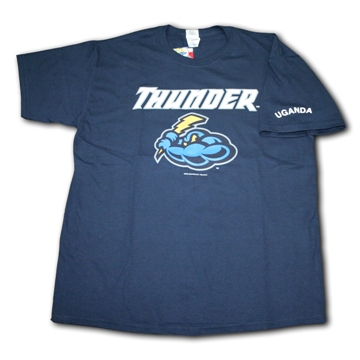 The
Trenton Thunder supplied the hats and shirts that the team wore
in Poland. The Trenton team was rooting for them to win so that they could
come to the U.S. and visit the Trenton stadium and be introduced to the
media and the crowd at a Trenton Thunder ball game. Uganda would
have been the first African Little League team to make it to the
Little League World Series in its almost 80 year history. The
Trenton Thunder supplied the hats and shirts that the team wore
in Poland. The Trenton team was rooting for them to win so that they could
come to the U.S. and visit the Trenton stadium and be introduced to the
media and the crowd at a Trenton Thunder ball game. Uganda would
have been the first African Little League team to make it to the
Little League World Series in its almost 80 year history.
|